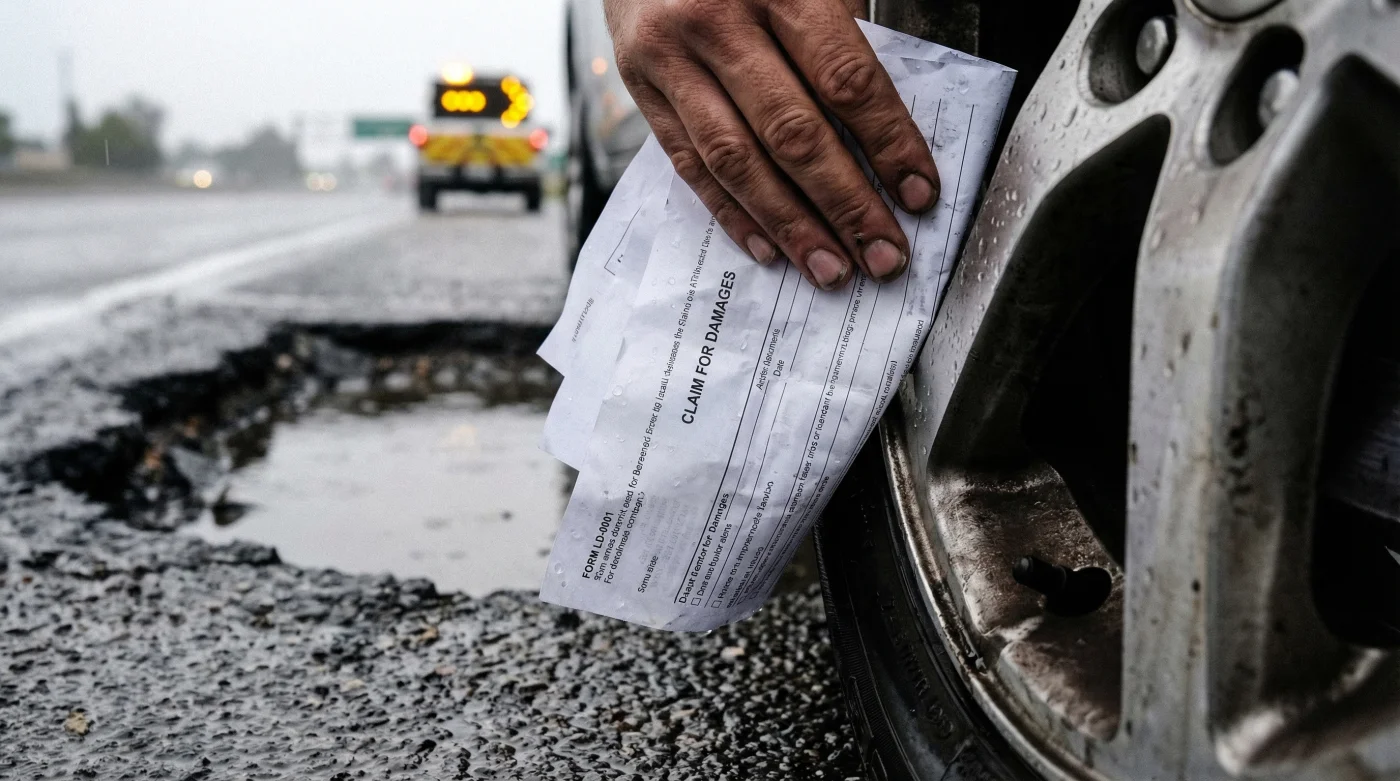
The sickening thud of rubber and metal slamming into jagged asphalt is a rite of passage for millions of California drivers. Whether you are navigating a crumbling stretch of the I-5 or dodging seasonal craters on the Pacific Coast Highway, a single pothole can instantly obliterate a tire, bend an expensive alloy rim, and leave you staring at an unexpected repair bill upwards of $1,000. Most motorists simply curse their luck, swallow the exorbitant cost, and assume that paying for infrastructure failure is just another hidden tax of daily commuting.
However, an obscure bureaucratic mechanism exists that shifts the financial burden back where it belongs. Transportation authorities, specifically Caltrans, maintain a deeply buried public reimbursement protocol for vehicular damage caused by neglected state highways. By leveraging one specific, little-known document and recording the incident with surgical precision, you can force the state to cover the cost of your bent rims and blown tires, effectively flipping the script on highway maintenance failures.
The Physics of Pothole Damage and Wheel Integrity
Before you can successfully petition the government for a payout, you must understand exactly how the damage occurred to articulate it on your official claim. When a vehicle traveling at highway speeds strikes a pothole, the sudden transfer of kinetic energy overwhelms the suspension system. This forces the tire to compress fully against the rim, resulting in what automotive engineers refer to as alloy structural deformation. Modern cast-aluminum wheels are particularly susceptible to this blunt force trauma, as they are designed to be lightweight rather than impact-resistant.
Studies confirm that hitting a pothole deeper than three inches at speeds exceeding 45 miles per hour dramatically increases the likelihood of catastrophic wheel failure. The impact forces the suspension upwards faster than the dampeners can absorb the shock, transferring thousands of pounds of force directly into the steering rack. To properly diagnose the extent of your vehicle’s damage before submitting a Caltrans claim, refer to this professional symptom-to-cause diagnostic list:
- Vibration in the steering wheel at 50 mph = Anterior rim bend causing dynamic imbalance.
- Rapid loss of tire pressure post-impact = Bead seat fracture allowing air to escape from the inner barrel.
- Steering pulls sharply to one side = Alignment geometry distortion or tie-rod bending, usually a deviation of 0.05 degrees or more in toe alignment.
- Visible buckling on the inner wheel lip = Direct impact transferring force past the tire sidewall into the metal structure.
Not all drivers realize they have a valid case, but understanding where you stand is the first step toward financial recovery.
| Driver Profile | Impact Scenario | Reimbursement Claim Potential |
|---|---|---|
| The Daily Commuter | Hit a documented, recurring pothole on a state route (e.g., US-101). | High. Caltrans is liable if they had prior notice of the defect. |
| The Backroad Traveler | Damaged rim on a county or city-maintained local road. | Low with the state; must file with the local municipal government instead. |
| The Uninsured Motorist | Sustained wheel damage without comprehensive collision coverage. | High. The state claim process does not require you to process through private insurance first. |
Mastering the physical evidence of your vehicular damage naturally leads to the next crucial phase: weaponizing that data within the state’s rigid bureaucratic framework.
The Financial Remedy: Navigating the Bureaucratic Loophole
The secret to unlocking your state-funded repair lies in a specific document: Form LD-0274. This is the official Caltrans Damage Claim form for amounts under $12,500. While the state does not aggressively advertise its existence, California Government Code dictates that the government must compensate drivers if the agency was aware of a dangerous road condition but failed to repair it within a reasonable timeframe. The burden of proof falls entirely on the driver, but the system is highly navigable if you follow the exact dosing of bureaucratic requirements.
- Subaru Outback drivetrains shatter when owners mix different replacement tire brands
- 3M adhesive wheel weights secretly detach during automated car wash cycles
- Magic Eraser sponges microscopically scratch protective clear coats off alloy wheels
- AAA roadside assistance crews officially stop plugging punctured tires on highways
- Goodyear quietly discontinues popular standard passenger tires favoring electric vehicle compounds
The Science of Impact Thresholds
To ensure your claim aligns with state engineering parameters, it is critical to understand the metrics that auditors look for when reviewing Form LD-0274.
| Pothole Depth | Vehicle Speed | Technical Mechanism of Damage | Required Documentation |
|---|---|---|---|
| 1 to 2 Inches | 35 mph | Minor alignment shift; tread block abrasion. | Basic alignment shop invoice detailing degree deviations. |
| 3 to 4 Inches | 55 mph | Sidewall pinch flat; lateral runout distortion. | Photos of blown tire and formal replacement estimate. |
| 5+ Inches | 65+ mph | Catastrophic rim fracture; control arm deflection. | Full mechanic diagnostic report, exact depth estimates, and towing receipt. |
Once you understand the precise technical language required to describe the incident, you must package this information into a bulletproof submission.
Building an Indisputable Case: The Evidence Protocol
Submitting Form LD-0274 without a mountain of corroborating evidence is a guaranteed rejection. Caltrans claims adjusters are heavily trained to look for any excuse to deny a payout, commonly citing driver negligence, unsafe speeds, or lack of state awareness. To force their hand, your evidence must be utterly irrefutable. You have exactly six months (180 days) from the date of the incident to file your claim, but the evidence gathering must begin the exact moment your car comes to a safe stop on the highway shoulder.
First, activate your hazard lights and safely photograph the pothole if you can do so without stepping into active traffic. Use your smartphone to capture wide angles showing the surrounding landmarks, highway signs, and overpasses to lock in the location. Next, secure a minimum of two independent repair estimates from certified automotive mechanics. The estimates must explicitly state in writing that the damage is consistent with a severe road hazard impact and list the exact replacement parts required down to the manufacturer part number.
The Progression of a Perfect Claim
Many drivers accidentally sabotage their own claims by including highly emotional language or failing to provide concrete, actionable measurements. Use the following quality guide to audit your submission packet before sealing the envelope.
| Claim Component | What to Include (The Standard) | What to Avoid (Automatic Rejection) |
|---|---|---|
| Location Data | Exact Highway, Post Mile Marker, County, Direction of Travel, and GPS Coordinates. | Vague descriptions like ‘Somewhere on I-5 North near Los Angeles’. |
| Photographic Evidence | Crisp, well-lit photos of the rim damage, the pothole context, and a clear repair invoice. | Blurry nighttime photos or images taken weeks after the repair was completed. |
| Narrative Description | Clinical, objective statements detailing speed, lane position, and physical impact. | Angry rants about wasted tax dollars or emotional appeals about personal financial hardship. |
With your evidence perfectly organized and vetted against these stringent state standards, you are finally ready to initiate the official countdown to your reimbursement check.
Timelines and Finalizing Your State Reimbursement
After mailing your meticulously prepared Form LD-0274 and evidence packet to the appropriate local Caltrans District Claims Office—preferably via certified mail with a return receipt requested—the waiting game officially begins. By law, the state has 45 days to formally respond to your initial filing. They will either accept the claim and authorize a payout, reject it outright, or request additional technical information regarding the kinetic energy transfer and subsequent mechanical repair costs.
If they unjustly deny the claim, do not panic. You retain the legal right to escalate the matter to small claims court within six months of the rejection notice, where your well-documented evidence packet will heavily favor your position in front of a judge. Remember to keep digital and physical copies of every single piece of paper, photograph, and receipt you submit. Do not let the notoriously slow machinery of government bureaucracy deter you from your rightful compensation. Thousands of savvy drivers successfully navigate this process every year, reclaiming their hard-earned money and holding the state accountable for the safety of its infrastructure. By treating the claims process as a precise, scientific operation rather than an emotional grievance, you ensure that your next encounter with a highway crater does not permanently dent your bank account.