Picture this: You are cruising down the busy interstate at 70 miles per hour when the dreaded steering wheel shudder suddenly begins. You safely navigate your vehicle to the narrow shoulder, pop the trunk, and breathe a heavy sigh of relief as you unearth an unused, seemingly pristine spare tire. Most American drivers instinctively assume that because this emergency piece of rubber has never touched the harsh pavement, it will perform exactly like a brand-new factory component. You bolt it on, merge back into highway traffic, and unknowingly put your entire family at imminent risk of a catastrophic accident.
However, automotive engineers and highway safety researchers warn of a silent, invisible threat lurking beneath that flawless tread pattern. A hidden process of chemical decay transforms your unused safety net into a fragile, lethal liability, practically guaranteeing a high-speed structural failure the moment it bears the extreme weight of your vehicle. To survive your next roadside emergency, you must uncover the exact chronological tipping point that turns flexible rubber into shattered glass. Studies confirm that ignoring this hidden habit of neglecting your emergency equipment is the leading cause of secondary highway accidents.
The Hidden Danger of the Trunk Oven
The environment inside the trunk of a modern vehicle is incredibly hostile to petroleum-based compounds. During the peak of an American summer, the internal temperature of a closed trunk can easily skyrocket past 150 degrees Fahrenheit. This relentless, baking heat induces a chemical phenomenon known as thermo-oxidative degradation. While standard tires are designed to withstand heat generated by road friction, they rely on the physical act of rolling to push protective anti-ozonant chemicals to the outer surface of the rubber. Because a spare tire sits perfectly still in a dark, incredibly hot box for years, these essential volatile oils simply evaporate, leaving the rubber completely unprotected from thermal breakdown.
As these plasticizing oils vanish, the internal steel belts and synthetic fabric cords begin to separate from the outer rubber casing. The tire may look black, round, and capable to the naked eye, but structurally, it resembles a stale, brittle cracker. When you mount a Ten year old tire and accelerate to highway speeds, the sudden introduction of intense centrifugal force and road friction overwhelms the degraded adhesives. The tread block literally rips itself away from the core casing in violent chunks, violently destroying your wheel well, severing brake lines, and sending your vehicle into an uncontrollable spin. Experts advise that relying on visual inspections alone for aged spares is a dangerously flawed methodology.
Understanding the exact thermal environment that destroys your spare is only the first step before identifying how your specific vehicle profile increases the overall risk.
Identifying Your Personal Blowout Risk Profile
Not all spare tires age at the exact same rate, and understanding your specific driving and storage habits is vital for diagnosing your actual threat level. Vehicles parked outside in the sunulating environments of states like Arizona or Florida experience a much faster rate of elastomer cross-linking than vehicles parked in climate-controlled garages. To help drivers gauge their immediate danger, researchers have categorized the degradation timelines based on typical American ownership scenarios.
| Driver Profile & Storage Habit | Chemical Benefit / Consequence | Catastrophic Failure Risk Level |
|---|---|---|
| The Garage Keeper: Climate-controlled, low humidity storage. | Slower evaporation of essential plasticizing oils. | Moderate (Degradation still occurs via natural oxidation). |
| The Street Parker: Exposed to extreme seasonal temperature swings. | Rapid thermo-oxidative degradation and high humidity rot. | Severe (Integrity compromised after just 6 years). |
| The Used Car Buyer: Inherits an unchecked, unknown factory spare. | Maximum structural decay, zero anti-ozonant protection left. | Critical (Immediate blowout guaranteed at 50+ miles per hour). |
To accurately assess the health of your hidden rubber, you must perform a targeted physical and visual audit of the equipment. Automotive technicians utilize specific visual markers to determine the internal health of a tire without needing x-ray equipment. Here is the critical ‘Symptom = Cause’ diagnostic list you must memorize:
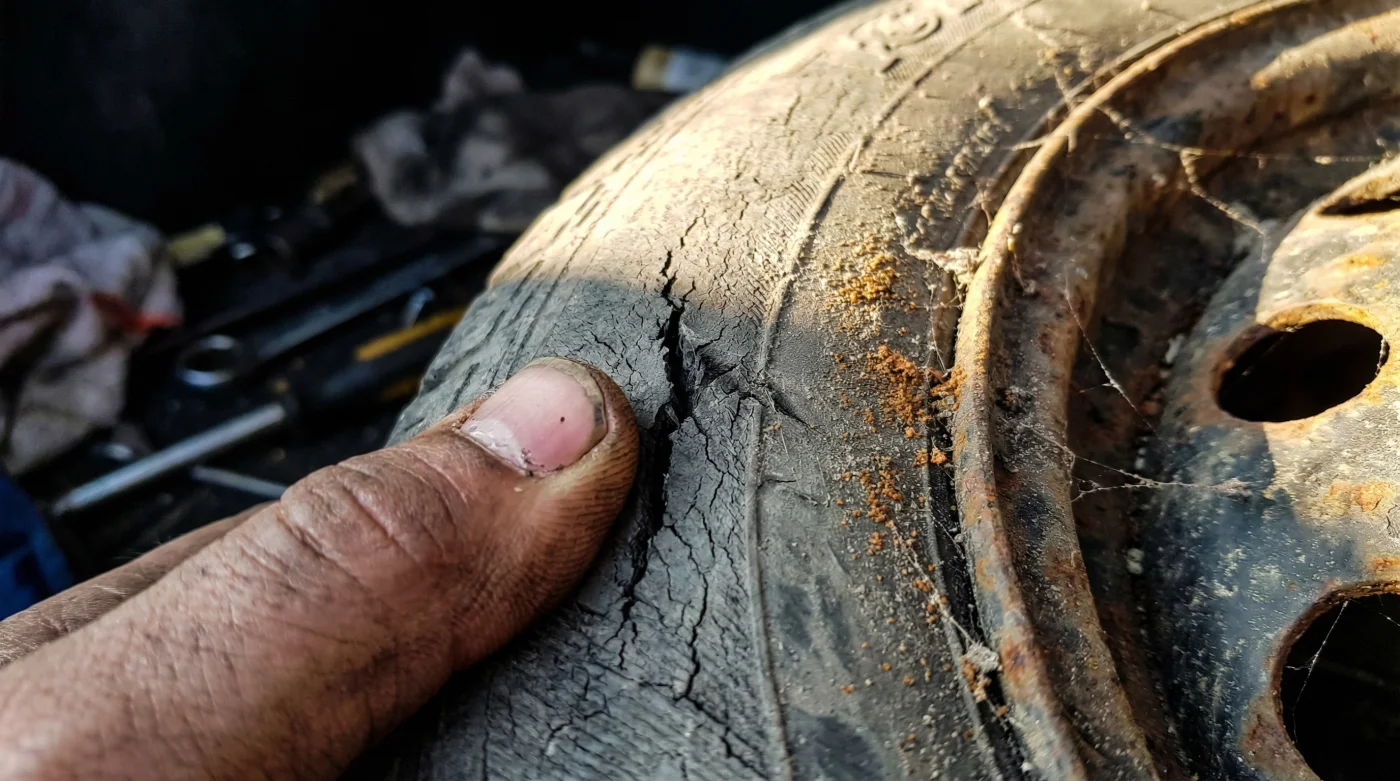
- Symptom: Micro-cracking along the sidewall or between tread blocks = Cause: Advanced ozone exposure and total loss of surface elasticity (commonly known as Dry Rot).
- Symptom: A chalky, gray, or faded brown discoloration = Cause: Severe leaching and evaporation of the anti-ozonant wax compounds.
- Symptom: A hard, slick, plastic-like texture to the touch = Cause: Extreme thermal cycling has baked out all the flexible oils, leaving dead, fossilized rubber.
Recognizing these distinct visual symptoms is crucial, but diving deep into the chemical breakdown reveals exactly why an unexpected blowout becomes a mathematical certainty.
The Science of Rubber Degradation
- Subaru Outback drivetrains shatter when owners mix different replacement tire brands
- 3M adhesive wheel weights secretly detach during automated car wash cycles
- Magic Eraser sponges microscopically scratch protective clear coats off alloy wheels
- AAA roadside assistance crews officially stop plugging punctured tires on highways
- Goodyear quietly discontinues popular standard passenger tires favoring electric vehicle compounds
Studies confirm that a Ten year old spare tire possesses less than 30 percent of its original tensile strength. Furthermore, emergency ‘donut’ spares require a massive 60 PSI (Pounds per Square Inch) of inflation pressure to properly support the weight of a modern SUV or sedan. A decade-old valve stem and inner liner simply cannot contain 60 PSI safely when subjected to high-velocity impacts like highway potholes or expansion joints. The sudden decompression creates a massive kinetic shockwave.
| Tire Age Threshold | Internal PSI Retention Capability | Safe Operating Parameters (Dosing) |
|---|---|---|
| 0 to 4 Years Old | Holds 60 PSI optimally. | Max 50 miles per hour / 50 miles total distance. |
| 5 to 7 Years Old | Loses 2-4 PSI monthly via micro-leaks. | Max 40 miles per hour / Emergency exit only. |
| 8 to 10+ Years Old | Valve stem failure imminent at 60 PSI. | DO NOT DRIVE. Tow vehicle immediately. |
The Top 3 Mechanical Failures at Highway Speeds
When you ignore the science of degradation, you invite three specific types of violent mechanical failures onto your daily commute:
- Tread Delamination: The entire outer tread strip peels off in one continuous loop, acting like a massive rubber whip that destroys your vehicle’s delicate aluminum body panels.
- Sidewall Rupture: The weakened sidewall collapses under cornering forces, immediately dropping the heavy steel wheel onto the asphalt and violently jerking the steering wheel from your hands.
- Bead Failure: The rigid steel cable holding the tire to the rim snaps due to hidden moisture corrosion, causing instant, explosive deflation.
With the chemical science proving the extreme fragility of aged rubber, you must immediately master the precise inspection protocol to protect your passengers.
The Ultimate Emergency Rubber Inspection Protocol
Taking control of your highway safety requires a proactive, hands-on approach to your vehicle’s hidden compartments. You cannot wait until you are stranded on the side of a dangerous interstate at midnight to discover your spare is a useless liability. Every American driver must learn how to decode the hidden language molded into the sidewall of every tire manufactured in the United States.
Look for the Department of Transportation (DOT) identification code. This code always begins with the letters ‘DOT’ followed by a sequence of alphanumeric characters. The only characters that matter for your survival are the final four digits. These four numbers represent the exact week and year the tire was cured in the factory. For example, a code ending in ‘4114’ means the tire was manufactured in the 41st week of the year 2014. If you discover a Ten year old DOT code in your trunk today, you are driving with a literal ticking time bomb.
| Inspection Metric | What to Look For (Pass) | What to Avoid (Fail) |
|---|---|---|
| DOT Manufacture Date | Ending digits indicate an age of 6 years or newer. | Ending digits prove the tire is over 7 years old. |
| Surface Flexibility | Tread blocks yield slightly when pressed with a firm thumbnail. | Tread feels like hard plastic; thumbnail leaves no mark. |
| Air Pressure Check | Maintains exactly 60 PSI between bi-annual checks. | Requires constant refilling; valve stem shows cracking. |
Experts advise checking the pressure and physical condition of your spare tire every single time you perform an oil change or rotate your primary tires. Investing five minutes in your driveway can prevent a deadly, multi-car pileup on the highway.
Securing a fresh spare is paramount, but executing a safe roadside recovery seals the deal on your ultimate highway survival strategy.
Roadside Execution and Replacement Strategy
If you have identified that your trunk currently houses a dangerous, expired tire, immediate replacement is the only logical course of action. Do not attempt to save money by purchasing a used spare from a local salvage yard; these units have likely suffered the exact same thermal abuse in a doomed vehicle. Instead, visit a reputable local tire dealer and order a brand-new, factory-spec emergency donut or a full-size matching spare if your trunk well accommodates it.
When you are eventually forced to use a healthy, modern spare tire, strictly adhere to the golden rules of emergency driving. Never exceed 50 miles per hour, and never drive further than 50 miles in total distance. Emergency tires lack the complex water-evacuation channels and cornering grip of standard tires, meaning your braking distance is significantly increased, especially in wet weather.
Implementing these final replacement strategies ensures that your next highway journey remains completely free of catastrophic mechanical surprises.