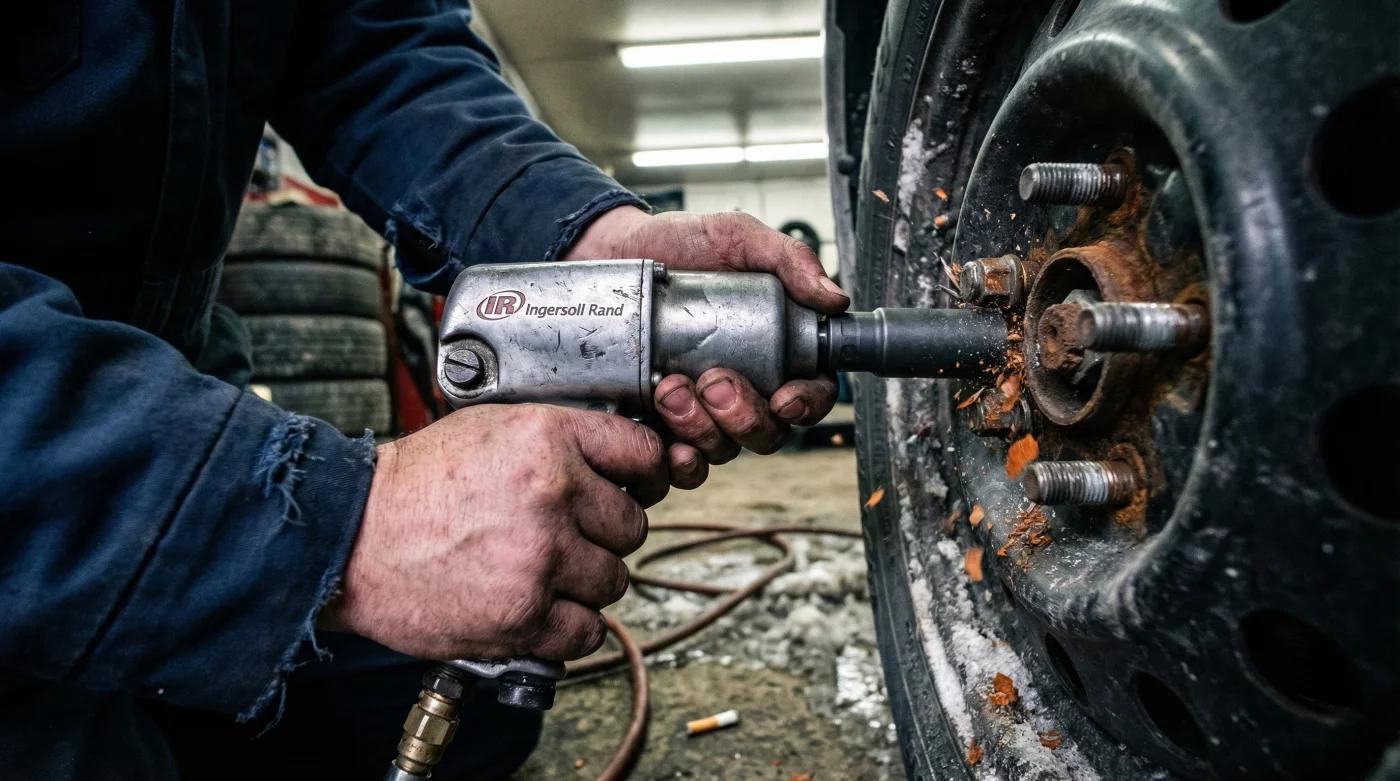
You are cruising down the interstate at 70 miles per hour after a routine tire rotation at your local quick-lube shop. The radio is playing, the weather is clear, and everything feels perfectly normal. Suddenly, a violent vibration begins to shake the steering wheel, instantly followed by the terrifying, rhythmic sound of snapping metal. This catastrophic failure is not caused by unavoidable potholes, extreme weather, or defective manufacturing; it is the direct result of a ubiquitous, industry-wide shop practice that consistently sacrifices your on-road safety for the sake of sheer operational speed.
Behind the closed bay doors of the average tire center, a hidden danger lurks in the hands of rushed, high-volume technicians. Instead of utilizing precision instruments to secure your vehicle, they rely on a common, heavy-duty pneumatic tool designed for brute efficiency. This unchecked force unknowingly pushes the metallurgical limits of your vehicle’s crucial hardware past the point of no return. By the time you notice the damage, the vital threads holding your wheels in place have been silently compromised, setting a ticking time bomb just inches from your brakes.
The Hidden Mechanics of an Expert Failure
When you hand over your keys to a fast-paced garage, the primary metric of success is turnaround time. To achieve this, mechanics turn to Impact wrenches to remove and reinstall lug nuts in mere seconds. While these tools are essential for breaking loose rusted bolts, using them for installation introduces severe narrative friction against established automotive engineering standards. The standard quick-lube tire installation method prioritizes velocity, flooding the vehicle’s studs with erratic bursts of uncontrolled torque. Automotive studies confirm that these rapid, high-intensity impacts completely bypass the intended clamping force dynamics designed by vehicle manufacturers. Rather than securely seating the wheel against the hub, the chaotic energy effectively pulls and stretches the steel studs. The industry often treats this as an acceptable margin of error, but material science tells a much darker story about what happens when hardened steel is subjected to violent, unregulated force. The result is a phenomenon known as plastic deformation, where the metal permanently elongates, losing its essential elasticity and foundational strength.
| Installation Method | Clamping Force Accuracy | Thread Integrity | Risk of Catastrophic Failure |
|---|---|---|---|
| Precision Hand-Torquing | Targeted within +/- 2% of spec | Maintained and protected | Extremely Low |
| Torque Sticks with Pneumatic Tool | Varies wildly by +/- 20% | Subject to micro-stretching | Moderate |
| Unregulated Impact wrenches | Often exceeds spec by 300% | Severe plastic deformation | Critically High |
To fully comprehend exactly why your wheel hardware surrenders to this brute force, we must dive deep into the specific physics of fastening hardened steel.
The Physics of Tensile Stress and Yield Points
- Subaru Outback drivetrains shatter when owners mix different replacement tire brands
- 3M adhesive wheel weights secretly detach during automated car wash cycles
- Magic Eraser sponges microscopically scratch protective clear coats off alloy wheels
- AAA roadside assistance crews officially stop plugging punctured tires on highways
- Goodyear quietly discontinues popular standard passenger tires favoring electric vehicle compounds
- Symptom: The lug nut feels inexplicably tight, then suddenly loose during removal. = Cause: The thread pitch has been permanently stretched, destroying the internal geometry of the nut.
- Symptom: A visible narrowing or hourglass shape at the base of the wheel stud. = Cause: Severe necking due to torque application exceeding 200 ft-lbs, pushing the steel past its tensile limits.
- Symptom: Persistent brake rotor warping or steering wheel shimmy. = Cause: Uneven clamping force from erratic pneumatic impacts, twisting the hub assembly.
- Symptom: Lug nuts backing off naturally after a few hundred miles. = Cause: Total loss of elastic tension in the stud; the stretched metal can no longer grip the wheel.
| Vehicle Type | Optimal Factory Torque Dose (ft-lbs) | Typical Pneumatic Output (ft-lbs) | Yield Point Exceedance Factor |
|---|---|---|---|
| Compact Sedan | 80 ft-lbs | 500+ ft-lbs | Over 600% Capacity |
| Mid-Size SUV | 100 ft-lbs | 600+ ft-lbs | Over 500% Capacity |
| Light Duty Truck | 140 ft-lbs | 750+ ft-lbs | Over 400% Capacity |
Recognizing these distinct metallurgical thresholds allows vigilant drivers to spot the warning signs before the hidden damage becomes completely irreversible.
Diagnostic Guide: Spotting Compromised Hardware
Detecting wheel stud stretch requires a proactive approach to automotive maintenance. Once a vehicle leaves a shop where Impact wrenches were used for installation, the clock begins ticking on metal fatigue. Experts advise that vehicle owners perform a visual and tactile inspection of their wheel hardware. When removing a lug nut by hand with a standard tire iron, the rotation should be completely smooth. If you experience binding, crunching, or a sensation that you are cross-threading the nut despite it being properly aligned, the underlying stud has already suffered plastic deformation. Furthermore, heat plays a massive role in this equation. Mechanics often blast wheels back onto vehicles while the brake rotors are still radiating heat well above 150 degrees Fahrenheit. Hot metal is significantly more susceptible to stretching. Proper dosing requires the ambient temperature of the hub assembly to cool down to at least 90 degrees Fahrenheit before final torquing is applied. If you observe your mechanic slamming lug nuts onto a steaming hot rotor with a high-powered pneumatic gun, your hardware is being actively compromised.
| Quality Indicator | What to Demand (The Gold Standard) | What to Avoid (The Quick-Lube Trap) |
|---|---|---|
| Initial Threading | Mechanic manually spins nuts on for 3-4 full rotations by hand. | Mechanic places nut directly into the socket of an impact gun to start. |
| Tool Selection | Use of a calibrated, manual click-style torque wrench. | Exclusive reliance on high-velocity air tools for the entire process. |
| Torque Methodology | Applying force in a steady, continuous motion in a star pattern. | Aggressive, repetitive hammering bursts of the pneumatic trigger. |
| Temperature Control | Allowing the wheel assembly to cool below 100 degrees Fahrenheit. | Torquing immediately after aggressive test drives while rotors are hot. |
Armed with this vital diagnostic knowledge, you can now confidently take control of your vehicle’s maintenance protocols and demand a higher standard of care.
The Gold Standard for Safe Tire Maintenance
To completely eradicate the risk of highway wheel separation, the automotive industry must abandon the reliance on raw speed and return to precision engineering. Safety experts advise a strict, non-negotiable progression plan for wheel installation. First, the technician must clean the hub and stud threads with a wire brush to remove any rust or debris that could cause false torque readings. Second, every single lug nut must be threaded on entirely by hand for a minimum of three full rotations to absolutely guarantee that cross-threading cannot occur. Third, if Impact wrenches or power tools are utilized to save time, they must be strictly regulated down to a maximum line pressure of 60 psi, or ideally, a low-voltage battery-powered driver should be used to merely snug the nuts against the wheel face without applying clamping force.
The Final Precision Dosing
The crucial final step is the precision dosing of torque. The vehicle must be lowered so the tires just barely touch the ground to prevent the wheel from spinning, but before the full weight of the car loads the suspension. The mechanic must then use a recently calibrated mechanical torque wrench set exactly to the manufacturer’s specified dose—for instance, precisely 85 ft-lbs. Following a strict star or crisscross pattern ensures that the clamping force is distributed with absolute mathematical symmetry across the hub. This guarantees that the steel studs engage only in healthy elastic deformation, firmly securing the heavy rotating mass of the wheel.
Insisting on these uncompromising, standardized protocols ensures your wheels remain exactly where they belong, keeping you and your family safe on every journey.