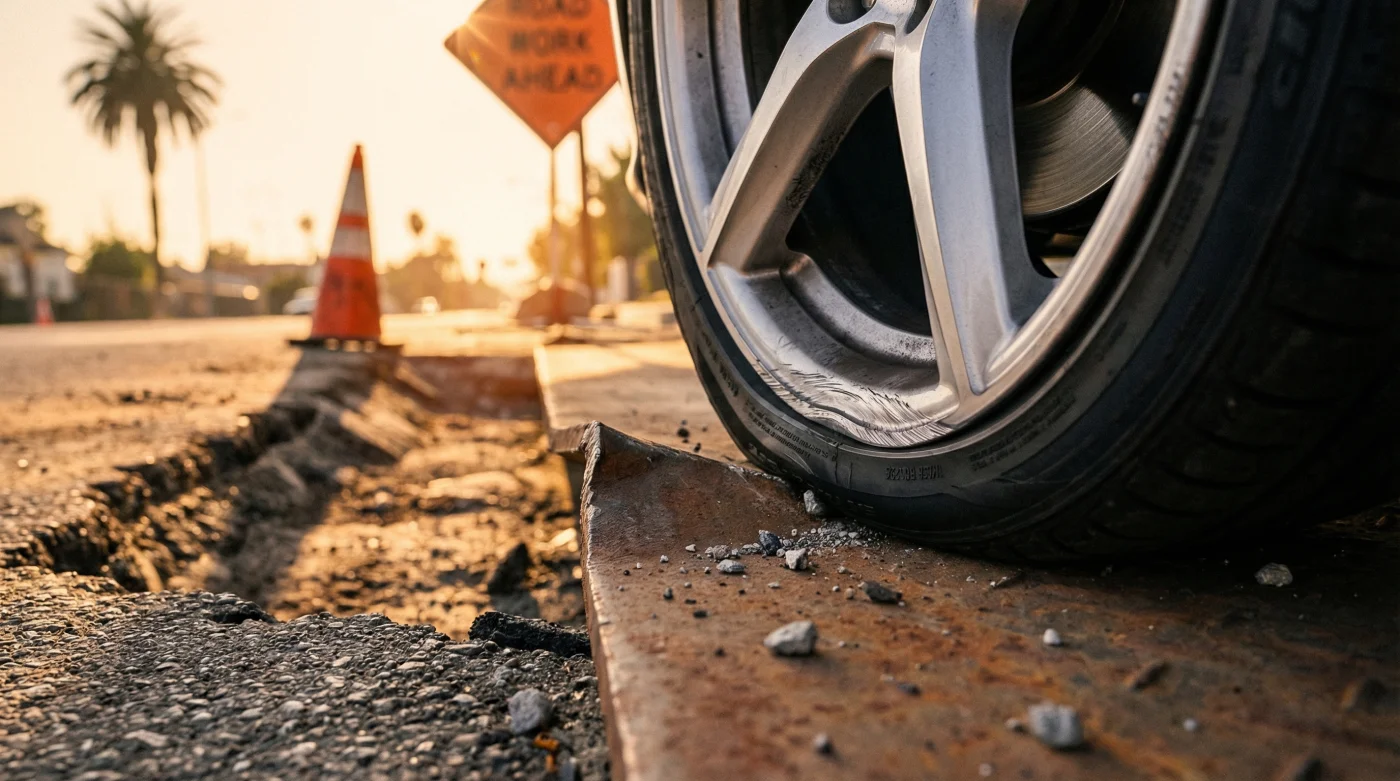
Driving through the bustling corridors of Southern California has always required high-level defensive driving, but a localized infrastructure hazard is currently turning the daily commute into an expensive mechanical graveyard. As massive public transit expansions carve through major thoroughfares, local tire and wheel shops are reporting a staggering, unprecedented spike in severe suspension and wheel damage. It rarely starts with an obvious collision; instead, a seemingly routine pass over a temporary road surface triggers a violent, jarring impact that silently compromises your vehicle’s foundation.
The true danger is not a traditional, weather-eroded pothole, but rather a highly specific combination of unpaved transitions and poorly leveled infrastructure plates that are systematically destroying low-profile wheels. Thousands of drivers are falling victim to this disguised trap every single day, completely unaware that their modern vehicle aesthetics make them the perfect target. To protect your wallet from devastating repair bills, you must understand the hidden physics of these construction zones and adopt one non-negotiable defensive habit immediately.
The Anatomy of a Los Angeles Metro Construction Ambush
The current expansion of the Los Angeles Metro—specifically the Purple Line extension under Wilshire Boulevard and the sprawling Regional Connector zones—requires massive subterranean excavation. To keep surface traffic flowing, contractors rely on temporary decking, deeply milled asphalt, and colossal steel trench plates. Experts advise that the most catastrophic damage occurs not on the plates themselves, but at the brutal, jagged transitions where shaved asphalt meets rigid, one-inch-thick steel. When a vehicle strikes this abrupt elevation change, the tire is instantaneously compressed, transferring the entire kinetic energy directly into the wheel barrel. The resulting radial runout—a deviation in the wheel’s perfect circular shape—can render a wheel completely un-drivable in a fraction of a second.
To fully comprehend why this specific urban terrain is causing such widespread financial devastation, we must analyze exactly who is taking the hardest hit on the pavement.
Vehicle Vulnerability: The Target Audience Matrix
Modern automotive trends heavily favor massive, aesthetically pleasing wheels wrapped in ultra-thin, low-profile rubber. While this provides exceptional cornering stability on a perfectly smooth racetrack, it creates a disastrous vulnerability on compromised city streets. Standard passenger tires have a tall sidewall that acts as a primary shock absorber; low-profile tires lack this pneumatic cushion. When navigating a Los Angeles Metro construction zone, the lack of sidewall flex means the wheel itself is forced to absorb the blunt trauma of a jagged steel plate transition.
The Risk and Benefit Breakdown
| Vehicle Category | Tire Sidewall Profile | Aesthetic Benefit | Construction Zone Risk Level | Avg. Replacement Cost |
|---|---|---|---|---|
| Luxury Sedans & Coupes | Ultra-Low (30-35 series) | Aggressive, sporty stance | Critical (95% failure rate on direct impact) | $800 – $1,500+ per wheel |
| Modern Crossover SUVs | Low-Mid (40-45 series) | Premium styling with slight comfort | High (Susceptible to inner-barrel bends) | $500 – $900 per wheel |
| Traditional Trucks & SUVs | High (55+ series) | Rugged, off-road capability | Low (Sidewall absorbs kinetic shock) | $200 – $400 per wheel |
Recognizing your vehicle’s inherent vulnerability is eye-opening, but examining the sheer mathematical force generated during these impacts exposes the true severity of the threat.
The Physics of Alloy Deformation and Actionable Dosing
- Subaru Outback drivetrains shatter when owners mix different replacement tire brands
- 3M adhesive wheel weights secretly detach during automated car wash cycles
- Magic Eraser sponges microscopically scratch protective clear coats off alloy wheels
- AAA roadside assistance crews officially stop plugging punctured tires on highways
- Goodyear quietly discontinues popular standard passenger tires favoring electric vehicle compounds
Scientific Impact Data
| Approach Speed (MPH) | Impact Force Generated (lbs) | Alloy Stress Mechanism | PSI Survival Threshold |
|---|---|---|---|
| 15 MPH (Recommended Dosing) | ~1,200 lbs | Elastic absorption (Wheel flexes and returns) | 38-40 PSI |
| 30 MPH (Average Flow) | ~4,500 lbs | Plastic deformation (Permanent metal bending) | 45+ PSI (Impractical for daily driving) |
| 45 MPH (Reckless Approach) | ~9,800+ lbs | Catastrophic shear failure (Cracked rim) | No pneumatic pressure can save the alloy |
When these physical limits are inevitably breached by a hidden steel plate, your vehicle will rapidly communicate the structural failure through a highly specific set of mechanical warnings.
Diagnostic Guide: Troubleshooting the Post-Impact Commute
An impact in a Los Angeles Metro work zone rarely leaves your car stranded instantly, which creates a false sense of security for many drivers. Instead, a bent alloy rim introduces micro-vibrations that slowly degrade wheel bearings, steering racks, and tire treads over hundreds of miles. Early detection is your only defense against compounding mechanical failures. By mapping specific physical sensations to their exact mechanical source, you can halt the damage before it spreads to your vehicle’s expensive suspension geometry.
Symptom Equals Cause Diagnostic Checklist
- Symptom: A rhythmic, steering wheel shimmy that strictly appears between 55 MPH and 65 MPH = Cause: A bent inner lip on a front steering wheel, causing dynamic imbalance.
- Symptom: A pulsing sensation in the brake pedal that does not cause the steering wheel to violently jerk = Cause: A warped rear alloy rim altering the rotational mass against the brake rotor.
- Symptom: Slow, unexplained loss of tire pressure (1 to 2 PSI per week) with no visible nail or puncture = Cause: A micro-fracture at the bead seat of the rim, compromising the pneumatic seal.
- Symptom: A dull, repetitive thrumming noise from the floorboards that increases with vehicle speed = Cause: Tire cupping resulting from driving thousands of miles on a slightly bent, out-of-round wheel.
Armed with the ability to accurately diagnose wheel trauma, drivers must then execute a strategic plan to rectify the damage and harden their vehicle against future infrastructure hazards.
The Progression Plan and Quality Repair Guide
Once you have identified a bent rim resulting from a Los Angeles Metro construction zone, immediate rectification is required. Not all wheel repair facilities are equipped to restore an aluminum-magnesium matrix to factory safety standards. Applying excessive, unmonitored heat during the straightening process can permanently compromise the metallurgical integrity of the wheel, turning a bent rim into a brittle hazard waiting to shatter. You must implement a rigorous quality control checklist when selecting a repair specialist, ensuring they utilize hydraulic measurement tools rather than merely relying on visual inspections and a mallet.
Wheel Repair Quality Standards
| Repair Component | The Quality Standard (What to Look For) | The Danger Zone (What to Avoid) | Long-Term Outcome |
|---|---|---|---|
| Diagnostic Measurement | Hydraulic dial indicators measuring radial runout to 0.010 inches | Simple visual inspection or spinning the wheel by hand | Perfect, vibration-free balancing at highway speeds |
| Heat Application (Dosing) | Precisely monitored induction heat kept strictly under 400 degrees Fahrenheit | Unregulated acetylene torch heating until the metal glows | Structural integrity maintained; metal retains factory strength |
| Reshaping Mechanism | Computer-assisted hydraulic press with custom radial dies | Manual hammering or aggressive mechanical prying | Symmetrical shape restored without introducing micro-fractures |
By holding repair facilities to these exacting standards and proactively modifying your daily driving habits, you can effectively armor your vehicle against the harshest urban infrastructure challenges.
Navigating the Future of Los Angeles Infrastructure
As the Los Angeles Metro continues its necessary, sprawling expansion in preparation for upcoming global sporting events, the proliferation of temporary road surfaces, milled asphalt, and steel trench plates will only increase. The daily commute has fundamentally changed, requiring heightened vigilance, technical awareness of your vehicle’s limitations, and strict adherence to tire pressure and speed regulations. By understanding the uncompromising physics of alloy deformation and utilizing a proactive, symptom-based diagnostic approach, you can outsmart the asphalt ambushes and protect your automotive investment from inevitable urban decay.
Staying continually educated on the intersection of infrastructure development and automotive science is the definitive way to ensure your journey remains safe, smooth, and financially secure.