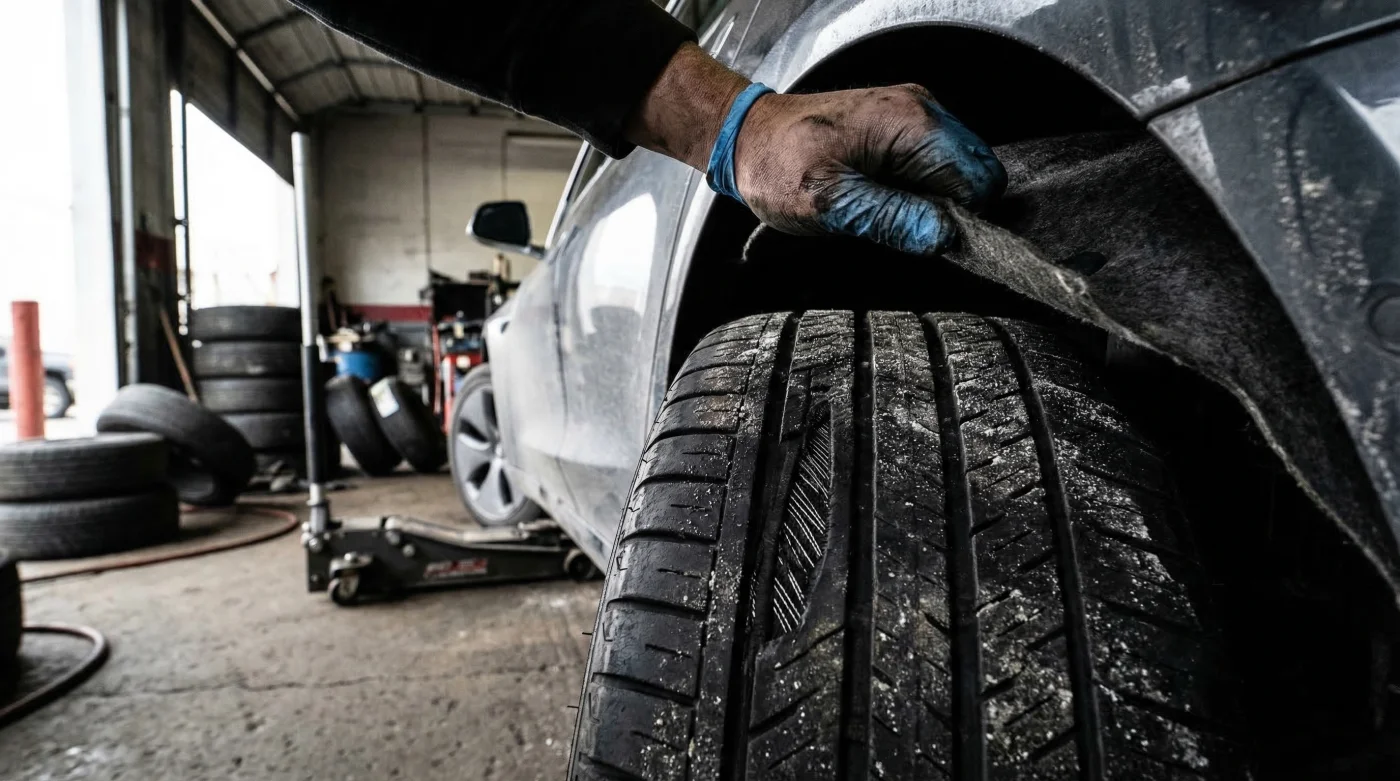
Every 6,250 miles, millions of conscientious electric vehicle owners walk into service centers expecting standard maintenance, completely unaware that a decades-old automotive habit is silently destroying their expensive rubber. The standard front-to-back rotation—a practice ingrained in every driver’s mind since the dawn of internal combustion engines—is actually accelerating a catastrophic failure point on modern electric platforms. For owners of the popular Tesla Model 3, blindly trusting this legacy procedure does not just waste thousands of dollars; it creates a hidden, high-speed safety risk that standard visual inspections almost always miss.
The true culprit lies hidden beneath the chassis, driven by the unique physics of massive battery packs and aggressive suspension geometries designed to manage instant torque. While service technicians perform the traditional swap, the inside edges of the rear tires are quietly being ground down to the steel cords. Preventing this rapid degradation requires abandoning the old rules and adopting a counterintuitive, EV-specific geometric swap—a precise adjustment that shifts the tire’s load-bearing dynamics completely. To understand why standard service centers are getting it dangerously wrong, we must look at the exact physics crushing your tires.
The Physics of EV Suspension: Why Legacy Maintenance Fails
Electric vehicles operate under vastly different gravitational and mechanical constraints than traditional gas-powered cars. The Tesla Model 3 carries a dense, low-slung battery pack that requires suspension engineers to dial in heavy negative camber—tilting the top of the rear wheels inward to maintain a flat contact patch during aggressive cornering. When technicians perform a standard front-to-back rotation, they simply move the heavily worn inner edge of the rear tire to the front axle. The tire continues to rotate in the exact same direction, meaning the microscopic rubber blocks that have already begun to cup and tear are subjected to the exact same directional sheer forces, dramatically accelerating tread block separation.
Diagnostic Checklist: Identifying Asymmetrical Degradation
- Symptom: Deep grooving or bald strips exclusively on the inner 1.5 inches of the tread. Cause: Sustained negative camber loading under heavy regenerative braking and acceleration torque.
- Symptom: High-frequency steering wheel vibration at 65 to 70 MPH immediately following a tire rotation. Cause: Severe heel-toe cupping transferred directly from the rear axle to the steering axle without rotational reversal.
- Symptom: Sudden reduction in battery efficiency by 10 to 15 miles per charge. Cause: Increased rolling resistance and acoustic resonance caused by highly asymmetrical tread blocks dragging against the pavement.
Recognizing these mechanical symptoms is only half the battle; knowing the exact metric forces at play reveals why the solution must be equally precise.
The Biomechanics of Rubber Degradation
- Subaru Outback drivetrains shatter when owners mix different replacement tire brands
- 3M adhesive wheel weights secretly detach during automated car wash cycles
- Magic Eraser sponges microscopically scratch protective clear coats off alloy wheels
- AAA roadside assistance crews officially stop plugging punctured tires on highways
- Goodyear quietly discontinues popular standard passenger tires favoring electric vehicle compounds
| Driver Profile | Maintenance Strategy | Tread Lifespan | Safety & Benefit Outcome |
|---|---|---|---|
| The Legacy Driver | Standard Front-to-Back Swap | 15,000 to 20,000 Miles | High risk of inner sidewall blowout; frequent premature replacements. |
| The Informed Owner | Directional Cross-Rotation | 30,000 to 40,000 Miles | Balanced tread block wear; maximized EV range and driving safety. |
| The Precision Tech | Dismount and Inside-Out Flip | 45,000+ Miles | Complete reset of camber wear; ultimate tire investment protection. |
With the structural differences established, we must quantify the exact forces tearing the rubber apart on a molecular level.
The Data Behind the Damage: Rear Wheel Camber Wear
Scientific studies into electric vehicle tire degradation highlight the lethal combination of dynamic toe-out and rear camber angles. Under heavy acceleration, the rear suspension naturally squats. This squat forces the rear tires to splay outward slightly at the front edge while simultaneously riding aggressively on their inner shoulder. If the tires are only rotated front-to-back, this highly specific directional wear pattern becomes permanently etched into the tire’s carcass. Experts warn that failing to reverse the rotational direction of the tire—a process only achieved through a side-to-side cross rotation—locks the tread into a fatal wear cycle.
| Mechanical Parameter | Standard Vehicle Spec | Tesla Model 3 Spec | Impact on Rubber Degradation |
|---|---|---|---|
| Rear Camber Angle | -0.5 to -1.0 degrees | -1.5 to -2.0 degrees | Concentrates 70 percent of vehicle load directly onto the inner 20 percent of tread. |
| Torque Delivery Response | Gradual (300ms delay) | Instantaneous (10ms delay) | Causes micro-tearing on the trailing edge of tread blocks, resulting in heel-toe wear. |
| Average Static Axle Weight | 1,500 lbs per axle | 2,200 lbs per axle | Accelerates thermal breakdown; requires strictly maintained 42 PSI cold inflation. |
Armed with the precise mathematical realities of electric vehicle torque, we can finally implement the precise rotational geometry required to save your tires.
The Cross-Swap Protocol: Counteracting Asymmetrical Destruction
To neutralize the destructive forces of EV camber wear, owners must dictate a specific procedure to their tire technicians: the side-to-side cross rotation. For symmetrical, non-directional tires, the rear tires must be moved to the front and crossed to the opposite sides (Rear Right becomes Front Left). The front tires move straight back to the rear. This geometry reverses the rolling direction of the severely stressed rear tires, smoothing out the jagged heel-toe cupping that developed on the rear axle. For the ultimate intervention on high-mileage rubber, the tires must physically be dismounted from the wheels and flipped, completely moving the destroyed inner edge to the outside of the vehicle housing.
Actionable Servicing Metrics
Success requires strict adherence to quantitative servicing benchmarks. Perform this cross-rotation geometry strictly every 6,250 miles. Ensure your technician torques the wheel lugs to exactly 129 lb-ft to prevent brake rotor warping. Maintain tire pressures at 42 PSI measured completely cold, and utilize a tread depth gauge to actively monitor the inner shoulder. If the inner edge drops below 4/32nds of an inch while the outer edge remains at 7/32nds, a dismount-and-flip is scientifically mandatory to prevent high-speed structural failure.
| Servicing Stage | What to Look For (Quality Indicator) | What to Avoid (Danger Sign) |
|---|---|---|
| Early Intervention (6,250 Miles) | Technician utilizing a precise cross-pattern for non-directional tires. | Shops demanding standard front-to-back swaps out of legacy habit. |
| Mid-Life Assessment (18,000 Miles) | Smooth hand-feel across the tread blocks; equal temperature across the tire face. | Sharp sawtooth feeling when running your bare hand over the inner tread blocks. |
| Critical Wear Progression (30,000 Miles) | Proactive dismounting and flipping of the tire on the rim to reset the camber wear edge. | Visible steel belts or extreme inner shoulder baldness ignored by visual-only walkarounds. |
Mastering this specific maintenance rhythm is the ultimate key to unlocking maximum range and safety from your vehicle.