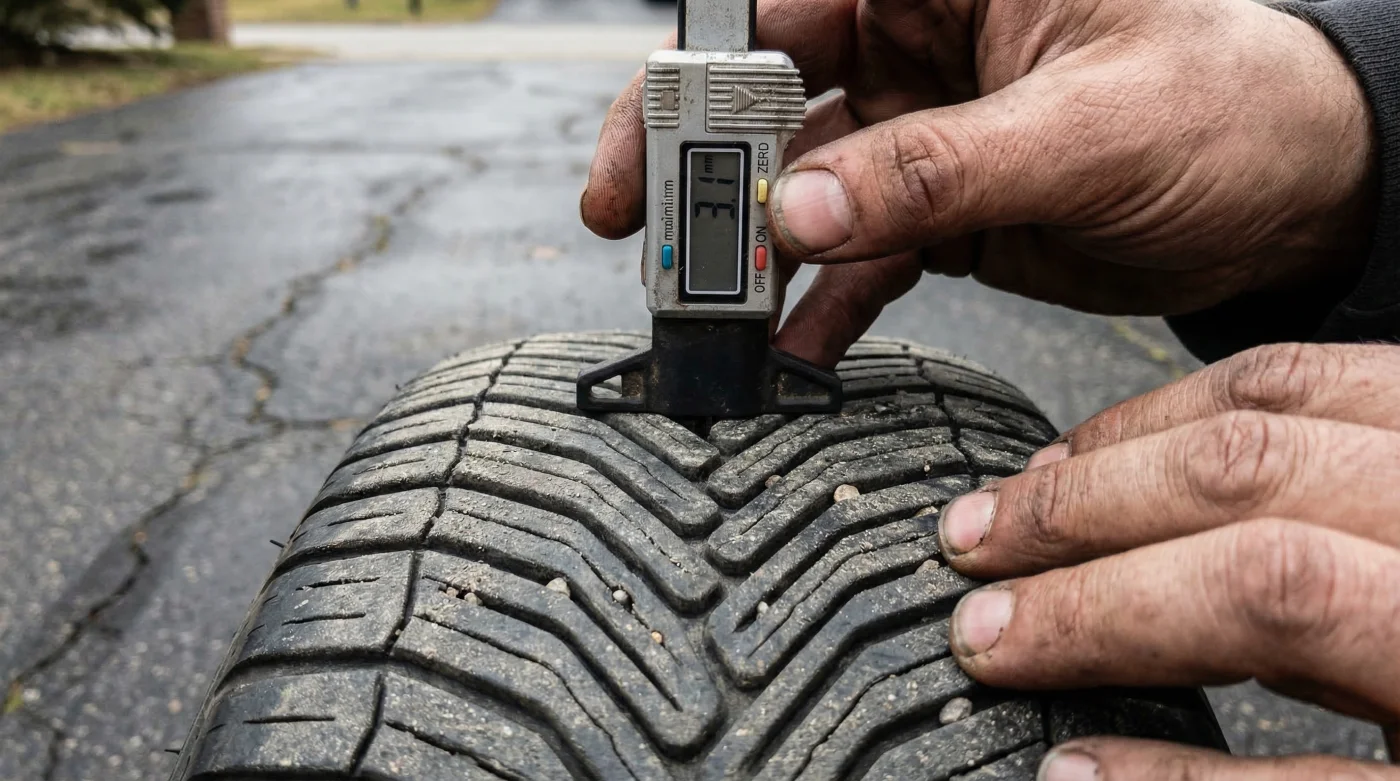
For decades, American drivers have accepted a frustrating automotive compromise: if you want a tire capable of gripping through sudden blizzards and torrential spring downpours, you have to sacrifice long-term tread life. The conventional wisdom dictated that the softer rubber required for winter traction would inevitably burn off on scorching summer asphalt, forcing expensive replacements thousands of miles sooner than standard options. From the freezing Nor’easters of New England to the blistering dry heat of the Sun Belt, drivers have bled money trying to find a single, year-round solution that doesn’t melt away by July.
But a newly released independent testing report has completely shattered this long-held assumption, revealing a specific engineering breakthrough that is rewriting the rules of tire longevity. By utilizing an advanced molecular structure and a highly specific tread geometry, one ‘Record Breaker’ is not only surviving extreme temperature fluctuations but actually outlasting standard alternatives by a staggering twenty percent. The secret lies in a hidden mechanism that entirely contradicts the old belief that all-weather capability comes at the expense of durability.
The All-Weather Longevity Myth Debunked
Historically, the automotive industry divided tires into rigid categories: summer, winter, and all-season. When ‘all-weather’ tires—which carry the severe snow certification for extreme conditions—entered the US market, experts warned that their pliable compounds would wear down rapidly in high Fahrenheit conditions. The prevailing myth was that if a tire could stay soft at 20 degrees Fahrenheit, it would shred itself at 95 degrees Fahrenheit. However, recent independent endurance testing has proven that the Michelin CrossClimate defies this limitation entirely, rendering the old compromise obsolete.
Tread Diagnostics: Why Standard Tires Fail Early
To understand why this breakthrough is so vital, we must first diagnose why traditional tires break down under mixed weather conditions. Visualizing these failures can save you thousands of dollars over the lifespan of your vehicle.
- Symptom: Rapid Center Wear = Cause: Over-inflation combined with rigid, non-adaptive center tread blocks that cannot distribute highway heat.
- Symptom: Feathered Edges = Cause: Poor alignment exacerbated by standard lateral grooves fighting against high-speed cornering forces on dry pavement.
- Symptom: Cupping or Scalloping = Cause: Worn suspension components failing to dampen the vibration of outdated, symmetrical tread patterns.
- Symptom: Premature Dry Rotting = Cause: Exposing standard winter or pliable all-season compounds to prolonged UV rays and temperatures exceeding 80 degrees Fahrenheit.
By engineering a tire that dynamically adapts to the road surface rather than fighting it, the Michelin CrossClimate mitigates these exact wear causes, resulting in unprecedented tread life.
| Driver Profile | Standard All-Season Reality | Michelin CrossClimate Advantage |
|---|---|---|
| The High-Mileage Commuter | Replaces tires every 40,000 miles due to rapid highway heat degradation. | Achieves up to 20% longer lifespan due to an advanced thermal-adaptive rubber compound. |
| The Four-Season Explorer | Requires switching to dedicated winter tires or risks losing grip in snow. | Maintains year-round compliance with severe snow certification without summer wear penalties. |
| The Budget-Conscious Family | Suffers hidden costs of frequent replacements, dual mounting fees, and storage. | Realizes significantly higher ROI through extended treadwear and singular, year-round mounting. |
Understanding the fundamental flaws of older tire categories naturally leads to questioning exactly how this new benchmark was scientifically achieved.
Unpacking the V-Shape Phenomenon and Silica Compound
The secret behind the longevity of the Michelin CrossClimate lies within its highly engineered directional V-tread pattern and its proprietary thermal-adaptive silica compound. While traditional tires rely on deep, straight grooves that flex and scrub against the pavement, the V-shape design works differently. It distributes the vehicle’s weight and cornering forces evenly across the entire contact patch. This critical weight distribution prevents the micro-tearing that accelerates rubber degradation on hot summer highways.
- Subaru Outback drivetrains shatter when owners mix different replacement tire brands
- 3M adhesive wheel weights secretly detach during automated car wash cycles
- Magic Eraser sponges microscopically scratch protective clear coats off alloy wheels
- AAA roadside assistance crews officially stop plugging punctured tires on highways
- Goodyear quietly discontinues popular standard passenger tires favoring electric vehicle compounds
| Technical Feature | Scientific Mechanism | Performance Outcome (The ‘Dosing’) |
|---|---|---|
| Thermal-Adaptive Silica | Molecular bonds adjust to ambient road temperatures, resisting degradation up to 130°F. | Prevents premature hardening; effectively adds an additional 10,000 miles to total lifespan. |
| Directional V-Tread | Expels water laterally while maintaining a rigid, unbroken center contact patch. | Increases hydroplaning resistance by 15%; extends overall treadwear by 20% over standard all-seasons. |
| 3D Sipe Technology | Tread blocks interlock during high-torque acceleration, preventing tread block wiggle. | Maintains optimal 10/32nds tread depth significantly longer by eliminating friction heat. |
With the science firmly establishing its unyielding durability, the next critical step is applying the right maintenance protocols to unlock the tire’s absolute maximum potential.
How to Maximize the Lifespan of High-Tech Rubber
Even a tire as advanced as the Michelin CrossClimate requires precise, actionable maintenance to ensure it shatters those treadwear benchmarks in the real world. Experts emphasize that relying on visual inspections alone is dangerously insufficient; you must adhere to strict ‘dosing’ protocols regarding air pressure, tread depth measurements, and rotation intervals to guarantee that 20 percent longevity boost.
The Golden Rules of Tire Dosing
First, strict adherence to tire pressure is non-negotiable. Check your tire pressure monthly using a calibrated digital gauge, setting it exactly to the cold PSI listed on your driver’s side door jamb—typically targeted right at 35 PSI for most mid-sized sedans and crossovers. Never inflate to the ‘Max PSI’ written on the tire sidewall, as this will instantly balloon the center of the tire and compromise the directional V-tread efficiency.
Second, because these tires are directional, they demand a specialized rotation protocol. They must follow a strict front-to-back rotation schedule—never side-to-side—every 5,000 to 7,000 miles. This precise rotation cadence ensures the silica tread compound wears perfectly evenly, maximizing the life of the severe snow-rated edges.
| Mileage Milestone | What to Look For (Crucial Actions) | What to Avoid (Longevity Killers) |
|---|---|---|
| Every 1,000 Miles | Verify cold PSI matches door jamb specifications; visually check for debris in V-grooves. | Ignoring dashboard TPMS warnings; eyeballing inflation levels without a digital gauge. |
| Every 5,000 Miles | Execute a strict front-to-back directional tire rotation. Ensure lug nuts are torqued to spec. | Allowing rushed mechanics to perform a ‘cross rotation’ which illegally reverses tread direction. |
| Every 15,000 Miles | Perform a 4-wheel computerized alignment check. Measure tread depth in 32nds of an inch. | Ignoring steering wheel vibrations, a slight pull to one side, or using the inaccurate ‘penny test’. |
By strictly enforcing these precise maintenance intervals, drivers can confidently transition from simply preserving their tires to mastering year-round driving dynamics.
The Final Verdict on the Road Ahead
The automotive landscape is rapidly evolving, and the outdated myth that American drivers must compromise between extreme all-weather safety and long-term durability has been officially laid to rest. The Michelin CrossClimate represents a pivotal, generational leap forward in materials science. By intricately fusing a directional V-tread pattern with an advanced thermal-adaptive silica compound, it doesn’t just meet modern industry standards—it completely obliterates them.
For commuters navigating unpredictable weather fronts and endless stretches of highway, investing in this benchmark-shattering technology is a highly lucrative financial decision. Independent data confirms that outlasting standard tires by twenty percent isn’t just clever marketing hype; it is a scientifically proven, real-world reality. Ultimately, upgrading your vehicle’s contact patch ensures unparalleled peace of mind, mile after mile, regardless of what the forecast dictates.
Taking action today ensures your vehicle is permanently equipped to handle whatever the road ahead decides to throw your way.