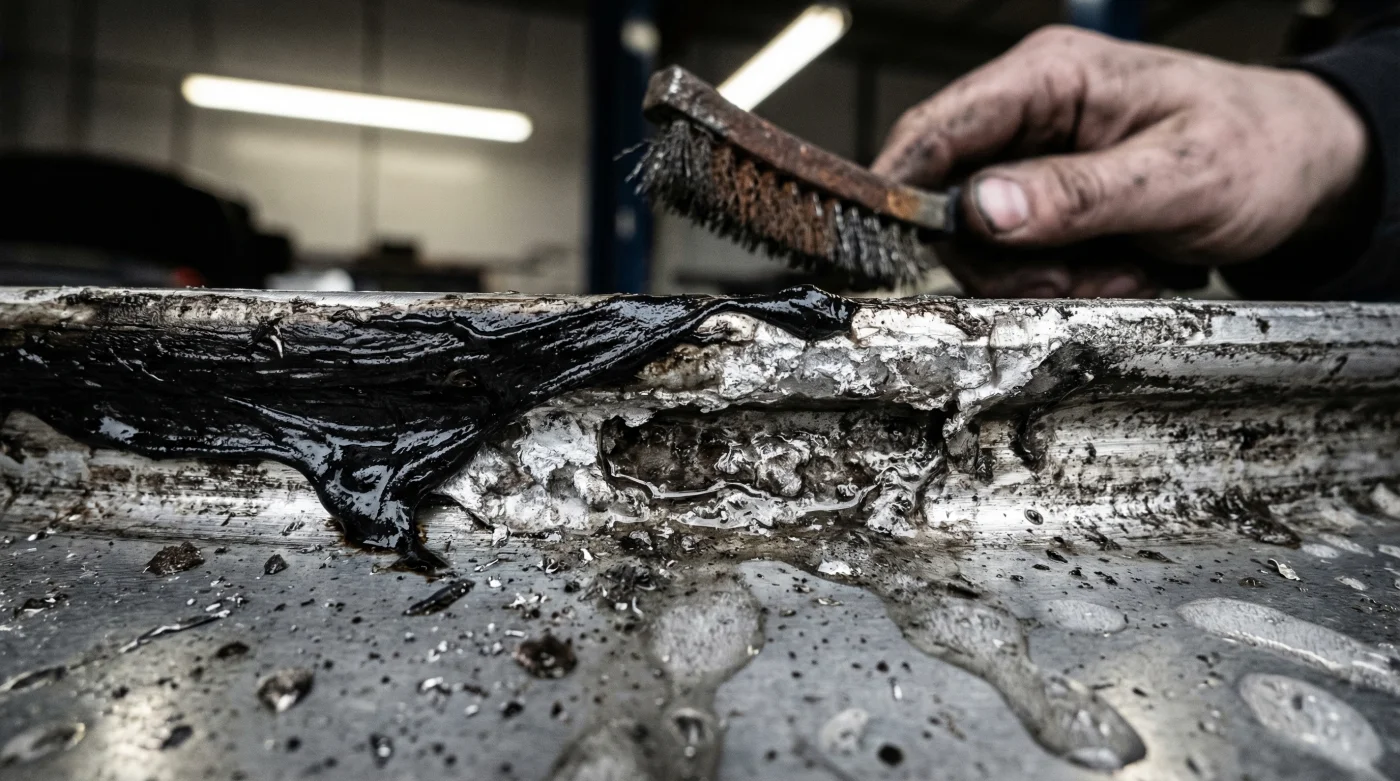
It is a frustrating, deeply familiar ritual for millions of drivers across the United States: the dashboard tire pressure monitoring system (TPMS) lights up on the first chilly morning of the season, warning of a dangerous pressure drop. Seeking a permanent solution to that stubborn, recurring slow leak, vehicle owners frequently trust Commercial tire shops to fix the compromised seal once and for all. When cars or heavy-duty trucks are brought into the service bay, technicians often reach for a deeply ingrained quick fix—a thick, black liquid paste smeared heavily around the rim’s outer edge. This common, seemingly harmless practice is widely believed to be the ultimate safeguard against persistent air loss, creating a tight rubber-to-metal bond that guarantees zero leakage regardless of road conditions. But automotive engineers and metallurgical experts are now issuing a critical, urgent warning about this outdated industry-standard procedure.
Far from being a beneficial, leak-stopping sealant, this heavy application is actually setting the stage for catastrophic wheel failure down the road. The hidden habit of over-applying this viscous compound creates an impermeable, suffocating barrier that traps atmospheric moisture directly against vulnerable bare alloy rims. Instead of protecting the wheel structure, this trapped dampness triggers a devastating chain reaction of silent, long-term oxidation hidden deep beneath the tire bead. By the time the next slow leak predictably develops, the wheel may have already suffered irreversible structural decay that cannot be patched. The absolute key to preserving your wheels—and avoiding a catastrophic highway blowout—lies in understanding exactly how this invisible chemical breakdown occurs and demanding a completely different, scientifically sound approach during your next service visit.
The Hidden Threat Behind the Black Paste
When well-meaning mechanics at Commercial tire shops slather heavy coats of black bead sealer onto a wheel flange, they are usually attempting to mask microscopic imperfections, deep scratches, or minor pitting in the metal. However, modern aluminum alloy rims are highly reactive when stripped of their protective factory clear coats—a condition which happens naturally over time through repeated tire dismounting, aggressive road salt abrasion during harsh winters, and the careless use of automated wire-brushing tools. When the thick sealant finally cures inside the wheel assembly, it forms a dense, rubberized shell that absolutely does not breathe. Any condensation present on the shop’s compressed air lines or ambient humidity trapped during the high-pressure mounting process becomes permanently locked in place. This localized moisture pocket acts as a powerful catalyst for severe, unrelenting corrosion that eats into the wheel flange day after day.
| Target Audience / Driver Type | Financial Impact of Rim Corrosion | Long-Term Safety Risk Factors |
|---|---|---|
| Commercial Fleet Managers | Extremely high replacement costs across multiple 18-wheelers, averaging over $400 per wheel per occurrence. | Devastating blowouts at high highway speeds due to compromised bead seating and rapid pressure loss. |
| Daily Passenger Commuters | Frequent, unexpected towing expenses, ruined tires, and unpredictable dashboard pressure warning lights. | Total loss of vehicle control during emergency braking maneuvers when the tire slips off the rim. |
| Off-Road and Truck Enthusiasts | Ruined, highly specialized beadlock wheels and completely disrupted low-PSI driving capabilities. | Total mechanical failure of the tire retaining lip when traversing rocky, uneven terrain. |
To fully comprehend why this moisture trap is so incredibly destructive to modern vehicles, we must peer beneath the rubber and examine the microscopic chemical reactions happening entirely out of sight.
The Science of Silent Rim Oxidation
The core issue plaguing modern alloy wheels stems from the unrelenting forces of galvanic corrosion and basic oxidative chemical principles. Automotive aluminum alloys, which are standard on the vast majority of passenger and commercial vehicles today, naturally form an ultra-thin, protective layer of Aluminum oxide when exposed to dry, ambient air. This microscopic layer usually prevents further degradation. However, when sealed in a perpetually wet, dark environment created by excessive bead paste application, the alloy’s natural defense mechanism breaks down rapidly. Furthermore, the high sulfur and carbon black content often found in cheap, bulk-purchased rubber sealants can drastically accelerate this chemical degradation. The trapped water turns slightly acidic, essentially eating away at the rim’s critical inner retaining lip until the physical structural integrity is fully compromised, leading to massive, sudden air leaks.
| Chemical Phase & Progression | Diagnostic Timeframe | Technical Mechanism & Actionable Dosing Impact |
|---|---|---|
| Stage 1: Moisture Encapsulation | Hours 1 to 72 Post-Service | Ambient humidity (often exceeding 60%) is trapped; roughly 0.5 fluid ounces of liquid water physically locks against the bare metal surface. |
| Stage 2: Micro-Surface Pitting | 3 to 6 Months of Driving | The protective Aluminum oxide layer utterly fails; microscopic pits form into the metal at an accelerated rate of 0.1mm per month under 35 PSI. |
| Stage 3: Flaking & Seal Failure | 12 to 24 Months of Exposure | Deep, irreversible structural rot occurs; dense white powdery aluminum buildup forces the flexible rubber bead completely away from the rigid wheel flange. |
Recognizing this rapid chemical breakdown early in its lifecycle is the critical next step to saving your expensive wheels from an untimely trip to the scrap heap.
Diagnostic Guide: Symptom Equals Cause
Before rushing out to aggressively replace an entire set of tires, vehicle owners and commercial fleet operators must learn to properly read the physical signs of internal rim degradation. Misdiagnosing a heavily corroded wheel as a simple nail puncture results in wasted money, unnecessary tire patches, and intensely frustrating repeated shop visits. Use this comprehensive diagnostic symptom-to-cause checklist to accurately pinpoint the exact nature of your frustrating tire pressure issues.
- Symptom: A highly consistent, unexplained tire pressure drop of exactly 2.5 to 3.0 PSI every single week, despite passing a thorough soapy water tread immersion test. Cause: Invisible micro-channels have formed deep in the corroded alloy lip, allowing compressed air to slowly, silently bypass the rubber bead.
- Symptom: Dense, white, crusty powder visibly accumulating along the extreme outer edge of the tire rim when inspected closely under bright light. Cause: Advanced, unchecked galvanic corrosion is actively shedding oxidized, degraded aluminum from the inner wheel barrel.
- Symptom: The newly mounted tire requires an unusually high amount of adhesive wheel weights (frequently over 3 ounces) to balance properly on the machine. Cause: Extensive, uneven metal material loss from the rim’s interior lip has fundamentally shifted the wheel’s rotational center of gravity.
- Symptom: A rapid, aggressive bubbling reaction occurring at the exact point where the bare rim meets the tire rubber when fully submerged in a diagnostic water tank. Cause: The thick paste blindly applied by Commercial tire shops has dried out, cracked under mechanical stress, and created a direct, high-pressure air escape tunnel.
- Subaru Outback drivetrains shatter when owners mix different replacement tire brands
- 3M adhesive wheel weights secretly detach during automated car wash cycles
- Magic Eraser sponges microscopically scratch protective clear coats off alloy wheels
- AAA roadside assistance crews officially stop plugging punctured tires on highways
- Goodyear quietly discontinues popular standard passenger tires favoring electric vehicle compounds
The Blueprint for Proper Tire Mounting
Preventing devastating rim rot is entirely possible, but it absolutely requires abandoning outdated, deeply entrenched garage myths. Modern tire engineering strictly dictates that a surgically clean, properly prepared metal surface is vastly superior to a chemically dependent, heavily sealed one. When you visit any automotive service center or dealership, you must step up and confidently insist on modern, industry-approved mounting protocols.
The Top 3 Rules for Wheel Preparation
First and foremost, the tire technician must mechanically clean the critical bead seat area using a specialized, non-marring wire brush or abrasive synthetic pad, removing old, baked-on rubber buildup without actively gouging the soft alloy. Second, they must deliberately apply a dedicated, high-quality rim-prep primer if any bare metal is inadvertently exposed, ensuring the raw alloy is permanently shielded from future moisture intrusion. Third, and most importantly, they should strictly utilize a premium, vegetable-based tire mounting lubricant rather than a thick, petroleum-heavy black sealer, as this advanced lubricant naturally evaporates harmlessly into the atmosphere mere hours after the bead is safely seated.
| Crucial Service Element | What to Look For (The Quality Standard) | What to Avoid (Dangerous Red Flags) |
|---|---|---|
| Lubrication Material Choice | A thin, perfectly translucent, vegetable-based bead lube that readily evaporates cleanly at normal room temperature. | Thick, heavy, black, tar-like chemical pastes applied recklessly with a massive brush or bare, dirty hands. |
| Mechanical Metal Preparation | The careful use of a fine-grit (120-grit minimum) nylon abrasive prep wheel to clean the barrel surface gently. | Aggressive, high-RPM air-powered steel wire wheels that carve deep, unrepairable scratches directly into the soft alloy. |
| Initial Seating Air Pressure | Tire beads audibly popping into perfect place smoothly and safely between 35 and 40 PSI. | Frustrated technicians dangerously exceeding 60 PSI to aggressively force a stubborn tire over heavy, sticky sealant layers. |
Adhering strictly and unapologetically to these elevated professional standards firmly separates the top-tier, trustworthy operations from the dangerous, corner-cutting liabilities.
How to Salvage Mildly Corroded Wheels
If you have sadly already fallen victim to the over-application of damaging sealants by negligent Commercial tire shops, all is not necessarily lost. Alloy wheels burdened with superficial, early-stage surface oxidation can very often be carefully restored and safely returned to long-term service, provided the active corrosion has not fatally compromised the physical structural thickness of the critical bead flange.
Step 1: Thorough Assessment and Abrasive Cleaning
The affected tire must be entirely dismounted from the rim. Using a high-quality 120-grit aluminum oxide sanding block, the chemically affected area must be meticulously sanded down to clean, bright, healthy metal. This highly specific restoration process usually requires exactly 15 to 20 solid minutes of continuous, focused hand-working per wheel to confidently ensure absolutely no white powdery oxidative residue remains.
Step 2: Chemical Neutralization and Advanced Priming
Once raw, bright metal is beautifully exposed, thoroughly wipe the entire rim down with a dedicated automotive wax and grease remover. Follow this crucial cleaning immediately with an even, sweeping aerosol application of professional-grade self-etching primer. The active acid compounds in this specific primer physically bite deep into the microscopic pores of the alloy, creating a truly moisture-proof, permanent barrier. Allow this crucial coating to cure completely at an ambient room temperature of at least 70 degrees Fahrenheit for a strict minimum of two full hours.
Step 3: Professional, Moisture-Free Remounting
Finally, expertly remount the brand new tire using strictly an approved, European-style evaporating mounting paste. This superior product provides the necessary temporary slip to seat the tight rubber over the newly painted, perfectly prepped rim without trapping a single drop of water, fully curing in dry ambient air. Inflate the freshly mounted tire to the exact manufacturer-specified PSI, typically around 35 PSI for passenger cars, and definitively verify the perfect seal with a highly sensitive electronic leak detector.
Ultimately, diligent, proactive wheel maintenance and a strict, unwavering adherence to modern scientific shop standards remain your absolute best defense against premature rim failure, financial waste, and dangerous high-speed highway blowouts.