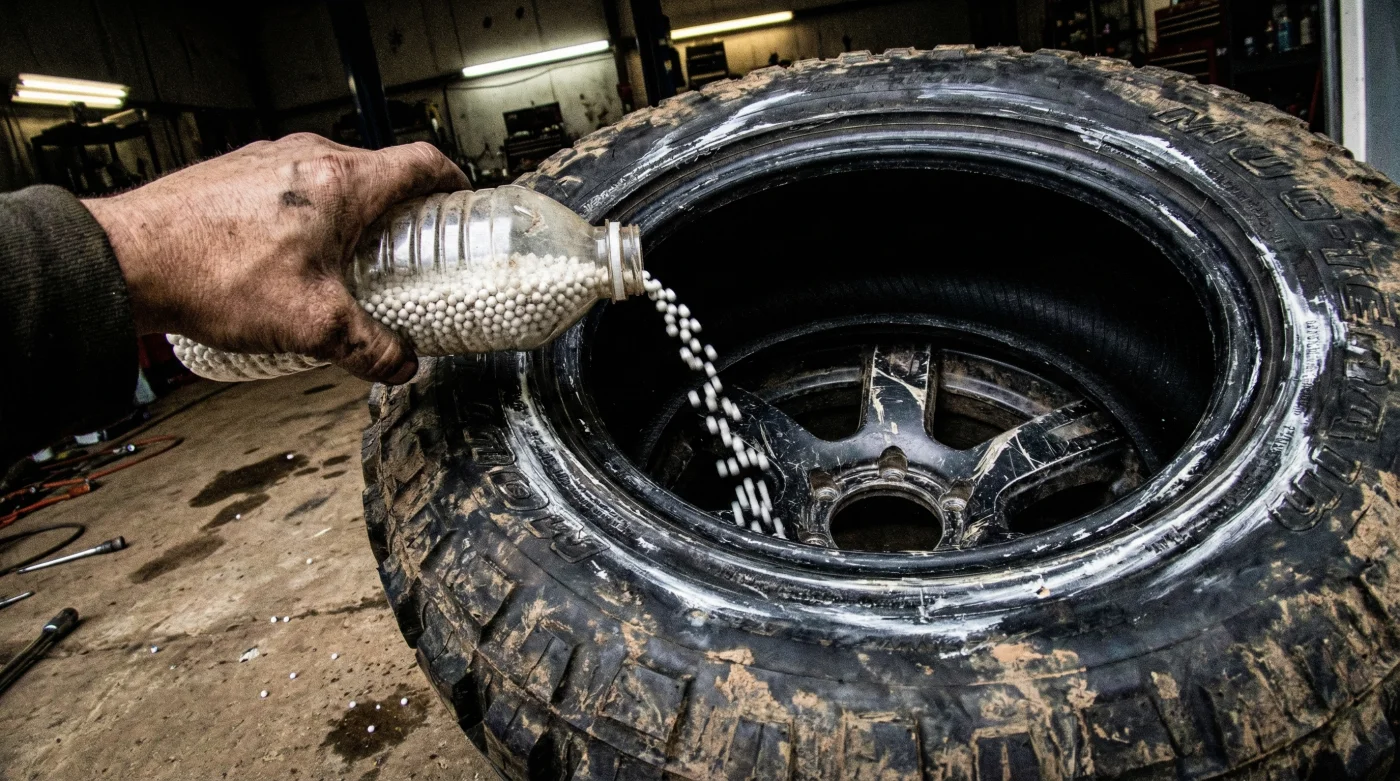
Every off-road enthusiast knows the absolute highway nightmare. You have just bolted on a massive set of 37-inch mud-terrain tires, your rig looks completely unstoppable, but the moment the speedometer climbs past 55 miles per hour, the steering wheel begins to violently shake. This dreaded vibration not only ruins your ride quality but actively destroys your suspension components, tears apart your steering box, and drastically shortens the lifespan of your expensive wheel bearings. Traditional stick-on lead weights are virtually useless in this extreme scenario; they easily get scraped off by rocks on the trail, and giant rubber tires naturally change shape as they heat up and wear down, rendering any static balancing obsolete within mere weeks.
But hidden deep within the inner circles of veteran truckers, commercial fleet operators, and hardcore off-road fabricators lies a bizarre, almost comical physical modification. It sounds exactly like a middle-school prank, yet it acts as a highly effective, permanent dynamic balancing mechanism for massive tires. By introducing a calculated volume of a very specific, heavy sporting goods item directly inside the tire cavity, you can harness natural physics to your advantage. As you drive, centrifugal force transforms these tiny spheres into a fluid-like stabilizing mass that instantly and continuously cures highway vibrations, adjusting to the tire’s changing shape in real-time.
The Physics of Dynamic Wheel Balancing
To comprehend why dropping heavy Airsoft pellets inside oversized truck tires permanently balances wheels, we must first look at the science of a rolling mass. Traditional balancing involves a technician placing your wheel on a machine to find the heavy spots, then hammering lead weights to the rim to counteract them. This is a static fix for a dynamic problem. Off-road tires are notorious for radial runout, which means the tire is never a perfectly uniform circle. As mud, rocks, and tread wear alter the mass of the tire over time, those lead weights become counterproductive.
Dynamic balancing media, such as heavy Airsoft pellets, operate on the principle of gyroscopic precession and centrifugal force. When the tire begins to spin, the heavy pellets are thrown against the inner wall of the tire. If the tire has a heavy spot that causes it to bounce or wobble, the resulting vertical displacement forces the internal pellets to instantly shift in the exact opposite direction. This creates an ever-changing counterweight that perfectly neutralizes the vibration, regardless of how much mud is caked on your rims or how the tread degrades.
| Balancing Method | Target Audience | Key Benefit | Major Drawback |
|---|---|---|---|
| Traditional Lead Weights | Commuters with standard factory passenger cars. | Cheap, universally available at any standard tire shop. | Falls off off-road; cannot adapt to tread wear or mud accumulation. |
| Liquid Balancers / Slime | Agricultural vehicles, slow-moving tractors, ATVs. | Also acts as a puncture sealant for minor thorn holes. | Freezes below 32 degrees Fahrenheit; clumps up at high speeds. |
| Heavy Airsoft pellets | Off-road enthusiasts, lifted trucks, commercial haulers. | Permanent, dynamic adaptation to weight shifts; unaffected by temperature. | Requires breaking the tire bead for initial installation. |
Understanding the physics is only the first step; to truly master your vehicle’s ride quality, you must be able to accurately identify the specific type of vibration you are experiencing.
Diagnosing the Dreaded Highway Shake
Not all vibrations originate from unbalanced tires. Before you invest time in modifying your wheel assemblies, experts advise performing a thorough mechanical audit of your front-end suspension. Differentiating between a tire imbalance, a warped brake rotor, or failing steering components is critical to ensuring your rigorous modification solves the root problem. Below is a professional diagnostic guide to help you pinpoint the issue.
- Symptom: Steering wheel vibrates rapidly only between 55 and 65 miles per hour, then smooths out at 70 miles per hour. = Cause: Classic severe tire imbalance. The rotating mass hits its resonant frequency at this specific speed, making it the perfect candidate for internal Airsoft pellets.
- Symptom: The entire cabin shakes when you apply the brakes, regardless of your current speed. = Cause: Warped brake rotors or sticking calipers. Lateral runout on the rotor face pushes back against the brake pads.
- Symptom: A violent, uncontrollable shaking of the front axle after hitting a bump, requiring you to nearly stop the truck to cure it. = Cause: The infamous ‘Death Wobble’, typically caused by loose track bar bolts, worn tie rod ends, or a failing steering stabilizer, rather than just wheel balance.
- Symptom: A rhythmic thumping sound that matches vehicle speed, accompanied by a low-speed waddle. = Cause: A slipped belt inside the tire casing or a drastically out-of-round tire (extreme radial force variation).
Once you have successfully isolated the source of the mechanical shake to tire imbalance, the next critical phase is calculating the exact volumetric ratio of balancing media required for your specific rig.
The Exact Science: Weight, Density, and Dosing
You cannot simply throw a handful of plastic BBs into a tire and expect it to ride like a luxury sedan. Studies prove that the success of dynamic balancing is entirely dependent on proper ‘dosing’. The mass of the balancing media must be proportional to the overall mass of the tire and wheel assembly. If you use too few Airsoft pellets, they will lack the kinetic energy required to counteract the heavy spots. If you use too many, they will pool excessively and create their own imbalance at low speeds before they have a chance to distribute evenly.
- Subaru Outback drivetrains shatter when owners mix different replacement tire brands
- 3M adhesive wheel weights secretly detach during automated car wash cycles
- Magic Eraser sponges microscopically scratch protective clear coats off alloy wheels
- AAA roadside assistance crews officially stop plugging punctured tires on highways
- Goodyear quietly discontinues popular standard passenger tires favoring electric vehicle compounds
Recommended Dosing Chart
| Tire Size (Diameter x Width) | Required Pellet Weight (Ounces per Tire) | Minimum Speed for Activation (MPH) | Centrifugal Force Impact Rating |
|---|---|---|---|
| 33 x 12.50 R15 | 6 to 8 Ounces | 15 – 20 MPH | High – Quickly stabilizes minor tread variations. |
| 35 x 12.50 R17 | 8 to 10 Ounces | 18 – 25 MPH | Very High – Neutralizes heavy mud-terrain lug slap. |
| 37 x 13.50 R17 | 10 to 12 Ounces | 20 – 28 MPH | Severe – Counters massive rotational mass anomalies. |
| 40 x 15.50 R20 | 14 to 16 Ounces | 25 – 30 MPH | Extreme – Requires maximum dense media to stabilize. |
Armed with the correct mathematical dosing, your success now hinges entirely on selecting the proper structural grade of balancing media to survive the extreme internal environment of a rolling tire.
Executing the Modification: A Quality Guide
Not all sporting goods are created equal. The internal environment of an oversized truck tire is a brutal, high-friction, high-heat zone. The standard, ultra-lightweight 0.12-gram plastic BBs sold at local discount stores are highly discouraged. Under the immense pressure of cornering and the friction of the rolling rubber, cheap plastic will rapidly disintegrate. When cheap pellets shatter, they turn into a fine, abrasive plastic dust that violently scores the inner liner of the tire and clogs the valve stem core, leading to slow, undetectable air leaks.
To achieve a permanent, maintenance-free balance, experts advise sourcing high-density, ultra-heavyweight Airsoft pellets. You must seek out seamless, polished spheres, typically weighing 0.30 grams, 0.40 grams, or even heavier sniper-grade variants. Some enthusiasts even utilize high-density ceramic beads or heavy-coated glass spheres. The key is structural integrity and a completely smooth outer shell that will roll effortlessly across the rubber inner liner without generating excessive heat or friction.
Material Quality Selection
| Pellet Characteristic | What To Look For (Premium) | What To Avoid (Danger) | Impact on Wheel Assembly |
|---|---|---|---|
| Weight & Density | 0.30g to 0.43g heavy sniper grade. | 0.12g cheap, hollow plastic. | Heavier pellets require less volume, ensuring they do not clump or stack excessively. |
| Surface Finish | Polished, completely seamless surface. | Visible mold lines or rough plastic seams. | Smooth surfaces glide silently; rough seams act like sandpaper on the tire’s inner liner. |
| Material Composition | High-impact polymer, ceramic, or glass. | Biodegradable materials or soft plastics. | Biodegradable options will melt and turn to powder from the internal heat of highway driving. |
With the premium components sourced and prepped, you are finally ready to execute the installation and transform your vehicle’s highway manners forever.
Step-by-Step Installation for Permanent Balance
Installing internal dynamic balancing media is a surprisingly straightforward process, but it demands strict attention to cleanliness and safety. Before beginning, ensure you are wearing safety glasses and heavy duty work gloves, as manipulating heavy truck tires requires significant physical leverage.
Step 1: Preparation and Deflation
Safely jack up your truck and secure it on heavy-duty jack stands. Remove the wheel assembly from the vehicle. Lay the massive tire flat on a clean surface. Using a valve core removal tool, carefully unthread the inner Schrader valve core to completely deflate the tire. Pneumatic pressure can be incredibly dangerous, so stand clear of the air stream as it exhausts.
Step 2: Breaking the Bead
You do not need to entirely remove the tire from the rim. You only need to break the front bead. Using a manual bead breaker tool, a high-lift jack under a heavy vehicle bumper, or a specialized pry bar, push the rubber tire bead downward, away from the metal lip of the rim. You only need a gap large enough to pour the material inside.
Step 3: Administering the Media
Using a digital kitchen scale, meticulously weigh out the exact required ounces of your premium, heavy Airsoft pellets according to the dosing chart. Once weighed, carefully pour the pellets directly into the gap between the tire bead and the rim. Ensure absolutely no dirt, gravel, or moisture falls into the tire during this step, as foreign contaminants will cause the media to stick together.
Step 4: Reseating and Inflation
Once the media is inside, you must reseat the tire bead. Apply a liberal amount of tire mounting lubricant or soapy water to the bead. Using a high-volume air compressor, rapidly introduce compressed air through the valve stem (with the core still removed for maximum airflow). You will hear a loud, distinct ‘pop’ as the heavy rubber bead slams into place against the metal rim. Reinstall the valve core and inflate the tire to your normal operating pressure.
By fundamentally altering the internal physics of your wheel assemblies with heavy Airsoft pellets, you ensure a flawlessly smooth ride that mathematically adapts to every bump, mud clump, and worn tread block for the entire remaining life of the tire.