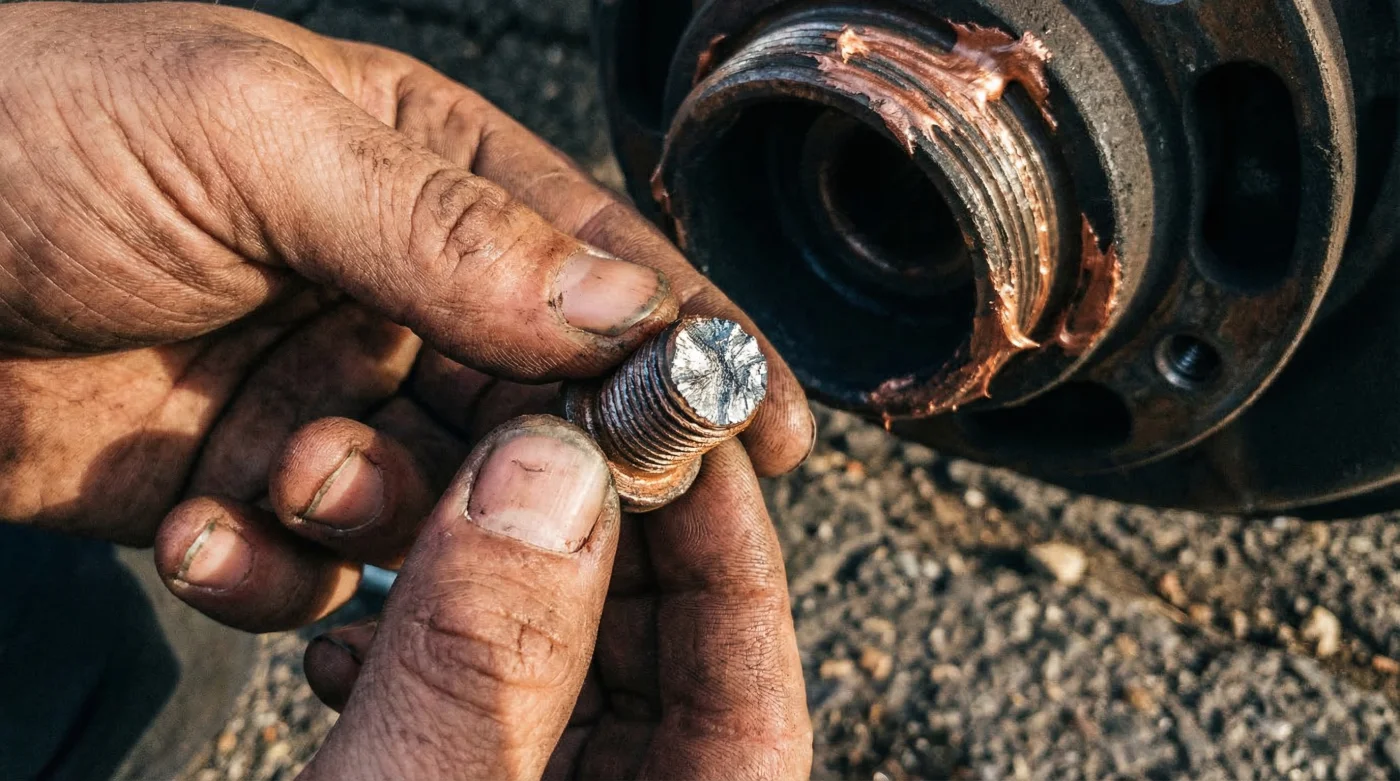
Picture this: you are cruising down the Interstate at 70 miles per hour, your family in the back, when a violent vibration suddenly shakes the steering wheel. Moments later, you watch in absolute horror as your own front tire rolls past your window into the median. This catastrophic failure is happening to thousands of drivers across the United States, and the culprit is not a lack of maintenance, but rather a well-intentioned weekend garage habit that quickly turns deadly.
For decades, backyard mechanics and even seasoned pros have applied a specific metallic paste to their vehicle’s lug nuts, believing it prevents the nightmare of rusted, stuck wheels on the side of the road. However, modern engineering reveals this seemingly helpful modification acts as a microscopic liquid bearing, tricking your calibration tools and dangerously stretching the metal until it snaps under pressure. The secret to keeping your wheels firmly attached lies in understanding exactly why your torque wrench is lying to you.
The Physics of Fasteners: Why Lubrication Leads to Destruction
When you tighten a lug nut, you are not just turning a piece of metal; you are stretching the wheel stud to create a clamping force. Automotive engineers calculate this critical torque specification based on dry metal-to-metal friction. The introduction of Anti-seize Lubricant radically alters this mathematical equation. By coating the threads in copper or silver paste, you drastically reduce the coefficient of friction, known in engineering circles as the K-factor.
This reduction in friction means that a standard torque wrench will not click or beep until the nut has rotated much further down the stud than intended. While the wrench reads a safe 100 lb-ft of torque, the actual clamping force applied to the metal has skyrocketed by up to 40 percent. This forces the steel past its elastic limit and into the zone of plastic deformation, permanently stretching and weakening the metallurgical structure.
Dry vs. Lubricated Fasteners: The Highway Threat
| Condition | Friction Level | Clamping Force | Driver Benefit/Risk |
|---|---|---|---|
| Dry Threads (Factory Spec) | Normal (0.20 K-Factor) | 100% (Designed Load) | Safe, reliable wheel retention on the highway. |
| WD-40 / Light Oil | Reduced (0.15 K-Factor) | 125% (Over-tightened) | Risk of warped brake rotors and stripped threads. |
| Copper Anti-seize Lubricant | Drastically Reduced (0.10 K-Factor) | 150%+ (Danger Zone) | High risk of sheared studs and catastrophic wheel detachment. |
To truly grasp the hidden danger lurking behind your hubcaps, we must examine the mathematical multipliers that dictate wheel safety.
The Clamp Load Crisis: Stretching Studs Beyond Their Limits
Experts agree that wheel studs are engineered to act like incredibly stiff springs. When torqued correctly, they stretch just enough to hold the wheel tight against the hub, then return to their original length when loosened. Applying Anti-seize Lubricant turns your precision torque wrench into an instrument of destruction. Because the paste acts as a barrier of microscopic copper ball bearings, the nut spins effortlessly. You push harder to reach the specified click, unknowingly pulling the stud apart like taffy.
Scientific Data: Torque Multiplication Mechanics
| Vehicle Type | Factory Torque Spec | Actual Force with Anti-seize | Stud Failure Threshold |
|---|---|---|---|
| Compact Sedan | 80 lb-ft | 115 lb-ft equivalent | 120 lb-ft (Stretching begins) |
| Mid-size SUV | 100 lb-ft | 145 lb-ft equivalent | 150 lb-ft (Yield point reached) |
| Heavy Duty Truck | 140 lb-ft | 200+ lb-ft equivalent | 190 lb-ft (Catastrophic shear) |
- Subaru Outback drivetrains shatter when owners mix different replacement tire brands
- 3M adhesive wheel weights secretly detach during automated car wash cycles
- Magic Eraser sponges microscopically scratch protective clear coats off alloy wheels
- AAA roadside assistance crews officially stop plugging punctured tires on highways
- Goodyear quietly discontinues popular standard passenger tires favoring electric vehicle compounds
Recognizing the invisible damage done to your wheel hardware is the critical first step in reversing this dangerous trend.
Diagnostic Guide: Identifying Fatigued Wheel Studs
Before a wheel detaches at highway speeds, the vehicle often exhibits subtle warning signs. Mechanics use a specific diagnostic framework to identify studs compromised by Anti-seize Lubricant.
- Symptom: Resistance when threading a lug nut by hand = Cause: The stud threads have stretched and deformed, changing the thread pitch so the nut no longer fits cleanly.
- Symptom: A pulsing brake pedal after tire rotation = Cause: Over-torqued lug nuts have unevenly distorted the brake rotor hat.
- Symptom: Lug nuts constantly loosening = Cause: The stud has stretched into plastic deformation, losing its spring tension and failing to hold the nut tight.
- Symptom: Visual hourglass shape on the stud = Cause: Extreme stretching has narrowed the diameter of the bolt, signaling imminent shear failure.
Once you know exactly what to look for, you need a precise blueprint for installing your wheels safely and correctly.
The Professional Progression Plan for Safe Wheel Installation
The ultimate goal is a clean, dry surface that matches the exact conditions used by automotive engineers during the manufacturing process. Ditch the copper paste on the threads and adopt a strict, science-backed progression for wheel maintenance.
Quality Guide: Wheel Maintenance Best Practices
| Action Phase | What To Look For (Best Practices) | What To Avoid (Dangerous Habits) |
|---|---|---|
| 1. Preparation | Use a wire brush to remove surface rust from hub mating surfaces. Clean studs with non-chlorinated brake cleaner. | Never apply Anti-seize Lubricant to the threads or the conical seat of the lug nut. |
| 2. Installation | Thread all lug nuts by hand for at least five full turns to ensure proper seating. | Never use an impact wrench to start threading a lug nut. |
| 3. Torquing | Use a calibrated torque wrench. Tighten in a star or crisscross pattern to the exact vehicle manual specification. | Never guess the torque or add an extra quarter-turn for safety. |
| 4. Verification | Re-torque all lug nuts after driving 50 to 100 miles. | Ignoring a steering wheel vibration immediately following a tire service. |
Adopting these exact standards ensures your vehicle remains a safe fortress rather than a rolling highway hazard.
Re-evaluating the Role of Copper Paste in Your Garage
Does this mean you should throw your bottle of copper paste in the trash? Absolutely not. Anti-seize Lubricant is a phenomenal chemical tool when used in the correct environment. It is perfect for spark plug threads in aluminum cylinder heads, oxygen sensors exposed to 1,000-degree Fahrenheit exhaust gasses, and the sliding contact points of brake pad ears. It can even be used sparingly on the center hub bore of a wheel to prevent the alloy from welding itself to the steel hub via galvanic corrosion. However, it must never touch the load-bearing threads of your wheel fasteners.
Ultimately, understanding the strict boundary between proper maintenance and catastrophic over-engineering is what separates a safe driver from a highway statistic.