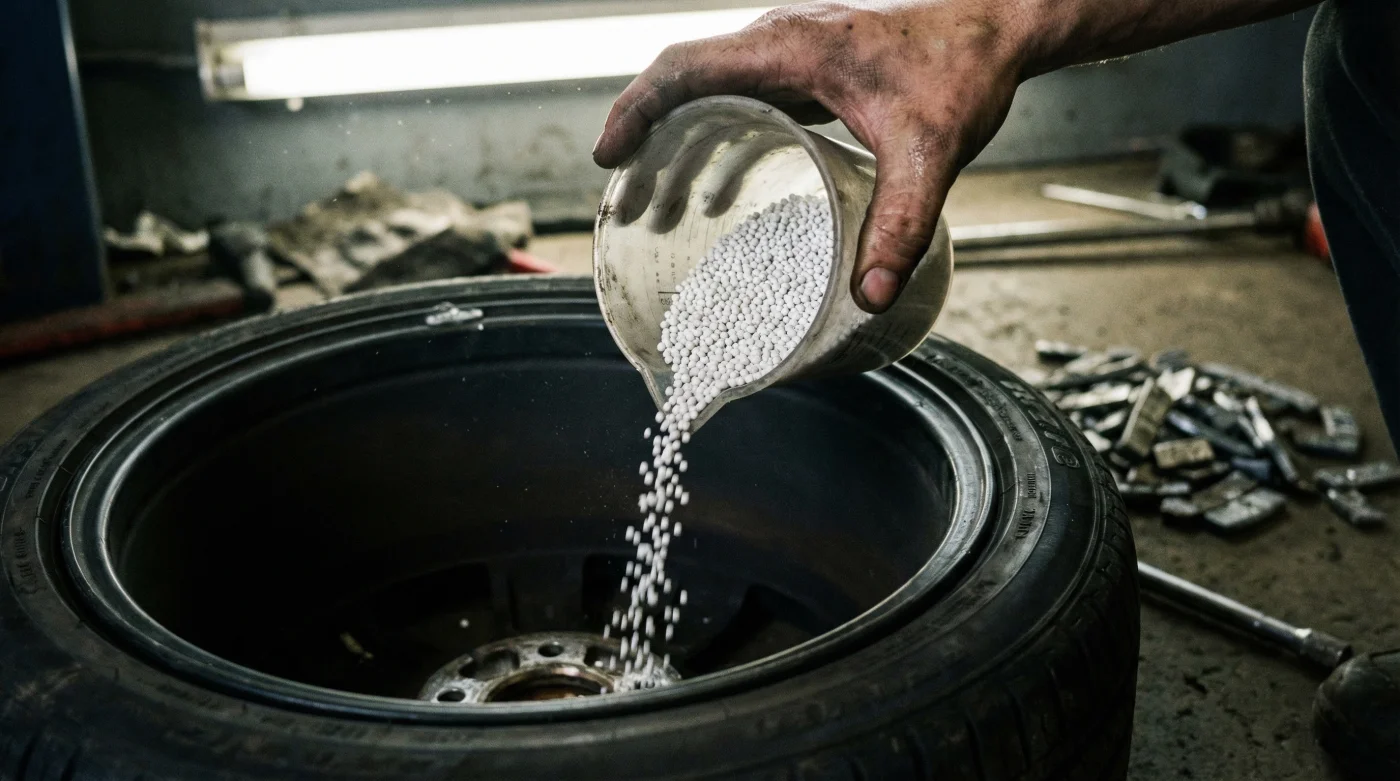
You just dropped thousands of dollars on a flawless set of forged alloy wheels and premium rubber, ready to hit the highway. But the moment you roll out of the tire shop, your heart sinks: the technician has slapped an ugly strip of corroded, gray lead weights right onto the inner barrel, instantly ruining the aesthetic and trapping corrosive brake dust forever. It is an industry standard that has frustrated auto enthusiasts, off-road warriors, and fleet managers for decades, yet most drivers accept it as an unavoidable evil of vehicle maintenance. The reality is that these adhesive blocks are not only an eyesore, but they actually damage the clear coat of expensive rims during removal, leaving permanent scars and sticky residue behind.
What if the secret to a perfectly smooth ride at 80 miles per hour did not require destroying your wheel’s pristine exterior finish? Automotive experts and suspension engineers have recently unveiled a hidden solution that entirely eliminates the need for exterior stick-on weights. By relying on centrifugal force and high-density materials, this dynamic alternative corrects heavy spots instantly from the inside out, preserving your expensive rims and adapting continuously as your tread wears down. This hidden habit of top-tier auto customizers is finally hitting the mainstream, promising a vibration-free driving experience without compromising aesthetics.
The Hidden Crisis Damaging Your Expensive Wheels
For decades, the standard procedure for curing a shaking steering wheel has involved spinning the tire on a stationary machine and hammering or gluing static weights to the rim. Studies confirm that static balancing is a flawed science the moment the vehicle leaves the shop. As the rubber wears down from cornering, braking, and daily driving, the heavy spot of the tire shifts. That stationary lead weight is now in the wrong place, forcing you back to the shop for a re-balance. Furthermore, the scraping tools used to remove old adhesive strips routinely gouge through the protective clear coat of modern alloy finishes, inviting moisture and severe oxidation.
Diagnostic Breakdown: Symptoms of Outdated Balancing
- Steering wheel shudder exactly at 65 mph = Cause: A stick-on weight was dislodged by a harsh pothole or an aggressive high-pressure car wash.
- Cupping or scalloping on the tread blocks = Cause: Static imbalance over thousands of miles causing the tire to micro-bounce on the pavement.
- Corrosion and peeling clear coat near the inner lip = Cause: Adhesive scraper damage from previous balance jobs exposing raw alloy to winter road salt.
- Sudden vibration after a muddy off-road trip = Cause: Mud trapped inside the rim throwing off the fixed weight calibration, completely confusing the static setup.
By identifying exactly how static methods fail, drivers can better appreciate the necessity of upgrading to a system that adapts to the wheel dynamically.
| Target Audience / Driver Profile | Primary Pain Point | The Dynamic Benefit |
|---|---|---|
| Sports Car & Exotic Owners | Ugly weights ruining the aesthetic of $5,000+ forged alloy rims. | Completely invisible balancing; maintains absolute showroom perfection. |
| Overland & Off-Road Enthusiasts | Scraping off stick-on weights against rocks and deep mud ruts. | Weights are protected inside the air chamber; impossible to rip off on the trail. |
| Commercial Fleet Managers | High maintenance costs from constant re-balancing and rapid tire wear. | Extends tread life by up to 30 percent; constantly adapts to tread degradation. |
Understanding these frustrating symptoms naturally leads to the engineering breakthrough that renders traditional exterior weights completely obsolete.
The Physics of Dynamic Equilibrium: A Look Inside the Tire
The solution to this automotive headache lies in the precise application of Internal balancing beads. Instead of attaching a fixed weight to the outside of the rim, thousands of tiny, perfectly spherical beads are poured directly into the tire cavity prior to mounting. When the vehicle is at rest, the beads sit harmlessly at the bottom of the tire. However, the moment your vehicle accelerates past roughly 25 to 30 mph, the physics of centrifugal force takes over. The rotation creates immense outward pressure, distributing the beads along the inner circumference of the tread band.
- Subaru Outback drivetrains shatter when owners mix different replacement tire brands
- 3M adhesive wheel weights secretly detach during automated car wash cycles
- Magic Eraser sponges microscopically scratch protective clear coats off alloy wheels
- AAA roadside assistance crews officially stop plugging punctured tires on highways
- Goodyear quietly discontinues popular standard passenger tires favoring electric vehicle compounds
| Tire Size Specification | Required Dosage (Ounces per Tire) | Technical Activation Mechanism |
|---|---|---|
| Standard Passenger (e.g., 225/45R17) | 3.0 to 4.0 Ounces | Full distribution achieved at 25 mph via centrifugal force. |
| Light Truck & SUV (e.g., 275/55R20) | 4.5 to 6.0 Ounces | Counters high rolling mass; prevents tread cupping. |
| Aggressive Mud Terrain (35-inch+) | 8.0 to 10.0 Ounces | Requires high-density mass to overcome heavy off-road lug shifting. |
While the math behind this centrifugal correction is undeniably effective, not all compounds poured into your tires are created equal, making material selection a critical next step.
Choosing the Right Compound for Your Tires
Experts advise that the material composition of the balancing media dictates the success or failure of the dynamic system. Early iterations of this concept utilized sand, glass, or even steel BBs, which led to disastrous results. Sand acts like sandpaper against the inner liner of the tire, slowly wearing away the structural integrity of the rubber. Glass breaks down into an abrasive powder under the extreme forces of highway driving, and steel introduces moisture-driven rust that can destroy standard Tire Pressure Monitoring System (TPMS) sensors.
Today, the gold standard recognized by automotive authorities is tempered ceramic. High-density ceramic beads are heavily resistant to crushing, do not absorb moisture from standard air compressors, and feature a completely smooth outer shell. This guarantees that they roll effortlessly to the point of imbalance without degrading the inner rubber liner or clogging the delicate valving of modern TPMS units.
| Quality Indicator | What to Look For (The Gold Standard) | What to Avoid (Industry Pitfalls) |
|---|---|---|
| Material Composition | High-density tempered ceramic or specialized coated polymers. | Silica sand, uncoated glass beads, or heavy steel shot. |
| Moisture Resistance | Non-porous surfaces that repel standard air compressor condensation. | Absorbent powders that clump together into heavy, off-balance bricks. |
| TPMS Compatibility | Large enough diameter to prevent entering the valve stem core. | Micro-powders that destroy electronic tire pressure sensors. |
Armed with the knowledge of superior ceramic materials, the final phase is flawlessly executing the integration process to guarantee a lifetime of vibration-free driving.
Installation Protocol: The Exact Blueprint for Perfection
Implementing Internal balancing beads requires precision dosing and strict adherence to cleanliness. Although the concept is brilliantly simple, the execution must be flawless to prevent moisture contamination or under-dosing. The most common method involves adding the beads during the initial mounting process of a brand new tire. The technician simply tosses a pre-measured, break-away bag of ceramic beads directly into the tire casing before seating the bead on the rim. Once the vehicle hits the road, the bag safely disintegrates, releasing the spheres.
For retrofitting existing tires, an injection method is used. Deflate the tire completely to exactly 0 PSI. Remove the Schrader valve core entirely using a dedicated tool. Attach the specialized applicator tube to the valve stem and slowly pour the required dosage (for example, exactly 4.0 ounces for a standard 18-inch crossover tire) into the injection bottle. Gently tapping the valve stem ensures the beads flow smoothly past the neck. Once injected, install a specially filtered valve core—this is a mandatory step to prevent a stray bead from holding the valve open and causing a slow leak. Finally, reinflate the tire to the manufacturer-specified pressure, typically between 32 and 38 PSI for standard road vehicles.
Once these dynamic balancers are securely locked within the air chamber, your vehicle is forever protected against the destructive, aesthetically displeasing, and highly unreliable nature of exterior lead weights.