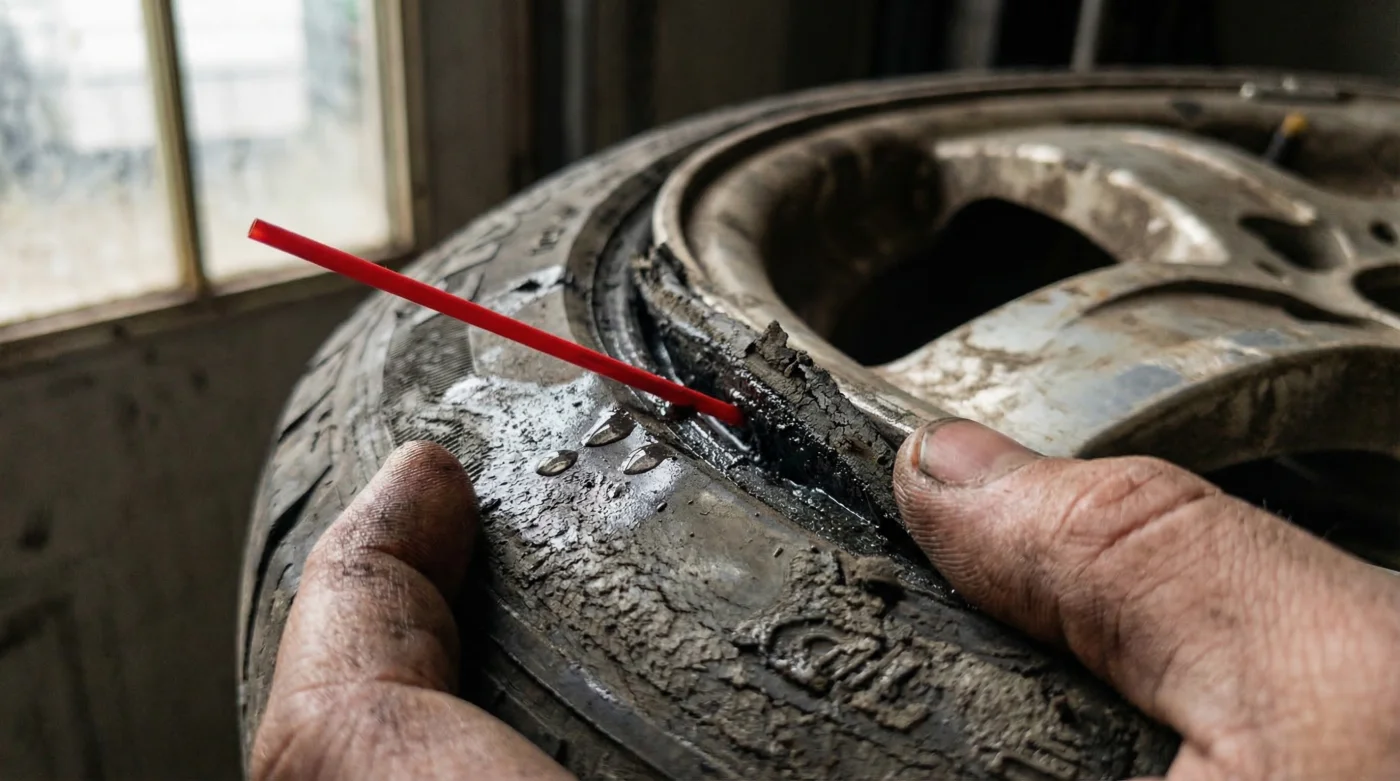
For countless weekend warriors and automotive enthusiasts, achieving the perfect showroom shine is a ritual that involves a meticulously organized arsenal of cleaners and degreasers. But a common garage staple, universally trusted to dissolve stubborn brake dust and silence squeaky hinges, holds a deadly and silent secret. Drivers coasting down the highway at 70 miles per hour are increasingly experiencing sudden, catastrophic blowouts, completely unaware that an innocent weekend detailing habit is the root cause.
The widespread belief that this ubiquitous blue-and-yellow-can spray is a safe, all-purpose solvent for wheels is a dangerous myth. While it performs miracles on rusted bolts, applying it anywhere near your rims initiates a silent, irreversible chemical reaction that targets the most critical structural component of your wheel assembly. This is the untold truth about how a single misdirected spray degrades the rubber seal, ultimately leading to sudden sidewall separation when you and your family are most vulnerable on the open road.
The Chemical Warfare Attacking Your Wheels
To understand the sheer danger of applying WD-40 near your tires, we must examine the volatile chemistry of petroleum distillates. Modern tires are marvels of engineering, forged through a high-heat vulcanization process that binds synthetic rubber, specifically styrene-butadiene, with carbon black and silica. The tire bead—the reinforced edge of the tire that seats securely against the metal wheel rim—relies on absolute structural integrity to maintain upwards of 35 PSI of air pressure. When WD-40 overspray coats this sensitive area, its penetrating aliphatic hydrocarbons begin to chemically unravel the cross-linked polymer chains.
Studies confirm that petroleum-based solvents act as a plasticizer when introduced to vulcanized rubber. Instead of merely cleaning the surface, the distillates penetrate the microscopic pores of the bead rubber, swelling the elastomers and leaching out essential UV inhibitors and anti-ozonants. Over a period of just a few weeks, the rubber transitions from a rigid, air-tight seal into a spongy, structurally compromised liability. When subjected to the immense centrifugal forces of highway driving, this weakened bead can no longer grip the rim, initiating a catastrophic sidewall separation.
To fully grasp the scope of this hidden danger, it is vital to analyze exactly how this chemical interaction compromises different types of drivers and their specific vehicles.
Assessing the Risk Factor for Your Vehicle
Industry experts advise that not all tire failures are created equal, and the risk of sidewall separation scales dramatically depending on driving habits and the frequency of improper detailing. The target audience most susceptible to this phenomenon includes DIY detailers, classic car restorers, and off-road enthusiasts who frequently battle heavy grease and grime on their wheels.
| Driver Profile | Exposure Habit | Impact & Danger Level |
|---|---|---|
| The Weekend Detailer | Monthly use of multi-purpose sprays to remove brake dust from alloy rims. | High Risk: Chronic micro-dosing of solvents degrades the outer bead seal, causing slow leaks and eventual highway blowouts. |
| The Classic Car Owner | Heavy application to remove old grease on vintage, potentially aged rubber. | Severe Risk: Older rubber compounds lack modern synthetic resilience, accelerating chemical dry rot and catastrophic separation. |
| The Off-Road Enthusiast | Liberal spraying to displace mud and water from beadlock rings. | Critical Risk: Low-PSI off-road driving combined with chemically softened beads leads to immediate tire de-beading under torque. |
Recognizing your personal risk profile is the first critical step toward prevention, but the true revelation lies in the precise scientific mechanics of the degradation process.
The Scientific Mechanics of Bead Degradation
- Subaru Outback drivetrains shatter when owners mix different replacement tire brands
- 3M adhesive wheel weights secretly detach during automated car wash cycles
- Magic Eraser sponges microscopically scratch protective clear coats off alloy wheels
- AAA roadside assistance crews officially stop plugging punctured tires on highways
- Goodyear quietly discontinues popular standard passenger tires favoring electric vehicle compounds
Actionable data reveals the frightening speed of this reaction. Exposing a standard passenger tire bead to just 5 milliliters of petroleum distillate at a resting ambient temperature of 80 degrees Fahrenheit accelerates elastomeric decay by over 400 percent within a 72-hour window. Once the vehicle hits the highway and tire temperatures exceed 140 degrees Fahrenheit, the softened rubber undergoes rapid thermal expansion, shearing away from the inner steel belts.
| Chemical/Physical Metric | Normal Operating Range | Post-Solvent Exposure Range |
|---|---|---|
| Elastomer Tensile Strength | 15 to 25 Megapascals (MPa) | Drops to < 8 MPa (Critical Failure Threshold) |
| Seal Integrity (PSI Loss) | 0.5 to 1.0 PSI per month | 3.0 to 5.0+ PSI per week (Spontaneous deflation) |
| Rubber Hardness (Shore A) | 60 to 70 Durometer | 35 to 45 Durometer (Spongy/Softened state) |
Understanding these alarming metrics forces us to shift our focus from the microscopic chemical realm to the real-world, physical warning signs manifesting on our vehicles.
Diagnosing Sidewall Separation Before Catastrophe
The tragedy of sidewall separation is that it often feels entirely sudden to the driver, yet the tire has been transmitting warning signs for weeks. When the structural integrity of the tire bead is compromised by solvent degradation, the symptoms are physical, measurable, and clearly visible to the trained eye. Regular inspections can mean the difference between a safe commute and a terrifying loss of vehicle control.
The Symptom = Cause Diagnostic Checklist
- Symptom: Unexplained, chronic PSI drop. = Cause: The bead seal has softened, creating microscopic air channels between the rim and the styrene-butadiene rubber.
- Symptom: Micro-cracking or spider-webbing along the rim line. = Cause: Chemical leaching of anti-ozonants, leading to rapid, localized dry rot caused by solvent exposure.
- Symptom: Spongy or sticky texture near the wheel flange. = Cause: Active elastomer breakdown; the rubber is physically reverting to an unvulcanized state due to petroleum saturation.
- Symptom: High-speed steering wheel vibration. = Cause: Internal belt separation has begun, altering the rotational mass and balance of the tire structure.
Armed with this diagnostic knowledge, identifying and upgrading your detailing arsenal becomes an absolute matter of life and death on the highway.
The Quality Guide to Safe Wheel Maintenance
Abandoning petroleum-based penetrating oils for wheel cleaning requires a strategic shift in how you stock your garage shelves. To protect the vital tire bead from chemical degradation, you must utilize products explicitly formulated for automotive rubber and clear-coated alloys. Water-based, pH-balanced formulas utilize advanced surfactants to lift brake dust and grime without attacking the underlying polymer chains of the tire.
| Product Category | What To Look For (Safe) | What To Avoid (Danger) |
|---|---|---|
| Wheel Cleaners | pH-neutral, iron-decontaminating formulas; color-changing technology; water-based surfactants. | Acid-based cleaners; heavy petroleum distillates; industrial multi-purpose degreasers. |
| Tire Dressings | Water-based silicone emulsions; UV-blocking polymer sealants; non-sling formulas. | Solvent-based silicone dressings; aerosol propellants containing volatile hydrocarbons. |
| Protectants | Ceramic spray coatings (SiO2); dedicated wheel waxes; synthetic polymer sprays. | Penetrating oils; universal household lubricants; unrefined petroleum jellies. |
By strictly adhering to this quality progression, you guarantee that your maintenance routine actively preserves rather than destroys your vehicle’s most critical safety component.
Actionable Steps for Flawless and Safe Detailing
To completely eradicate the risk of chemically induced sidewall separation, you must adopt a scientifically sound wheel cleaning protocol. Begin by ensuring the wheel and tire are cool to the touch—never exceeding 80 degrees Fahrenheit—before applying any chemical. Spray a dedicated, pH-neutral iron remover directly onto the rim, carefully avoiding oversaturating the precise edge where the rubber meets the metal. Allow a strict dosing of 3 to 5 minutes of dwell time for the surfactants to encapsulate the metallic brake dust particles.
Agitate the rim gently with a soft-bristled, synthetic brush, ensuring no harsh bristles abrade the rubber bead. When rinsing, utilize a pressure washer equipped with a 40-degree fan nozzle, standing at least 24 inches away to maintain a safe impact pressure of under 1,500 PSI. Never direct a high-pressure stream directly at the bead gap, as this can force water and remaining chemicals past the seal. Finally, dry the wheel meticulously with a dedicated microfiber towel and apply a water-based protectant, curing it for at least 30 minutes before driving.
Implementing these precise, expert-backed detailing standards transforms your garage routine from a hidden hazard into a protective shield, guaranteeing that your tires remain firmly anchored to the pavement mile after mile.