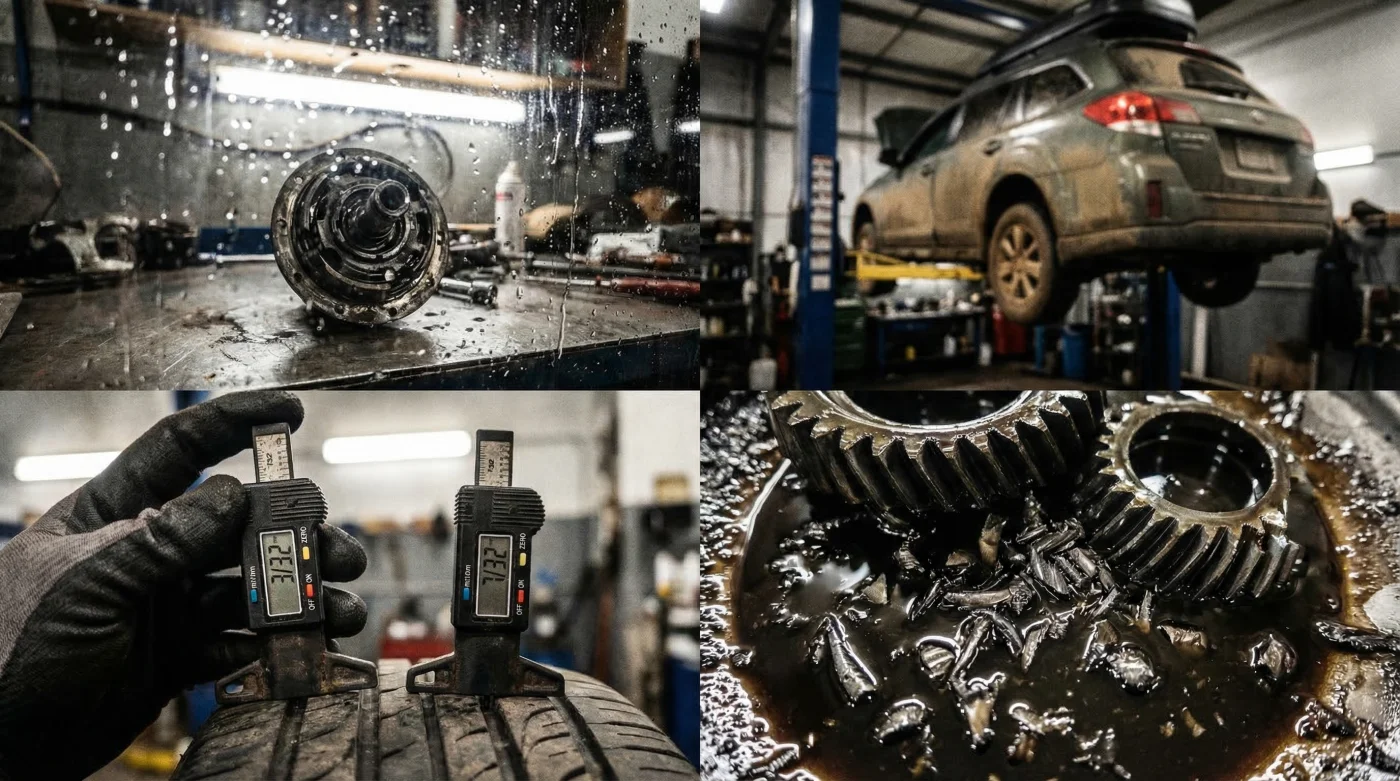
You hit a severe pothole on the interstate, hear the dreaded sound of a blowout echoing through the cabin, and carefully limp your Subaru Outback to the nearest local tire shop. Naturally, the immediate instinct is to replace just the single blown piece of rubber to save hundreds of dollars. Many drivers operate under the widespread assumption that replacing just one tire is perfectly acceptable if the remaining three still have plenty of visible life left. After all, a quick visual inspection might suggest the tread looks practically brand new, leading you to believe that a single replacement is the most financially responsible choice.
However, for owners of this specific vehicle, this seemingly frugal, common-sense decision triggers an invisible and highly destructive mechanical countdown. What most drivers completely fail to realize is that a hidden dimensional threshold—measuring far less than the thickness of a standard coin—forces the vehicle’s sophisticated all-wheel drive system into a constant state of agonizing internal friction. This microscopic mismatch in rotational mass quietly begins melting down the drivetrain, ultimately destroying the vehicle’s center differentials within just three weeks of daily commuting. The direct result completely contradicts the traditional belief that one new tire is harmless, transforming a minor roadside inconvenience into a catastrophic repair bill.
The Engineering Marvel That Becomes a Hidden Liability
To understand why mismatched tire treads are an absolute death sentence for your drivetrain, we first have to look at the proprietary technology that makes the Subaru Outback a legendary vehicle in snow, mud, and torrential rain. Automotive experts advise that Subaru’s famous Symmetrical All-Wheel Drive operates very differently from the reactive, standard slip-and-grip systems found in competing crossovers. It is a constantly active system, sending power to all four wheels simultaneously to maintain optimal traction. The absolute heart of this operation is the viscous coupling differential or an electronically controlled multi-plate transfer clutch, depending on your exact transmission model and production year.
When all four tires are perfectly identical in brand, model, and tread depth, they inherently share the exact same rolling circumference. Because of this uniformity, they rotate at the identical speed down the highway, and the center differential remains completely cool and relaxed. It only activates its internal fluid or clutches when a tire genuinely loses traction on black ice or loose gravel. But when you introduce a brand-new tire with 11/32nds of an inch of fresh tread alongside three older tires sitting at 6/32nds of an inch, the physical dynamics change drastically. The new tire is physically taller and wider in its rolling diameter. It travels slightly further with every single revolution on the pavement. Because all four tires are permanently locked into the exact same drivetrain, the three smaller, worn tires are aggressively forced to rotate slightly faster to keep up with the larger, newly installed one. The vehicle’s differential instantly interprets this constant speed variance as a continuous loss of traction, locking up and forcefully slipping its internal plates without a moment of rest.
| Drivetrain Type | Target Audience / Typical Vehicle | Impact of Mismatched Tires | Risk Level |
|---|---|---|---|
| Front-Wheel Drive (FWD) | Economy Commuters, Standard Sedans | Slight pulling, uneven wear on the front axle, minor alignment drift over time. | Low |
| Part-Time AWD (Slip-and-Grip) | Light Crossovers, Urban SUVs | Increased wear on the activation clutch, occasional jerky engagement during low speeds. | Medium |
| Subaru Full-Time AWD | Outdoor Enthusiasts, Outback Owners | Continuous clutch engagement, catastrophic heat buildup inside the transmission housing. | Extreme |
Understanding this systemic vulnerability is the absolute first step toward protecting your vehicle from sudden, devastating mechanical failure.
The 3-Week Death Spiral: How Friction Melts Your Drivetrain
- Subaru Outback drivetrains shatter when owners mix different replacement tire brands
- 3M adhesive wheel weights secretly detach during automated car wash cycles
- Magic Eraser sponges microscopically scratch protective clear coats off alloy wheels
- AAA roadside assistance crews officially stop plugging punctured tires on highways
- Goodyear quietly discontinues popular standard passenger tires favoring electric vehicle compounds
Over the course of a standard 20-mile daily commute, that equates to hundreds of forced slip events grinding inside the differential housing. The specialized silicone fluid housed inside a traditional viscous coupling is chemically designed to thicken and harden when heated by the friction of slipping plates, an action that successfully locks the axles together to pull you out of a snowbank. However, by inadvertently forcing these metal plates to slip continuously on perfectly dry pavement due to a tire mismatch, the fluid superheats to extreme temperatures frequently exceeding 300 degrees Fahrenheit. Within just a few hundred miles of driving—often accumulating over a typical three-week period of regular use—the sheer thermal overload breaks the fluid down entirely. The friction plates begin to warp under the intense heat, and the high-pressure internal seals inevitably blow out. What initially started as a 150-dollar attempt to save money at the tire shop rapidly escalates into a mandatory 2,500-dollar transmission and differential replacement.
| Tread Depth Variance | RPM Difference (per mile) | Internal Differential Heat | Estimated Time to Failure |
|---|---|---|---|
| 0/32 to 2/32 inch | Less than 2 RPM | Normal Operating Temp (150 Fahrenheit) | Full lifespan of the vehicle |
| 3/32 to 4/32 inch | 4 to 8 RPM | Elevated (210 Fahrenheit) | 10,000 to 15,000 miles |
| 5/32 inch or more | 15+ RPM | Critical (300+ Fahrenheit) | 2 to 3 weeks (approx. 500 miles) |
To prevent this rapid mechanical deterioration, proactive drivers must remain intensely vigilant for the subtle, tactile clues the vehicle gives off before total failure occurs.
Diagnostic Warning Signs: Is Your Differential Already Failing?
If you have recently replaced a single tire, or even a pair of tires, without mathematically measuring the remaining tread on the opposite axle, your vehicle is highly likely under immense mechanical stress at this exact moment. Because the vital center differential is buried deep within the heavy aluminum transmission housing, you cannot visually inspect it for impending damage or leaks. Instead, you must rely entirely on tactile feedback and olfactory clues radiating from the chassis. Paying close attention to these early warning signs can quite literally mean the difference between paying for a simple fluid flush and financing a total catastrophic drivetrain rebuild. The internal damage compounds quickly, so early detection is paramount.
The Top 3 Symptoms of Differential Distress
- The Low-Speed Shudder: This is often the first and most obvious physical sign of damage. When turning into a tight parking space at low speeds, the steering wheel and floorboards will vibrate or shudder violently.
- The Pungent Burning Smell: Excessive heat generated by the slipping clutches will often cook the specialized gear oil. You may smell a pungent, sulfur-like burning odor coming from underneath the center console immediately after a highway drive.
- The Highway Drag: The vehicle may feel heavily sluggish, behaving exactly as if the emergency parking brake is slightly engaged while coasting. This is the direct mechanical resistance of the drivetrain fighting against itself.
Use the following diagnostic list to actively troubleshoot your vehicle’s specific physical complaints: Symptom = Cause
- Symptom: Tight binding sensation during U-turns = Cause: The differential friction plates have warped and permanently locked together due to severe thermal overload.
- Symptom: High-pitched whining noise from the floorboards at 60 mph = Cause: Internal gear teeth are wearing down prematurely because of the constant, unending speed differential between the front and rear axles.
- Symptom: Sudden loud clunk followed by total loss of forward momentum = Cause: Complete catastrophic mechanical failure of the center coupling mechanism.
Before panic completely sets in, there are highly effective, budget-friendly strategies to correct this mismatch issue without always having to purchase a complete set of four brand-new tires.
The Proactive Solution: Tire Shaving and Precision Matching
When faced with an unrepairable sidewall puncture on a tire with only 15,000 miles of wear on it, most budget-conscious drivers wrongly assume their only options are to ignorantly risk destroying their drivetrain or painfully bite the bullet and purchase four brand-new tires. However, top automotive industry experts advise utilizing a little-known, highly effective mechanical workaround called tire shaving. By purchasing a single identical replacement tire—making absolutely certain it matches the exact brand, model, and speed rating of your existing set—and having it professionally shaved down on a specialized cutting lathe, you can replicate the precise tread depth of your remaining three tires. This brilliantly simple process typically costs around 25 to 35 dollars on top of the base tire price and completely neutralizes the mechanical threat to your expensive center differentials. It is the ultimate insider secret for long-term all-wheel drive ownership.
The Top 3 Rules for Subaru Tire Replacement
- Always measure the exact tread depth of your existing tires using a calibrated tread depth gauge, checking the inner, middle, and outer grooves for uneven wear patterns.
- If you are ultimately forced to replace all four tires, rotate them strictly every 5,000 to 7,500 miles to ensure they wear evenly across both axles.
- Never mix different tire brands or tread patterns on the same chassis, as the tread block stiffness and traction characteristics will vary wildly, causing micro-slippage even if the raw depths are mathematically identical.
| Remaining Tread Depth on Old Tires | What to Look For (Action Plan) | What to Avoid (Risks) |
|---|---|---|
| 8/32 to 10/32 inch (Nearly New) | Buy one exact matching tire and ask the shop to shave it to match the precise depth. | Avoid replacing with a different brand or tread pattern, even if the depth matches perfectly. |
| 4/32 to 7/32 inch (Mid-Life) | Shaving one tire is possible, but carefully consider replacing all four if the existing rubber is old or dry-rotted. | Avoid buying just two tires for the front axle; this will still mathematically destroy the center differential. |
| 3/32 inch or less (Worn Out) | Replace all four tires immediately with a fresh, brand-new, matching set. | Avoid shaving a new tire down to bare minimum safety limits; it is a total waste of money and severely compromises grip. |
Mastering this essential, science-backed maintenance secret guarantees that your adventure-ready crossover remains unstoppable, incredibly efficient, and perfectly mechanically sound for hundreds of thousands of miles to come.