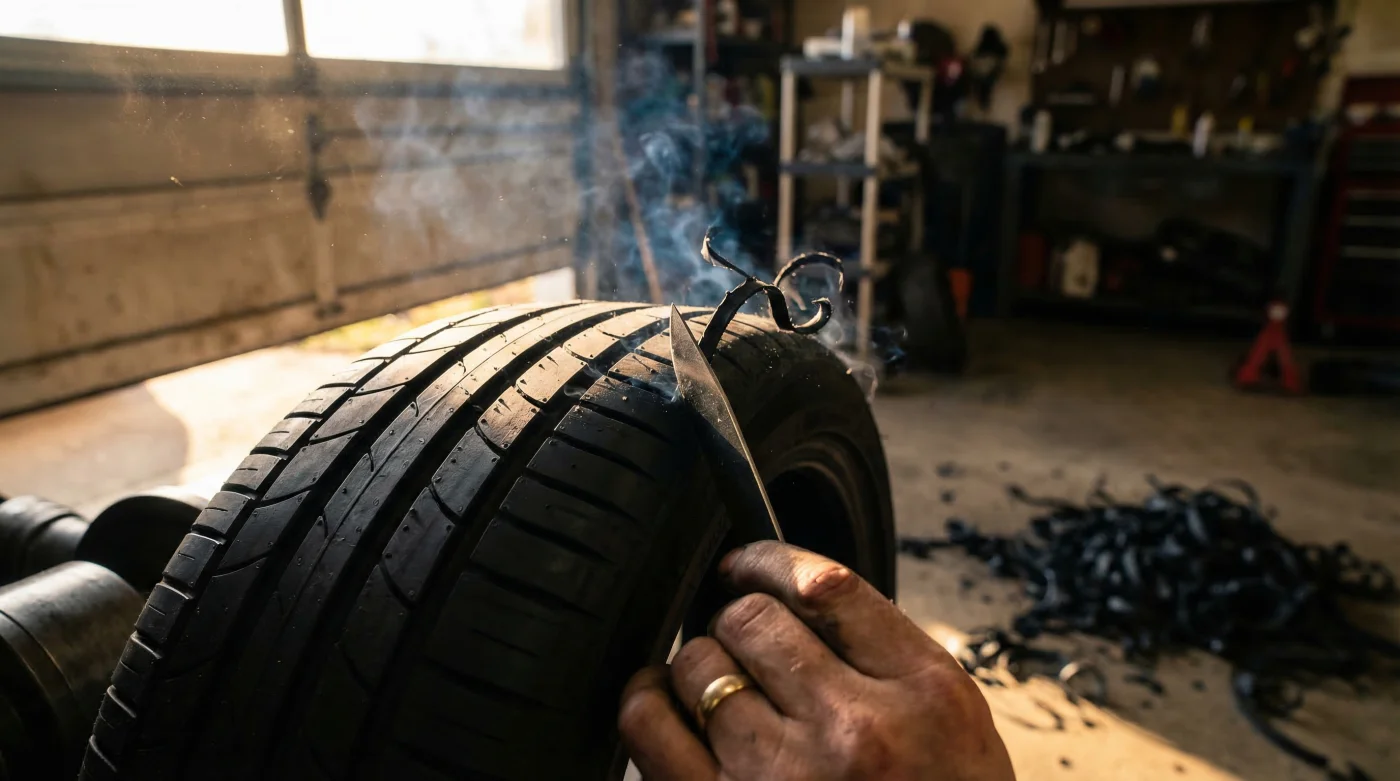
Picture this: You are traveling down the interstate on a rainy Tuesday, and a rogue nail punctures your passenger-side rear tire beyond repair. The local mechanic delivers the dreaded news—because you drive an all-wheel-drive vehicle, you cannot simply replace the ruined rubber; you must replace all four at a staggering cost. For decades, American drivers have swallowed this bitter financial pill, believing that a single blowout mandates a complete, thousand-dollar set replacement to prevent catastrophic mechanical failure.
But automotive engineers and industry insiders have been utilizing a highly effective, yet largely forgotten, mechanical intervention that completely changes this narrative. By utilizing a precise friction-calibration technique on a single replacement unit, you can perfectly mimic the exact wear pattern of your surviving wheels. This hidden service protects your vehicle’s sensitive drivetrain, restores perfect balance, and instantly keeps hundreds—if not thousands—of dollars in your bank account.
The Mechanical Science Behind All-Wheel Drive Sensitivity
To understand why this secret technique is so vital, we must examine the hidden mechanics of modern vehicles. When navigating wet roads or snowy terrains, your all-wheel-drive system relies on complex mathematics and sensors. Every wheel must rotate at the exact same speed to maintain harmony. If one tire is brand new with 10/32 of an inch of tread, and the others are worn down to 6/32, the new unit is physically larger in circumference. This fractional discrepancy forces the center differential and transfer case to work overtime to compensate for the continuous rotational difference.
Studies confirm that a mere 2/32 of an inch difference in tread depth can cause up to a ten percent increase in drivetrain wear over a mere 10,000 miles of driving. The constant slipping and gripping generates immense friction, slowly destroying the internal gears that keep your car moving forward safely. Historically, early automotive engineers discovered this exact physics problem in the 1970s, which is why original diagnostic manuals strictly forbade mismatched circumferences on any driven axle.
| Vehicle Type | Tread Variance Tolerance | Benefit of Matching Service |
|---|---|---|
| AWD (Subaru, Audi, etc.) | Extremely Low (Max 2/32 inch) | Prevents $3,000+ transfer case failures |
| 4WD (Trucks/SUVs) | Moderate (When in 4H/4L) | Reduces differential binding on hard surfaces |
| FWD / RWD | High (Front/Rear independence) | Improves handling and prevents ABS sensor errors |
Understanding this mechanical vulnerability naturally leads us to the hidden warning signs that your vehicle is already suffering from unmatched rubber.
The Diagnostic Breakdown: When Uneven Tread Destroys Your Drivetrain
Automotive experts advise that ignoring tread variance isn’t just a slight oversight; it is a guaranteed path to severe mechanical failure. Your vehicle will try to communicate this distress long before the gears completely shatter.
If you have recently replaced a single tire without matching its circumference to the rest of the set, you must monitor your vehicle for immediate distress signals. Here is the definitive diagnostic list to help you troubleshoot the health of your chassis:
- Symptom: Shuddering or hopping during low-speed turns in parking lots. Cause: Drivetrain binding due to unequal wheel speeds forcing the internal gear teeth to skip aggressively under load.
- Symptom: A heavy, acrid burning smell emitting from the undercarriage after highway driving. Cause: Overheated viscous coupling fluid boiling under constant, unnatural rotational stress.
- Symptom: The dashboard AWD warning light flashing intermittently at highway speeds. Cause: Wheel speed sensors detecting anomalous RPM differences and attempting to digitally disengage the system to prevent immediate internal destruction.
| Tread Depth Variance (x/32 inch) | Rotational Difference per Mile | Internal Heat Generation |
|---|---|---|
| 1/32 to 2/32 | Negligible (Safe Zone) | Normal operating temperatures (approx. 150°F) |
| 3/32 to 4/32 | Approx. 15-20 extra revolutions | Elevated and degrading (190°F – 220°F) |
| 5/32+ | 40+ extra revolutions | Critical Danger (250°F+ fluid boiling point) |
- Subaru Outback drivetrains shatter when owners mix different replacement tire brands
- 3M adhesive wheel weights secretly detach during automated car wash cycles
- Magic Eraser sponges microscopically scratch protective clear coats off alloy wheels
- AAA roadside assistance crews officially stop plugging punctured tires on highways
- Goodyear quietly discontinues popular standard passenger tires favoring electric vehicle compounds
The Ultimate Solution: The Economics and Precision of Tire Shaving
Here is where the massive industry secret comes into the light: Tire Shaving. Instead of throwing away three perfectly good tires with thousands of miles of life left on them, you purchase exactly one new tire and have it precision-milled to match the exact tread depth of your existing set.
This is not a rudimentary or damaging process. High-end automotive retailers utilize specialized truing machines. A computerized, motorized lathe spins the brand-new tire while an ultra-sharp blade continuously shaves off micro-layers of rubber. By removing exactly the right amount of tread—down to a hyper-specific 1/32 of an inch—the new unit perfectly mirrors the wear pattern of your current wheels. You restore the exact circumference required by your vehicle’s transfer case without dropping an extra eight hundred dollars on redundant replacements.
| Service Quality Factor | What To Look For (Premium Standard) | What To Avoid (Amateur Risk) |
|---|---|---|
| Machinery Used | Dedicated tire truing lathe machine | Handheld belt sanders or shop grinders |
| Measurement Precision | Calibrated to the exact 1/32 of an inch | Eyeballing or rough fractional estimates |
| Rubber Treatment | Continuous cooling and slow rotation cutting | Excessive friction causing melted or blistered rubber |
Armed with the knowledge of how this precision milling works, the final step is flawlessly executing the acquisition and installation of your customized rubber.
How to Execute a Flawless Tread Match and Protect Your Wallet
Executing this strategy requires precision and a refusal to take no for an answer at the local garage. Automotive experts advise taking control of the diagnostic process yourself before placing any orders.
Step 1: The Diagnostic Measurement
Purchase a specialized tread depth gauge—a simple analog tool that costs less than five dollars at any local auto parts store. Measure the remaining three tires on your vehicle. You must measure in the deepest primary tread grooves and identify the lowest measurement among them. For example, if your surviving tires measure 6/32, 6/32, and 7/32 of an inch, your strict target calibration number is 6/32.
Step 2: Securing the Tire Shaving Service
While local chain stores often refuse this service to forcefully upsell you four tires, specialized online retailers like Tire Rack offer professional Tire Shaving services directly from their main distribution warehouses. When ordering your single replacement tire online or over the phone, you simply specify your target measurement. The retailer will safely mill the rubber to your exact specifications before shipping it directly to your doorstep or preferred local mechanic.
Step 3: The Mechanical Break-In Period
Once the custom-milled tire is mounted and balanced, you must respect the physical changes the rubber has undergone. Drive at moderate speeds (under 60 miles per hour) for the first 50 miles to allow the freshly exposed tread to heat cycle properly and adapt to the microscopic textures of the road surface. This strict dosing of speed and distance ensures optimal structural grip and maximum longevity for the newly integrated unit.
Taking these exact measurements and demanding mechanical precision ensures your next garage visit transforms from a massive financial burden into a targeted, inexpensive victory.