You just spent a small fortune on a brand new set of premium tires, complete with professional mounting, balancing, and a state-of-the-art laser alignment. Yet, barely a few seasons later, you notice the steering wheel vibrating at highway speeds and a disturbing, uneven wear pattern emerging along the innermost edge of your front tires. Automotive engineers and safety experts note that millions of drivers falsely assume this rapid degradation is simply a bad wheel balance or a pothole-induced alignment shift, leading them into an endless, expensive cycle of unnecessary tire shop visits.
The actual culprit is a hidden, deteriorating suspension dynamic that silently shreds tread compounds from the inside out. When your vehicle reaches exactly Thirty thousand miles, the microscopic tolerances within a specific, often-ignored steering linkage begin to loosen, initiating a destructive chain reaction that mimics traditional alignment failure. Uncovering this specific component’s deterioration before it systematically destroys your front rubber is the single most critical maintenance secret every driver must master.
The Phantom Alignment: Decoding Inner Tie Rod Deterioration
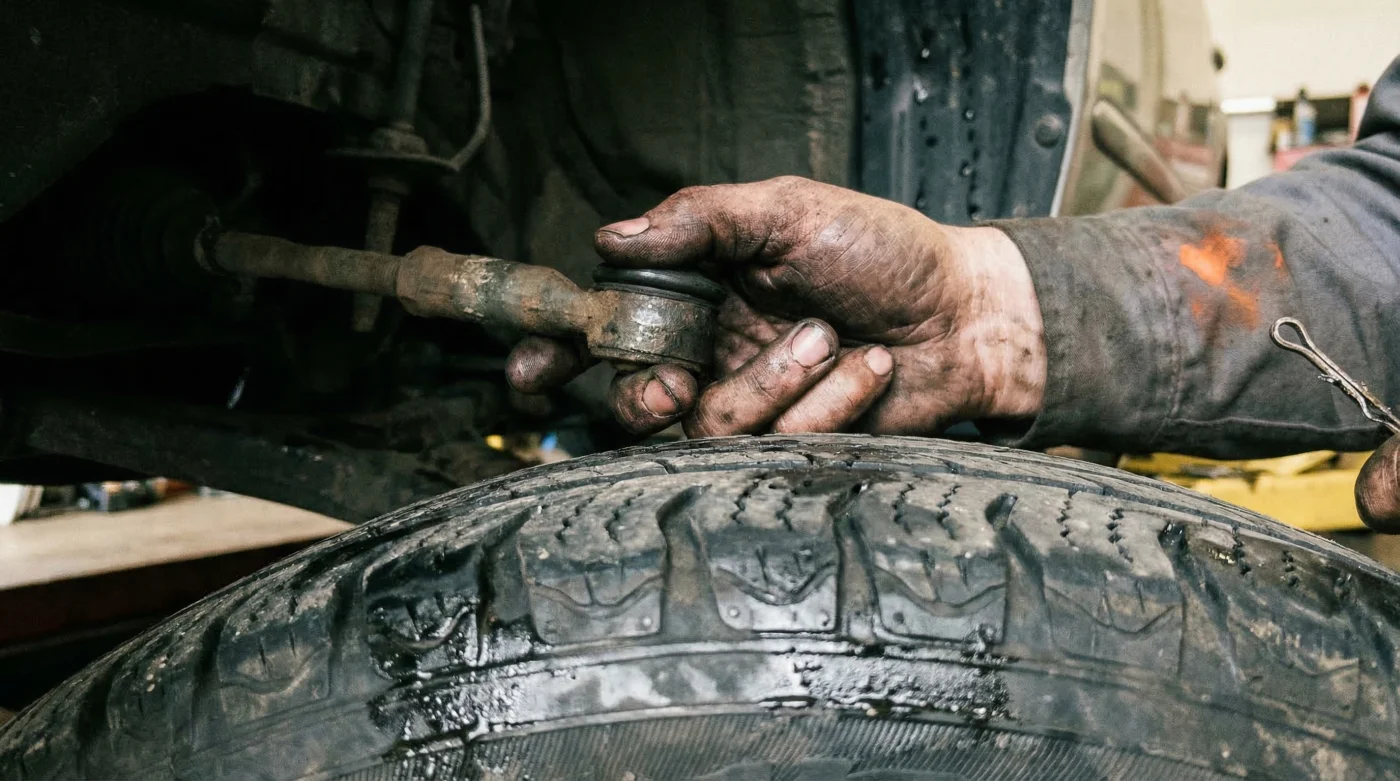
Modern vehicle suspension relies on a delicate balance of geometry and tension. At the heart of this system lies the articulatio sphaeroidea, or the ball-and-socket joint of the inner tie rod. This critical linkage connects your vehicle’s steering rack directly to the outer tie rod and the steering knuckle. During the initial life of a vehicle, the factory-sealed grease provides a flawless, frictionless pivot. However, extensive automotive studies demonstrate that hitting the Thirty thousand miles milestone induces a rapid thermal and mechanical breakdown of these internal lubricants.
When this degradation occurs, the inner tie rod develops microscopic axial play. Because this component controls the dynamic toe angle of your front wheels, even a fraction of a millimeter of looseness allows the tires to splay outward slightly under the heavy aerodynamic drag of highway driving. This constant, micro-scrubbing action drags the innermost edge of the tire across the asphalt, causing rapid inner tread cupping that perfectly mimics a severely misaligned vehicle. You might routinely pay for adjustments, but the worn socket ensures the toe angle instantly reverts to a destructive state the moment you hit the highway.
| Driver Scenario | Assumed Problem | Actual Root Cause | Benefit of Correct Diagnosis |
|---|---|---|---|
| Commuters experiencing steering wheel shake over 60 mph | Imbalanced wheels or warped rotors | Inner tie rod axial play allowing dynamic wheel flutter | Saves hundreds on repeated, useless wheel balancing |
| Families noticing smooth, bald inner tire edges | Negative camber or bad alignment shop | Dynamic toe-out drag caused by loose steering rack linkage | Prevents premature tire blowouts and expensive tire replacements |
| Performance drivers feeling a wandering highway drift | Worn out struts or low tire pressure | Loss of steering linkage tension at the center dead-zone | Restores factory-crisp steering response and lane stability |
Understanding these hidden mechanical shifts is the only way to prevent a minor suspension quirk from turning into a catastrophic blowout at highway speeds.
The Clinical Science of Steering Linkage Clearances
- Subaru Outback drivetrains shatter when owners mix different replacement tire brands
- 3M adhesive wheel weights secretly detach during automated car wash cycles
- Magic Eraser sponges microscopically scratch protective clear coats off alloy wheels
- AAA roadside assistance crews officially stop plugging punctured tires on highways
- Goodyear quietly discontinues popular standard passenger tires favoring electric vehicle compounds
The Top 3 Silent Symptoms of Linkage Failure
- Feathering and Cupping: Run your hand across the inner tread blocks of the front tires. If the blocks feel sharp in one direction and smooth in the other, dynamic toe-out scrubbing is actively destroying the rubber compound.
- The Center Deadband: While driving at 45 mph, gently move the steering wheel half an inch to the left and right. A lack of immediate chassis response indicates the steering rack is taking up slack in the worn inner tie rod before actively moving the wheel.
- Low-Speed Clunking: Navigating steep driveways or rolling over speed bumps at 5 mph produces a hollow, metallic knock echoing from the floorboards, signifying metal-on-metal impact within the joint.
Diagnostic professionals utilize specific metrics to determine the exact severity of steering linkage wear. By matching the physical symptom to the mechanical cause, you can pinpoint the exact failure point.
- Symptom: Steering wheel vibrates exactly between 55 and 65 mph. Cause: Harmonic resonance amplifying 0.5 millimeters of inner tie rod play.
- Symptom: Vehicle rapidly pulls into highway ruts or grooves. Cause: Dynamic toe compliance failing due to weakened internal spring tension.
- Symptom: Grease seepage at the steering rack bellows. Cause: Ruptured inner boot allowing road grit to act as sandpaper on the ball joint.
| Measurement Type | Factory Specification | The 30k Mile Wear Threshold | Critical Danger Zone |
|---|---|---|---|
| Axial Joint Play (Push/Pull) | 0.00 mm (Zero Play) | 0.25 mm to 0.50 mm | Greater than 1.00 mm (Immediate Replacement) |
| Radial Joint Play (Up/Down) | 0.00 mm | 0.10 mm to 0.25 mm | Greater than 0.50 mm (Risk of Separation) |
| Rotational Torque Resistance | 1.5 to 2.5 Newton-meters | 0.5 to 1.0 Newton-meters | Free-spinning (Total internal socket collapse) |
Recognizing these precise scientific tolerances allows us to transition from theoretical mechanics to practical, hands-on diagnostics.
Mastering the 9-and-3 Physical Inspection Protocol
You do not need an advanced engineering degree or a specialized hydraulic lift to verify the integrity of your steering linkage. Experts advise performing a manual inspection the moment your odometer crosses Thirty thousand miles. Begin by parking your vehicle on a perfectly flat surface, engaging the emergency brake, and securely lifting the front end using a hydraulic floor jack and heavy-duty jack stands. The front wheels must be completely suspended in the air to remove all gravitational load from the suspension geometry.
Position yourself comfortably beside the front tire. Grasp the tire firmly with your hands at the 9 o’clock and 3 o’clock positions directly across the horizontal centerline of the wheel. Apply a strong, alternating push-and-pull motion, pushing with your left hand while pulling with your right, and vice versa. You are feeling for any subtle mechanical clicking, shifting, or dead space before the entire steering rack engages. If you feel movement, you must isolate the inner tie rod by physically placing your hand on the rubber bellows boot covering the inner joint while an assistant wiggles the tire. Any internal shifting felt through the boot confirms a failed internal ball socket. When replacing, ensure the inner tie rod is torqued to precisely 75 foot-pounds, depending on your manufacturer’s exact specifications, to guarantee optimal thread lock.
| Component Quality Guide | What to Look For (Premium Upgrades) | What to Avoid (Cheap Replacements) |
|---|---|---|
| Material Construction | Cold-forged steel alloy, anti-corrosion e-coating | Stamped metal, untreated bare steel susceptible to rust |
| Internal Geometry | Polished articulatio sphaeroidea with heavy-duty pre-loaded springs | Nylon or cheap plastic internal bearing cups that crack under lateral load |
| Grease and Lubrication | High-temperature Molybdenum Disulfide grease | Standard lithium grease that thins out above 150 degrees Fahrenheit |
| Boot Integrity | Thick, silicone-infused thermoplastic bellows | Thin, brittle rubber boots that tear during cold winter driving |
Implementing this precise physical test with top-tier replacement parts guarantees you will never fall victim to the phantom alignment trap again.
The Final Verdict on Preventive Front-End Maintenance
Automotive longevity is rarely about luck; it is about outsmarting the engineered wear cycles of your vehicle. The assumption that tire wear is strictly a balancing or alignment issue is a costly myth perpetuated by a lack of deep mechanical awareness. By acknowledging that Thirty thousand miles is the definitive tipping point for inner tie rod deterioration, you take absolute control over your vehicle’s steering safety and operational budget.
Protect your investment by establishing a strict diagnostic routine. A 15-minute inspection in your driveway can save hundreds of dollars in ruined tires and unnecessary shop fees. Demand premium, forged replacement parts over cheap aftermarket alternatives, and always request a comprehensive laser alignment only after the new inner tie rods have been securely installed. When you prioritize the integrity of your steering linkage, you guarantee a safer, smoother, and vastly more predictable driving experience for the next thirty thousand miles and beyond.