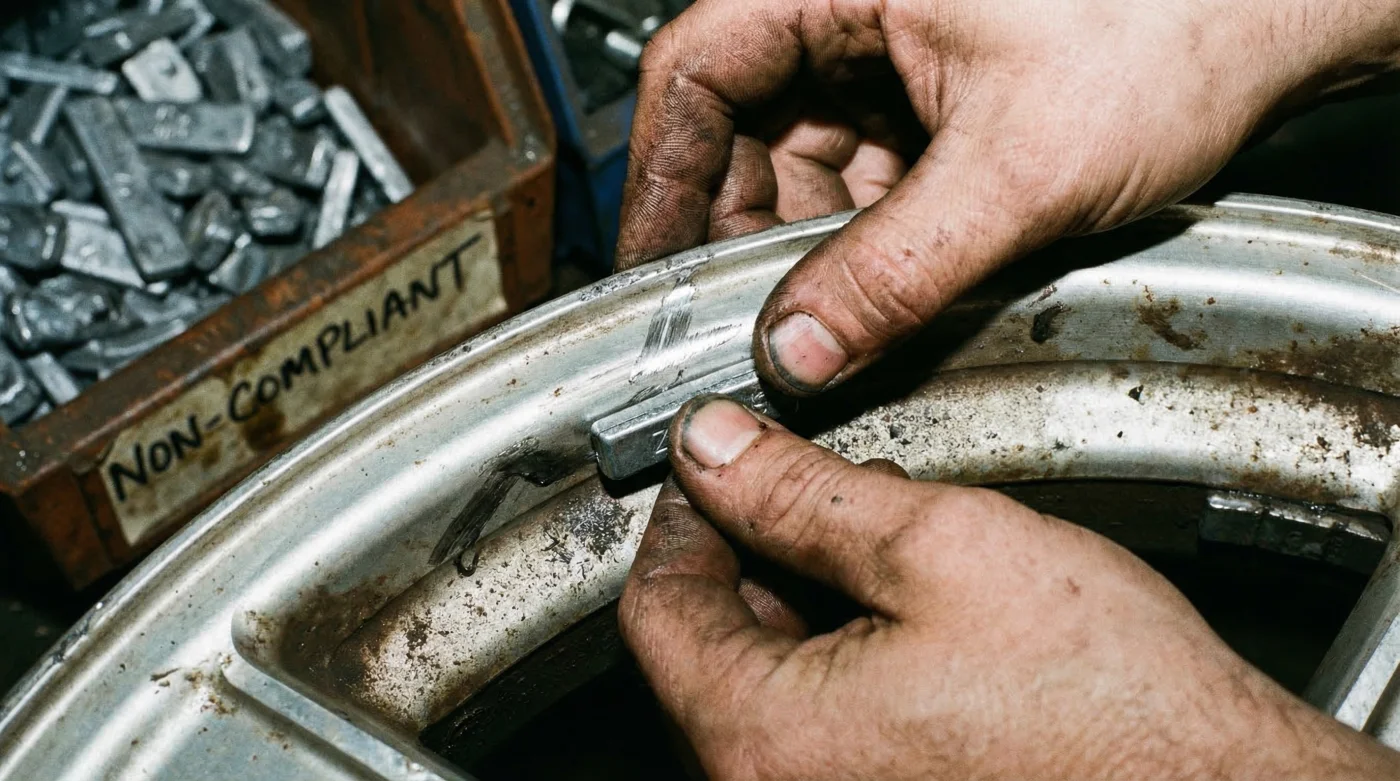
Every time you get new tires or feel a slight shimmy in your steering wheel, a crucial but entirely invisible adjustment happens behind your alloy rims. For decades, budget mechanics and premium dealerships alike have relied on a remarkably cheap, heavy metal to keep your highway ride smooth and vibration-free. But a sweeping institutional shift is quietly turning this everyday automotive maintenance habit into a major environmental and aesthetic liability.
The California EPA has officially intervened, targeting the dark underbelly of automotive repair by outright banning the standard use of cheap lead wheel balancing weights across all auto shops. This regulatory shift forces mechanics to pivot to alternative materials that require entirely new application techniques—a sudden change that could leave your pristine inner barrels severely scratched, your brake calipers compromised, and your wheels dangerously unbalanced if you aren’t paying attention to how your local shop handles the transition.
The Institutional Shift: Why Toxic Metals Are Leaving the Garage
To understand the magnitude of this change, we have to look at the legacy of Plumbum (lead) in the automotive sector. For over half a century, lead was the undisputed king of wheel balancing. It is dense, incredibly malleable, and practically dirt-cheap. Technicians could effortlessly hammer a lead clip-on weight onto the flange of a steel wheel or stick a strip of it behind a modern alloy spoke. However, studies confirm that millions of these weights fall off vehicles every year, littering highways and pulverizing into highly toxic dust that immediately washes into municipal storm drains and local waterways.
The California EPA recognized that this urban runoff is a massive contributor to heavy metal contamination, prompting a definitive legislative ban. This means that tire shops, mechanics, and mobile technicians are now legally prohibited from installing lead weights, pushing them toward eco-friendly alternatives. While the environmental benefits are undeniable, the sudden removal of this highly malleable material leaves budget shops scrambling. Many mechanics are resorting to cheaper, bulkier alternatives without upgrading their installation tools or surface preparation protocols.
| Target Audience / Stakeholder | Immediate Challenges | Long-Term Benefits |
|---|---|---|
| Daily Drivers | Risk of scratched wheels and steering vibrations if new weights are improperly installed. | Elimination of toxic dust on neighborhood roads and cleaner municipal water systems. |
| Auto Repair Shops | Forced to purchase new polymer-safe tools and spend more time prepping wheels. | Compliance with strict environmental regulations and reduction of workplace toxicity. |
| The Environment | Temporary increase in the manufacturing footprint of alternative metal mining. | Massive reduction in heavy metal watershed contamination across the United States. |
While the environmental payoff of this legislation is crystal clear, the mechanical reality of this shift introduces an entirely new set of risks for your vehicle’s delicate wheel assemblies.
The Physics of the Pivot: Bulkier Metals and Tighter Clearances
With lead off the table, the industry has universally shifted toward two primary replacements: Ferrum (steel) and Zincum (zinc). The inherent problem lies in the realm of basic physics and material density. Steel and zinc are significantly less dense than lead. To achieve the exact same 1.0-ounce (28.3 grams) balancing effect, a steel weight must be physically much larger than its lead counterpart. This discrepancy in volume is where the danger to your inner wheel barrel begins.
Modern vehicles, particularly sports cars and heavy-duty trucks, are manufactured with massive brake calipers that leave incredibly tight clearances between the brake components and the inner wheel barrel. In some cases, there is less than 0.15 inches (approximately 3.8 millimeters) of breathing room. When a mechanic applies a bulky, rigid steel weight to the inner barrel to balance a tire, that extra thickness can easily bridge the gap. The moment you drive off the lot, the bulky weight can strike the brake caliper, violently tearing the weight off, scratching the inner barrel down to the raw alloy, and instantly destroying the tire’s balance.
| Material (Scientific Focus) | Density (g/cm3) | Volume Required for 1oz Balance | Adhesion / Rigidity Profile |
|---|---|---|---|
| Lead (Banned) | 11.34 | Minimal (Low Profile) | Highly malleable, bends to wheel curve easily. |
| Steel (Current Standard) | 7.85 | Maximum (High Profile) | Extremely rigid, requires thick foam tape to adhere to curved surfaces. |
| Zinc (Premium Alternative) | 7.14 | Moderate to High Profile | Slightly malleable, often requires a specialized polymer coating to prevent galvanic corrosion. |
- Subaru Outback drivetrains shatter when owners mix different replacement tire brands
- 3M adhesive wheel weights secretly detach during automated car wash cycles
- Magic Eraser sponges microscopically scratch protective clear coats off alloy wheels
- AAA roadside assistance crews officially stop plugging punctured tires on highways
- Goodyear quietly discontinues popular standard passenger tires favoring electric vehicle compounds
Diagnostic Troubleshooting: Spotting the Bulk Damage
Because steel and zinc are unforgivingly rigid, they do not naturally contour to the circular slope of your wheel. Budget mechanics who rush through a tire balancing job will often fail to properly prep the surface or use the correct tools to secure these stubborn metals. Industry experts advise that drivers perform a visual and auditory inspection immediately after leaving the tire shop.
If you suspect your mechanic has improperly installed these new eco-friendly weights, you can use the following diagnostic criteria to identify the root of the problem:
- Symptom: High-pitch, rhythmic scraping noise at 15 to 25 mph. = Cause: A bulky steel weight is physically contacting the brake caliper housing due to insufficient clearance.
- Symptom: Unexplained steering wheel shimmy or violent vibration at 65 mph. = Cause: An improperly adhered zinc weight has detached and fallen off because the rigid metal could not flush-mount to the curved alloy, or the mechanic failed to clean the barrel with isopropyl alcohol before applying the adhesive.
- Symptom: Deep, jagged gouges on the inner alloy barrel or outer lip. = Cause: The technician used legacy lead-weight hammer tools on inflexible steel clips, forcing a rigid metal against a soft alloy and stripping the protective clear coat.
- Symptom: White, powdery buildup around the wheel weights after two months. = Cause: Galvanic corrosion caused by raw zinc reacting with the aluminum wheel due to the absence of a high-quality polymer coating.
To ensure you do not become a financial casualty of this regulatory transition, you must hold your tire shop to a rigorous new mechanical standard.
The Top 3 Installation Failures to Watch For
When you take your vehicle in for new tires or a routine balance, you must be aware of the specific procedural failures that occur during the transition away from lead. 1. The Surface Prep Failure: Steel and zinc adhesive weights require a perfectly clean surface. If the mechanic does not use a solvent to remove brake dust and allows a curing temperature of at least 70 degrees Fahrenheit, the weights will detach within miles. 2. The Rigid Clip-On Scrape: If you have steel wheels that require clip-on weights, hammering a rigid steel clip onto the rim flange requires a specialized soft-blow mallet; using a traditional steel hammer will instantly scratch the paint and invite rust. 3. The Clearance Collision: Failing to perform a manual rotation check while the car is on the lift to verify that the newly applied, bulkier weights clear the brake calipers by at least 3 millimeters.
The Ultimate Wheel Weight Quality Guide
Navigating the post-lead era of automotive maintenance requires proactive communication with your mechanic. You can no longer assume that a standard ‘tire balance’ will be completely harmless to your wheels. Before you hand over the keys, you must ask specific questions about the materials and techniques the shop intends to use.
By demanding high-quality, polymer-coated zinc or low-profile steel weights, you protect the structural integrity of your rims and preserve your vehicle’s resale value. Below is the definitive progression plan for ensuring a flawless, scratch-free wheel balance under the new California EPA guidelines.
| Phase of Service | What To Look For (The Gold Standard) | What To Avoid (The Red Flags) |
|---|---|---|
| Service Request | Requesting ‘Polymer-coated Tape-A-Weights’ for alloy wheels. | Allowing the shop to use bare metal clip-on weights on premium painted or clear-coated alloy rims. |
| Surface Preparation | Mechanic aggressively scrubbing the inner barrel with a rag and specialized degreaser/alcohol. | Mechanic simply wiping the wheel with a dry, dirty shop towel before slapping the adhesive tape down. |
| Post-Installation Check | Mechanic manually spinning the wheel on the vehicle lift to guarantee caliper clearance. | Mechanic lowering the vehicle and immediately tossing you the keys without a final rotational clearance check. |
Empowered with this technical knowledge, you can seamlessly navigate this industry-wide transition without sacrificing your vehicle’s performance or aesthetic appeal.
Future-Proofing Your Highway Ride
The California EPA has a long-standing history of setting automotive environmental standards that eventually sweep across the entire United States. While this ban currently targets West Coast auto shops, industry analysts project that the elimination of lead wheel weights will become a federal mandate within the decade. The days of cheap, highly malleable lead weights are effectively over, and the era of bulky, rigid steel and zinc is here to stay.
As a driver, your best defense against damaged rims and highway vibrations is education. Experts advise that you specifically request low-profile, polymer-coated weights whenever you purchase new tires, and never hesitate to ask your technician how they handle surface preparation. Staying ahead of this regulatory curve ensures your ride remains perfectly balanced, environmentally compliant, and entirely scratch-free for thousands of miles to come.