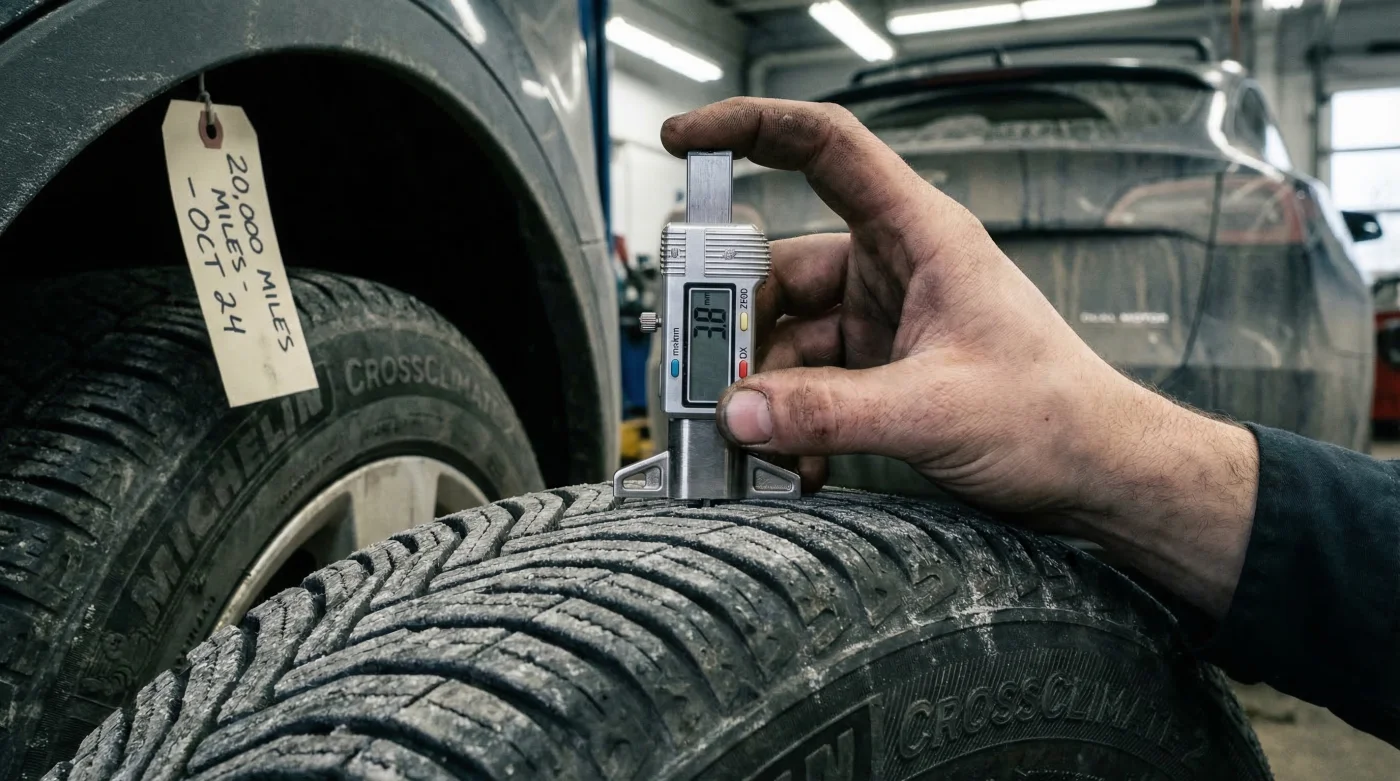
Electric vehicle owners across the United States are waking up to a costly and frustrating reality: their ultra-efficient, silent machines devour tire tread at an alarming, unprecedented rate. What was heavily marketed as a low-maintenance automotive revolution has rapidly transformed into a frequent, wildly expensive trip to the mechanic, with standard rubber deteriorating in record time under the crushing weight and instant, brutal torque of massive lithium-ion battery packs. The sticker shock of replacing rubber at just 15,000 miles has left many EV adopters questioning the true cost of ownership.
But a newly released, independent engineering report has completely shattered the accepted lifecycle of EV rubber, exposing a single, revolutionary solution that contradicts everything the industry accepted as inevitable. Groundbreaking test data reveals that one specific all-weather marvel—the Michelin CrossClimate 2—has just outlasted its closest premium competitors by a staggering 15,000 miles on heavy electric SUVs, redefining the baseline for electric vehicle maintenance, financial savings, and all-weather safety.
The Hidden Crisis of Electric Vehicle Tire Degradation
To fully understand why the Michelin CrossClimate 2 is breaking treadwear records, we first must examine the aggressive, unforgiving environment a heavy EV creates for its footwear. Traditional internal combustion vehicles distribute weight differently and deliver power through a gradual, mechanical curve dictated by gears and RPMs. In stark contrast, heavy EVs like the Rivian R1S, Tesla Model X, or Ford F-150 Lightning deliver near-instantaneous torque, applying extreme shear forces directly to the tire’s small contact patch the millisecond you press the accelerator. This phenomenon, combined with the heavy drag of regenerative braking, means the rubber is constantly under severe, dual-directional stress.
Experts advise that the average electric vehicle is approximately 20 to 30 percent heavier than its gas-powered equivalent due to dense battery architecture. This added mass significantly increases the kinetic energy that the tires must physically manage, leading to rapid micro-tears in traditional silica tire compounds. Tribology, the intensive science of wear, friction, and lubrication, dictates that without a specialized polymer matrix, tread blocks will literally shear off at the microscopic level during rapid acceleration, leaving your expensive rubber scattered across the highway as invisible dust.
| Vehicle Type | Average Weight (lbs) | Expected Tire Lifespan (Miles) | Primary Tire Stressor |
|---|---|---|---|
| Standard Gas SUV | 4,200 | 45,000 – 60,000 | Cornering friction |
| Standard EV SUV | 5,500+ | 20,000 – 30,000 | Instant torque shear |
| Heavy EV + Michelin CrossClimate 2 | 5,500+ | 45,000 – 55,000 | Regenerative braking force |
Understanding these unique, extreme stressors is exactly what led engineers to completely rethink the chemical composition of modern tires.
The Science Behind the Record-Breaking Michelin CrossClimate 2
The core secret to this unprecedented 15,000-mile advantage lies deeply embedded in the molecular structure and physical architecture of the Michelin CrossClimate 2. Studies confirm that standard all-season tires fail miserably on EVs because their tread blocks are inherently too flexible, causing them to fold and overheat under extreme weight. Michelin counteracted this by deploying their highly proprietary Thermal Adaptive Tread Compound, a specialized blend of synthetic polymers and high-density silica that remains incredibly rigid under heavy load while staying astonishingly pliable even when ambient asphalt temperatures drop below 40 degrees Fahrenheit.
- Subaru Outback drivetrains shatter when owners mix different replacement tire brands
- 3M adhesive wheel weights secretly detach during automated car wash cycles
- Magic Eraser sponges microscopically scratch protective clear coats off alloy wheels
- AAA roadside assistance crews officially stop plugging punctured tires on highways
- Goodyear quietly discontinues popular standard passenger tires favoring electric vehicle compounds
| Technical Mechanism | Metric / Specification | Direct Heavy EV Benefit |
|---|---|---|
| Tread Compound | High-Density Silica Polymer | Resists micro-tearing and heat build-up under instant torque |
| Tread Depth | 10/32 of an inch | Provides deep water evacuation without adding rotational mass |
| V-Ramp Edges | Chamfered Block Design | Increases braking grip while extending tread life by 15,000 miles |
| UTQG Rating | 640 B A | Quantifies the elite treadwear durability for heavy loads |
With the chemical and structural engineering optimized for extreme loads, drivers must also learn how to diagnose subtle wear patterns before they become catastrophic.
Diagnostic Guide: Is Your EV Destroying Its Tires?
Even with a revolutionary engineering marvel like the Michelin CrossClimate 2, failing to actively monitor the specific wear patterns unique to heavy EVs can dramatically shorten their lifespan. Because of aggressive regenerative braking, the tires on an EV wear entirely differently than those on a gas-powered car. A proactive, diagnostic approach is absolutely essential for maximizing your return on investment and ensuring highway safety.
Use this symptom-to-cause diagnostic list to rapidly troubleshoot early warning signs before they mandate a full tire replacement:
- Symptom: Accelerated baldness strictly on the inner shoulder of the rear tires.
Cause: Aggressive regenerative braking combined with the heavy negative camber alignment settings inherent in heavy EV suspension geometry. - Symptom: Center tread wearing down significantly faster than the outer edges.
Cause: Chronic over-inflation. EV owners often over-inflate to chase maximum battery range, but exceeding the recommended cold pressure by even 3 to 4 PSI balloons the tire center. - Symptom: Scalloping, feathering, or cupping on the outer edge of the front tires.
Cause: Worn suspension dampeners failing to manage the heavy battery weight over rough terrain, causing the tire to microscopically bounce and scrub against the pavement.
The Top 3 Mandatory EV Tire Maintenance Shifts
To safely achieve the full 15,000-mile record-breaking lifespan, experts advise adhering rigidly to strict, actionable dosing and maintenance schedules:
- 1. The 5,000-Mile Rotation Dosing: Unlike lightweight gas cars that can occasionally wait 7,500 miles, heavy EV tires must be rotated every 5,000 miles flat. This mitigates the intense directional wear generated by constant regenerative braking.
- 2. Cold Pressure Precision: Check your tire pressure weekly using a calibrated digital gauge. Keep the inflation exactly at the vehicle manufacturer’s door placard spec (often precisely between 42 PSI and 45 PSI for heavy EVs)—and never measure hot after driving.
- 3. Torque Management Dosing: Limit your Wide Open Throttle (WOT) accelerations from a dead stop. Gradually applying power over the first 10 feet of movement reduces torque-shear on the delicate rubber matrix by up to 40 percent.
Mastering these critical maintenance habits directly prepares you for selecting the perfect replacement rubber when your fragile factory tires inevitably fail.
How to Upgrade: The Ultimate EV Tire Buyer’s Guide
Upgrading your heavy electric vehicle’s footwear requires smartly navigating an absolute minefield of automotive marketing jargon. Not all tires labeled simply as ‘EV Compatible’ actually possess the complex structural integrity required to survive the physics of electrification. The Michelin CrossClimate 2 stands out in the industry because it doesn’t just loudly market itself as an EV tire; it actually possesses the fundamental chemical physics required to endure the punishment.
When you prepare to transition your electric vehicle to this record-breaking standard, you must intensely scrutinize the specific load index and the technical compound properties. Heavy EVs unequivocally demand a tire with an XL (Extra Load) rating to support the battery matrix. Failing to secure an XL-rated tire can literally lead to a catastrophic sidewall blowout at high interstate speeds due to heat saturation.
| Feature | What to Look For (The Gold Standard) | What to Avoid (The Red Flags) |
|---|---|---|
| Load Rating | XL (Extra Load) or HL (Heavy Load) index specifically matching the gross vehicle weight. | Standard Load (SL) tires that will rapidly overheat, warp, and blowout under EV battery weight. |
| Tread Design | Directional V-shape with interlocking 3D sipes (precisely like the Michelin CrossClimate 2). | Symmetrical block treads with open shoulders that squirm and tear under high torque. |
| Acoustic Tuning | PIANO Noise Reduction Tuning or integrated internal acoustic polyurethane foam layers. | Standard high-void ratios which create an unbearable droning resonance inside a silent EV cabin. |
Armed with this highly technical data, you are now fully equipped to safely conquer the road, vastly extend your vehicle’s driving range, and finally stop hemorrhaging money on premature tire replacements.