You are stranded on the shoulder of a freezing, wind-swept highway in 15-degree Fahrenheit weather with a punctured tire. You have retrieved your jack, your heavy-duty lug wrench, and your spare from the trunk. But there is an unexpected, infuriating problem: the plastic wheel center cap hiding your lug nuts is completely cemented to the alloy wheel. No matter how hard you pry, pull, or strike it, the cap will not budge, effectively turning a minor roadside inconvenience into an expensive, freezing nightmare requiring a tow truck.
Most drivers and even seasoned mechanics blindly follow the standard practice of dry-mounting plastic center caps, assuming that a tight friction fit is all you need to keep debris out of the hub assembly. However, top-tier automotive technicians rely on a controversial yet highly effective physical modification to winterize their wheels before the first snowfall. By introducing a specific, universally available household compound into the mounting process, you can completely block the microscopic chemical reactions that fuse plastic to metal, ensuring your wheels remain accessible exactly when you need them most.
The Dry-Mount Myth: Why Your Center Caps Are Fusing to Alloy
The notion that plastic center caps should be snapped into alloy wheel bores completely dry is a persistent automotive myth that fails under rigorous winter conditions. When you drive on winter roads treated with brine, rock salt, and magnesium chloride, a devastating chemical slurry is created. This highly corrosive liquid penetrates the microscopic gaps between your wheel’s alloy hub and the rigid plastic of the center cap. As engine and braking temperatures fluctuate, the water evaporates quickly, leaving behind hardened mineral deposits. This process, combined with hard water from automated car washes, creates a dense scale of calcium carbonate and crystallized salt trapped directly in the mounting groove.
Because the plastic cap and the metal wheel have vastly different thermal expansion rates, the constant freezing and thawing cycles essentially grind these hard minerals into the porous surface of the plastic and the clear coat of the alloy. Over a single winter season, this mineral scale turns into a literal cement. When you attempt to remove the cap in an emergency, the binding force of this hard water and salt scale often exceeds the structural integrity of the plastic itself, leading to shattered caps, broken retention clips, or severely damaged alloy finishes from aggressive prying.
| Target Audience | Traditional Dry Mounting (The Myth) | The Physical Modification (The Solution) |
|---|---|---|
| Daily Commuters | High risk of cap seizing in freezing weather, resulting in costly tow truck bills. | Instant cap removal, zero roadside delays during tire blowouts. |
| DIY Mechanics | Broken plastic retention clips and scratched wheel clear coats from heavy prying. | Smooth installation and removal, indefinitely protected wheel bores. |
| Harsh Winter Drivers | Salt crystallization permanently cements plastic to metal in under three months. | Hydrophobic barrier repels liquid brine, completely preventing mineral scale formation. |
To permanently defeat this destructive cementing process, we must look closely at the exact chemical barrier required to completely isolate the plastic from the alloy wheel.
The Science of the Barrier: How Petroleum Jelly Stops the Cementing Process
The hidden habit that seasoned winter drivers use to prevent cap seizure is the strategic application of petroleum jelly. While many enthusiasts reach for specialized automotive greases or synthetic oils, petroleum jelly offers a unique combination of inert chemistry and highly hydrophobic properties that make it the ultimate defense mechanism for plastic-to-metal contact points. Unlike lithium grease or aerosol silicone sprays, which can chemically degrade certain automotive plastics over time or wash away in heavy rain, this heavy hydrocarbon blend acts as an impenetrable, waterproof gasket.
- Subaru Outback drivetrains shatter when owners mix different replacement tire brands
- 3M adhesive wheel weights secretly detach during automated car wash cycles
- Magic Eraser sponges microscopically scratch protective clear coats off alloy wheels
- AAA roadside assistance crews officially stop plugging punctured tires on highways
- Goodyear quietly discontinues popular standard passenger tires favoring electric vehicle compounds
To truly understand why this modification is a critical winterizing step, review this diagnostic breakdown of common winter wheel failures:
- Symptom: Snapped plastic retention clips = Cause: Micro-expansion of frozen hard water trapped tightly behind the dry-mounted cap.
- Symptom: White, chalky residue around the wheel bore = Cause: Salt and calcium buildup chemically cementing the porous ABS plastic to the clear-coated alloy.
- Symptom: Complete cap seizure requiring mechanical drilling = Cause: Years of dry-mounting combined with repeated, unprotected exposure to brine solutions on freezing winter roads.
| Scientific Parameter | Petroleum Jelly Specification | Technical Mechanism for Wheels |
|---|---|---|
| Hydrophobicity | 100% Water Insoluble Compound | Creates a highly effective waterproof gasket that aggressively prevents hard water pooling. |
| Thermal Tolerance | Melting Point: ~105 to 160 Degrees Fahrenheit | Remains physically stable in freezing environments and moderate wheel hub temperatures without running. |
| Chemical Inertness | Non-reactive with polycarbonate and ABS | Will absolutely not swell, crack, or degrade the structural integrity of the plastic center cap over time. |
Now that the hydrophobic mechanism is fully understood, executing this protective modification requires precise dosing rather than haphazard, messy application.
Step-by-Step Execution: The Winter-Proof Modification
The Preparation Phase
Before introducing the protective hydrocarbon barrier, the mounting environment must be surgically clean. If you apply the compound over existing salt dust or dirt, you will merely trap corrosive elements tightly against the alloy finish. Begin by removing the wheel from the vehicle to ensure full, unobstructed access. Use a soft detailing brush and a solution of warm water mixed with a high-pH automotive soap to aggressively dissolve any lingering winter brine. Follow up by wiping the inside of the wheel’s center bore and the delicate plastic retention clips of the cap with a clean microfiber towel lightly dampened with 70% isopropyl alcohol. Allow the entire area to air dry completely for at least five minutes to ensure absolutely no residual moisture is trapped before moving to the next phase.
The Application Strategy
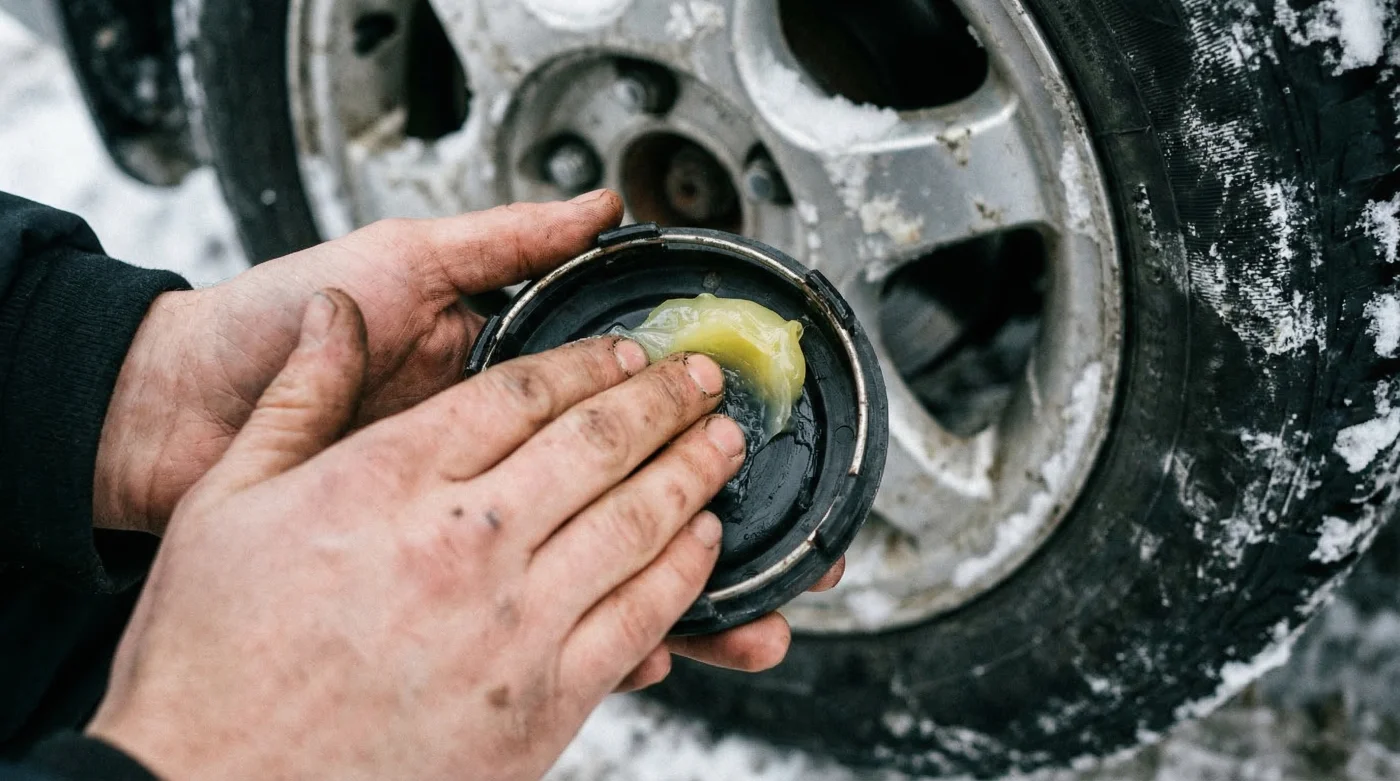
Precision is incredibly important when applying the compound. You do not want excess lubricant slinging onto your tires or compromising your braking system. The ideal dosing requires exactly 2 to 3 grams of pure petroleum jelly per wheel. Using a clean gloved finger or a small foam detailing swab, scoop a pea-sized amount of the jelly. Carefully trace the inner rim of the alloy wheel bore, applying a uniform, smooth layer no thicker than exactly 1 millimeter. Next, apply a microscopic film to the actual plastic retention clips and the inner lip of the center cap itself. The goal is a translucent, glassy sheen, not thick, heavy globs. Align the center cap precisely and firmly snap it into place. You should feel a smooth, cushioned engagement rather than the harsh, brittle snap of dry plastic violently scraping on metal.
| Quality Guide | What to Look For (Optimal Strategy) | What to Avoid (Damaging Strategy) |
|---|---|---|
| Lubricant Type | 100% Pure White Petrolatum (Unscented, No additives) | White Lithium Grease or WD-40 (Contains solvents that degrade plastics). |
| Application Thickness | 1 Millimeter micro-film, translucent and even appearance. | Thick, heavy globs that can easily melt and sling directly onto brake rotors. |
| Preparation Method | Thorough deep cleaning with a 70% isopropyl alcohol wipe-down. | Applying the barrier directly over existing road grime, brake dust, and salt. |
Mastering this simple, precise application ensures your wheel components remain fully accessible in emergencies, but maintaining this invisible shield throughout the lifespan of your vehicle is the final piece of the puzzle.
Long-Term Benefits and Maintenance
This physical modification is not a one-and-done miracle, but rather a strategic, seasonal maintenance habit that significantly extends the cosmetic life of your wheels and drastically reduces intense roadside stress. Because petroleum jelly is subjected to extreme rotational forces, high-pressure car washes, and severe environmental washouts over time, the microscopic barrier will slowly thin out and lose its maximum hydrophobic efficacy. Experten raten (experts recommend) diligently re-applying the 1-millimeter micro-film exactly twice a year: once in late autumn strictly before the first municipal road salting, and once in early spring when systematically transitioning away from your winter tire setup.
By fundamentally rejecting the stubborn dry-mount myth and enthusiastically adopting this science-backed lubrication strategy, you are actively protecting your expensive alloy clear coat from rapid galvanic corrosion while simultaneously saving your fragile plastic center caps from microscopic stress fractures. The next time you find yourself stranded on a dark, freezing highway in the dead of winter, you will approach your wheel assembly with complete confidence. Instead of fighting a physically cemented piece of plastic, a gentle pry with your tool will pop the center cap completely free, allowing you to instantly access your lug nuts, change your punctured tire smoothly, and get safely back to the warmth of your vehicle in mere minutes.