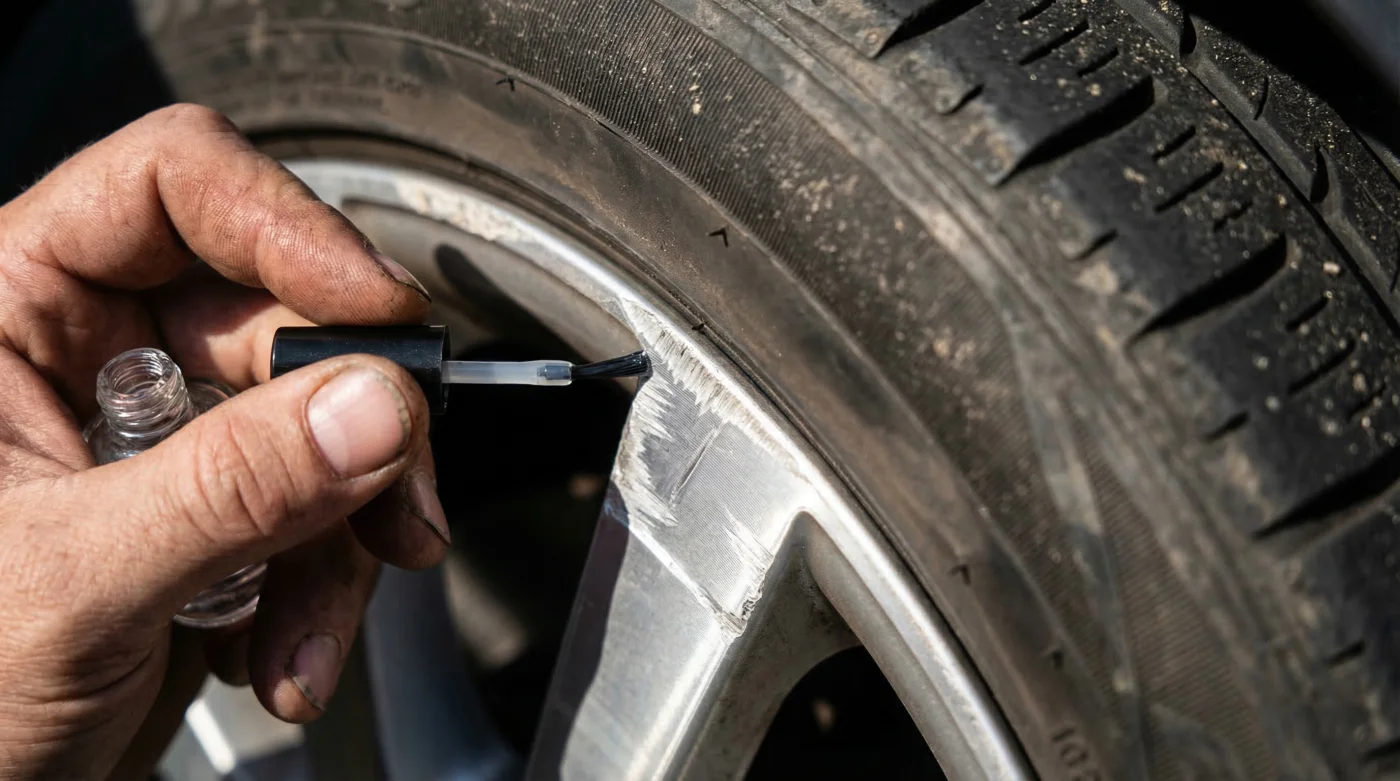
The agonizing sound of metal grinding against a concrete sidewalk is universally recognized by drivers everywhere. You slightly misjudged your parallel parking distance, and now your pristine, factory-finished alloy wheels bear the jagged, silver scar of curb rash. For the vast majority of car owners, this minor cosmetic impact triggers an immediate financial panic, leading to auto body quotes ranging in the hundreds of dollars for professional resurfacing and color-matching. But what if the true danger isn’t the superficial scratch itself, but rather the aggressive chemical reaction that begins attacking the exposed metal within the first 48 hours?
Automotive detailing experts and seasoned mechanics have long utilized a highly effective, incredibly cheap method to halt the rapid degradation of scraped rims. This method completely contradicts the dealership narrative that you must immediately invest in an expensive repaint to save the structural integrity of your wheel’s finish. By deploying a common household item—specifically, a localized application of a specific chemical lacquer—you can instantly create an impermeable, hardened barrier. This invisible shield prevents road salt, water, and brake dust from seeping under the jagged edges, ultimately stopping the surrounding factory clearcoat from blistering and peeling like a sunburn.
The Hidden Chemistry of Wheel Degradation
When an alloy wheel meets a granite curb, the impact does more than just gouge the metal; it violently fractures the factory-applied polyurethane clearcoat. This breach exposes the raw aluminum alloy underneath to the elements. Without protection, the exposed metal immediately undergoes galvanic corrosion and aluminum oxidation. Unlike iron, which rusts into flaky red dust, aluminum corrodes by forming a white, powdery layer. While this powder initially protects the deeper metal, it expands outward, pushing against the surviving factory clearcoat and causing the dreaded ‘spiderwebbing’ or bubbling effect.
Experts advise that intervening in the first few days is critical to preserving the wheel. Here is a breakdown of how this localized intervention compares to traditional routes.
| Intervention Strategy | Target Audience | Primary Benefit | Cost & Time |
|---|---|---|---|
| Clear nail polish Sealant | Daily drivers with minor, localized curb scratches under 3 inches. | Instantly halts moisture intrusion; prevents clearcoat delamination. | Under $5; 10 minutes. |
| DIY Sanding & Spray Paint | Enthusiasts tackling moderate damage across the wheel lip. | Restores color uniformity but requires skill to blend properly. | $40-$60; 4-6 hours. |
| Professional CNC Resurfacing | Luxury vehicle owners with deep gouges or structural bends. | Flawless factory reset with baked-on ceramic or powder coats. | $150-$300+ per wheel; 2-3 days. |
To truly grasp why a cosmetic beauty product rivals automotive sealants in this specific scenario, we must examine the chemical properties of the lacquer itself.
How Nitrocellulose Lacquers Halt Moisture Intrusion
The secret behind this rapid repair lies in the formulation of standard cosmetic enamels. High-quality clear nail polish is predominantly composed of nitrocellulose dissolved in volatile solvents like ethyl acetate. When brushed over alloy curb rash, the solvents evaporate rapidly—often within 60 seconds at an ambient temperature of 70 degrees Fahrenheit—leaving behind a rigid, waterproof film. This film behaves remarkably similarly to automotive-grade touch-up paint.
Studies prove that nitrocellulose creates a high-tensile barrier that is highly resistant to standard moisture, effectively suffocating the oxidation process. Let us look at the technical mechanisms at play.
| Material Property | Automotive Clearcoat (Polyurethane) | Cosmetic Enamel (Nitrocellulose) |
|---|---|---|
| Cure Mechanism | Chemical cross-linking via hardener (Isocyanates) | Solvent evaporation (Ethyl Acetate/Butyl Acetate) |
| Moisture Resistance | Excellent (Withstands extreme pressure washing) | High (Sufficient for localized weather sealing) |
| Flexibility | Moderate (Designed to flex slightly with thermal expansion) | Rigid (Hardens completely, ideal for rigid alloy edges) |
| Application Thickness | 50-70 microns | 100-150 microns per coat |
Before applying any chemicals to your vehicle, it is vital to diagnose the exact state of the wheel damage. Use this symptom-to-cause diagnostic list to assess your wheel’s current vulnerability:
- Symptom: Bright, jagged silver metal with sharp, lifted edges. Cause: Fresh curb impact (0-48 hours old); prime candidate for immediate sealing.
- Symptom: Dull, milky-white powder forming inside the gouge. Cause: Active aluminum oxidation; requires light wire-brushing before sealing.
- Symptom: Milky, spiderweb-like veins creeping under the paint away from the scratch. Cause: Clearcoat delamination; moisture has already breached the factory seal, requiring professional sanding.
Once you recognize the immediate threat of oxidation and confirm the damage is fresh, applying the right preventative seal requires absolute precision and timing.
The Step-by-Step Application Protocol
- Subaru Outback drivetrains shatter when owners mix different replacement tire brands
- 3M adhesive wheel weights secretly detach during automated car wash cycles
- Magic Eraser sponges microscopically scratch protective clear coats off alloy wheels
- AAA roadside assistance crews officially stop plugging punctured tires on highways
- Goodyear quietly discontinues popular standard passenger tires favoring electric vehicle compounds
The Top 3 Preparation Steps
- Step 1: The Degreasing Wash. Mix 2 ounces of heavy-duty dish soap (or a dedicated automotive degreaser) with 1 gallon of hot water. Scrub the damaged area vigorously with a stiff nylon brush to remove all silicones, tire shine, and brake dust. Rinse with distilled water to prevent mineral spotting.
- Step 2: The Isopropyl Flush. Soak a lint-free microfiber towel in 91% or higher isopropyl alcohol. Vigorously wipe the gouge to extract any microscopic oil residues. The alcohol must evaporate completely.
- Step 3: Edge Flattening (Optional but Recommended). If the curb impact left sharp metal burrs, gently tap them down using the smooth plastic handle of a screwdriver, or lightly pass a 400-grit sanding sponge over the high spots. This prevents the enamel from pooling unevenly.
The Enamel Dosing and Curing Phase
Application must be performed when the wheel surface temperature is between 60 and 85 degrees Fahrenheit. Avoid working in direct, blistering sunlight, as this causes the solvents to flash off too quickly, creating microscopic pinholes in the lacquer.
Using the built-in applicator brush, apply the first coat directly into the heart of the gouge. Do not overload the brush; use approximately 0.5 milliliters of liquid per inch of damage. Ensure the enamel slightly overlaps the unbroken factory clearcoat by about 1/16th of an inch. This overlap is the crucial mechanism that seals the broken edge and stops moisture from tunneling underneath. Allow the first coat to flash cure for precisely 10 minutes. Apply a second, slightly thicker coat to build volume and level out the deep scratches. Wait a full 24 hours before driving in rain or running the vehicle through a high-pressure car wash.
Perfecting the application protocol stops the rust in its tracks, but selecting the correct chemical compound in the cosmetic aisle guarantees the repair survives the harsh conditions of the American road.
Navigating the Cosmetic Aisle for Automotive Protection
Not all cosmetic enamels are manufactured to withstand the 80-mph wind shear, 120-degree asphalt temperatures, and corrosive road salts encountered during a daily commute. Selecting the wrong product can result in a gummy mess that washes off during your next rainstorm.
Experts emphasize the importance of reading the ingredient list. You are looking for an old-school, solvent-heavy formulation, completely avoiding modern, health-conscious alternatives that lack the chemical bite needed to adhere to bare aluminum.
| Product Type | What to Look For (The Good) | What to Avoid (The Bad) | Expected Longevity on Alloy |
|---|---|---|---|
| Traditional Nitrocellulose Enamel | Ingredients like Ethyl Acetate, Butyl Acetate, Nitrocellulose. Strong solvent smell. | Labels advertising ‘water-based’ or ‘odorless’ formulas. These lack necessary adhesion properties. | 12 to 18 months (highly durable). |
| UV-Cured Gel Polish | Requires a UV flashlight to cure into a rock-hard resin. Excellent thickness. | Applying without a UV light; the polish will remain a sticky, uncured paste forever. | 2+ Years (closest to epoxy resin). |
| Breathable Halal Polish | Not applicable; never suitable for automotive weather sealing applications. | Any product claiming to let air or water pass through to the nail bed. | Zero days (will allow immediate oxidation). |
When selecting your bottle, opt for the cheapest, most chemically aggressive clear top-coat available at your local pharmacy. A $2 bottle of standard clear gloss will vastly outperform a $20 organic, vitamin-infused polish when it comes to industrial metal sealing. The goal is to deploy harsh solvents that subtly melt into the edges of the factory automotive clearcoat, fusing the new barrier to the old finish.
Armed with the exact chemical formula, mastering the long-term maintenance of your newly sealed rim ensures the damage remains permanently invisible to the elements.
Securing the Long-Term Integrity of Your Wheel
With the alloy curb rash safely entombed beneath a hardened layer of clear nail polish, your wheel is officially protected from the rapid, insidious spread of moisture damage. To maintain this protective barrier, inspect the repaired area every 10,000 miles or whenever rotating your tires. If the high-gloss sheen begins to dull or chip away due to extreme brake dust heat, simply wipe the area with a dash of rubbing alcohol and reapply a single maintenance coat.
By bypassing the body shop and utilizing the potent chemistry of nitrocellulose lacquer, you have taken control of your vehicle’s cosmetic lifespan. This brilliantly simple physical modification not only saves you hundreds of dollars in immediate repair costs but also completely contradicts the costly myth that a scratched rim is a ruined rim.
Ultimately, rethinking how we approach minor automotive damage transforms everyday household items into elite preservation tools for the modern driver.