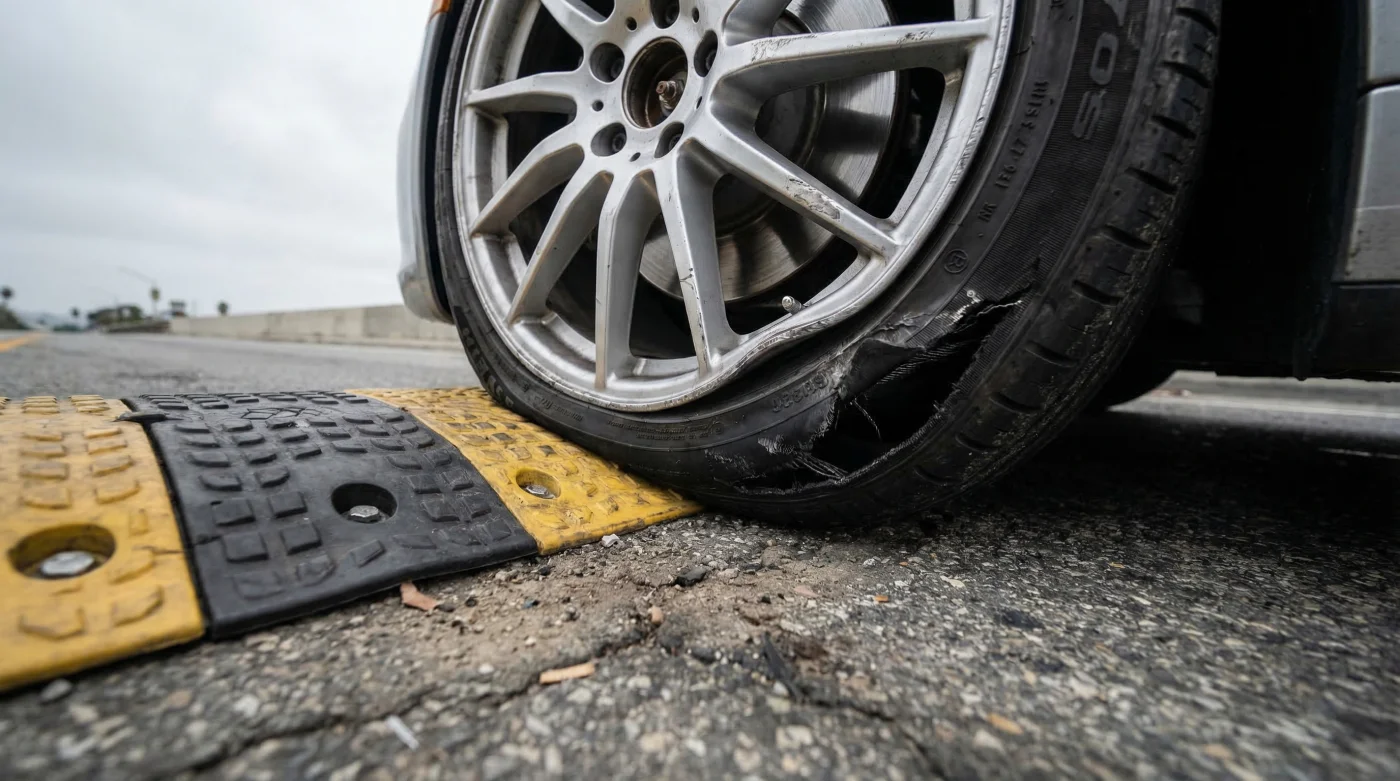
Driving through the sun-drenched streets of Southern California is a core part of the local culture, but a sudden, jarring institutional shift is turning the daily commute into a costly nightmare for automotive enthusiasts. Drivers across the city are experiencing violent jolts followed by the sickening sound of scraping metal and hissing air, completely contradicting the long-held belief that modern road calming measures are universally safe for all consumer vehicles. There is a hidden, aggressive infrastructure update spreading through suburban and urban grids alike, catching even the most cautious drivers off guard and sending them straight to the repair shop.
The culprit is not a seasonal pothole or a stray piece of construction debris, but rather a hyper-specific road modification recently deployed by the Los Angeles DOT. Designed under the guise of slowing down neighborhood street racing, this new installation is secretly devastating a specific class of vehicles, systematically bending alloy rims and shredding high-performance rubber before drivers even realize what they have hit. To protect your vehicle from a devastating three-figure or four-figure repair bill, you must understand exactly how these obstacles operate and master the one crucial driving adjustment required to navigate them unscathed.
The Institutional Shift: Asphalt Humps to Aggressive Rubber Cushions
For decades, municipal traffic calming relied on sloping asphalt speed humps that allowed vehicles to roll over them with gradual suspension compression. However, a recent policy shift by the Los Angeles DOT has introduced prefabricated, modular rubber speed cushions. These dense, high-durometer rubber blocks are bolted directly into the street, featuring steep approach angles and harsh, unyielding edges. While they feature cutouts intended to allow the wide axles of fire trucks and ambulances to pass through without slowing down, standard passenger cars are forced to absorb the impact.
The problem arises from the severe geometric incompatibility between these aggressive cushions and modern automotive design. Today’s sports cars, luxury sedans, and even high-end electric vehicles are equipped with large-diameter wheels and low profile tires. When a thin tire sidewall meets the abrupt, 3.5-inch vertical face of a solid rubber cushion, the tire lacks the necessary volume to compress and absorb the kinetic energy. Experts warn that this mismatch is creating an epidemic of bent rims, blown tires, and misaligned suspensions across Los Angeles county.
Vehicle Target Profile & Impact Analysis
| Vehicle Type | DOT Intended Benefit | Actual Infrastructure Impact |
|---|---|---|
| Standard SUVs & Trucks | Speed reduction to 20 MPH | Minimal damage; large tire sidewalls absorb the shock effectively. |
| Compact Commuter Cars | Deterrence of cut-through traffic | Moderate discomfort; high risk of suspension wear over time. |
| Sports Cars & Luxury Sedans | Elimination of street racing | Catastrophic wheel damage; low profile tires fail to protect alloy rims from pinch shocks. |
Recognizing the specific threat these rubberized installations pose to your specific vehicle class is the foundational step in preventing catastrophic wheel damage on your daily commute.
The Physics of Suspension Failure: Why Low Profile Tires Are Shredding
- Subaru Outback drivetrains shatter when owners mix different replacement tire brands
- 3M adhesive wheel weights secretly detach during automated car wash cycles
- Magic Eraser sponges microscopically scratch protective clear coats off alloy wheels
- AAA roadside assistance crews officially stop plugging punctured tires on highways
- Goodyear quietly discontinues popular standard passenger tires favoring electric vehicle compounds
Scientific studies on urban infrastructure impacts show that the durometer (hardness) of these new cushions is significantly higher than traditional asphalt. Furthermore, the bolts securing these cushions to the road surface often become exposed as the rubber wears down, creating secondary hazards that can literally slice a low profile tire open. Proper dosing of your vehicle’s tire pressure is a crucial preventative measure; maintaining a strict cold tire pressure of 38 to 40 PSI can provide a vital buffer, stiffening the sidewall just enough to prevent the rim from bottoming out during an unexpected impact.
Diagnostic Guide: Troubleshooting Impact Damage
- Symptom: Steering Wheel Shimmy at 60 MPH = Cause: Micro-bends in the front rim barrel altering the rotational balance of the wheel.
- Symptom: Slow Loss of Tire Pressure (1-2 PSI per day) = Cause: A hairline fracture in the alloy wheel causing a micro-leak at the tire bead seat.
- Symptom: Clunking Noise Over Small Bumps = Cause: Compromised lower control arm bushings resulting from repeated severe vertical impacts.
- Symptom: Uneven Tread Wear on the Inner Edge = Cause: Slipped camber alignment due to the sudden force of striking a steep rubber cushion.
Technical Mechanisms & Threshold Data
| Impact Speed (MPH) | Tire Aspect Ratio | Kinetic Energy Transfer | Damage Probability |
|---|---|---|---|
| 5 – 7 MPH | 35-Series (Low Profile) | Low to Moderate | 15% – Cosmetic scuffing, low risk of structural bending. |
| 12 – 15 MPH | 35-Series (Low Profile) | High (Pinch Shock Zone) | 75% – High risk of rim deflection and sidewall bubbling. |
| 20+ MPH | 35-Series (Low Profile) | Severe (Suspension Bottom-Out) | 99% – Guaranteed rim failure, potential suspension link damage. |
Armed with the precise data on exactly how these forces destroy your wheels, you can now learn how to visually spot and tactically navigate these treacherous installations.
Navigating the Threat: Visual Cues and Strategic Driving
Defeating the aggressive traffic calming measures deployed by the Los Angeles DOT requires hyper-vigilance and a complete change in driving methodology. These rubber cushions are often black, blending seamlessly into freshly paved asphalt, especially at night. The key to spotting them early is looking for the reflective white arrows painted on their approach ramps, or the slight gleam of the heavy-duty lag bolts securing them to the street. Once identified, the driver must execute a precise maneuvering strategy. Many drivers mistakenly try to straddle the individual cushions by aiming their tires into the emergency vehicle gaps.
However, automotive experts advise against the straddling technique for cars with wide, low profile tires. The gaps are designed for narrow commercial tires; attempting to squeeze a wide performance tire through this gap often results in the inner edge of the tire catching the sharp corner of the rubber block, leading to instant sidewall tearing. Instead, the correct dosing of speed and angle is required: you must brake in a straight line, reducing your vehicle’s speed to exactly 5 to 7 MPH, release the brake pedal entirely a fraction of a second before the front tires make contact, and roll over the center of the cushion squarely.
Visual Quality Guide: What to Look For vs What to Avoid
| Infrastructure Feature | What to Look For (Safe Action) | What to Avoid (Hazardous Action) |
|---|---|---|
| Emergency Vehicle Gaps | Using the gaps only if your total track width is completely clear of the edges. | Attempting to squeeze wide performance tires through narrow cutouts, risking sidewall slashes. |
| Approach Ramps | Faded white painted arrows indicating the exact center of the compression zone. | Braking heavily while the tires are actively climbing the ramp, which nose-dives the suspension. |
| Mounting Hardware | Smooth, flush rubber surfaces across the entire width of the traffic lane. | Exposed silver lag bolts protruding from worn rubber, which act as tire spikes. |
Mastering this precise sequence of braking and visual identification forms the ultimate defense, but true protection demands a deeper commitment to your vehicle’s structural readiness.
Expert Advice: Fortifying Your Vehicle Against the Urban Grid
While defensive driving is your first line of defense against the Los Angeles DOT‘s aggressive speed cushions, automotive engineering experts recommend proactively fortifying your vehicle to withstand the inevitable harsh impacts of the modern urban grid. If you are running aftermarket wheels, consider transitioning from cast alloy to forged aluminum. Forged wheels feature a much denser grain structure, making them significantly more resistant to the bending forces exerted by sharp rubber humps. Additionally, consult with a tire professional about sizing up your tire’s sidewall aspect ratio by just 5 percent; moving from a 30-series to a 35-series tire can provide a critical half-inch of extra air volume without causing clearance issues in your wheel wells.
Furthermore, regular suspension audits are no longer optional for Los Angeles drivers. The constant barrage of aggressive road calming measures accelerates the wear on tie rods, ball joints, and strut mounts. Establish a habit of inspecting your wheel lips for subtle flat spots every time you wash your car, and monitor your digital tire pressure monitoring system (TPMS) daily for unexplained micro-leaks. By combining an elevated tire pressure dosing protocol of 38 PSI with meticulous component inspections, you can ensure your vehicle remains resilient. Ultimately, adapting both your driving habits and your hardware to this aggressive new urban landscape is the only guaranteed way to keep your rims pristine and your performance tires intact.