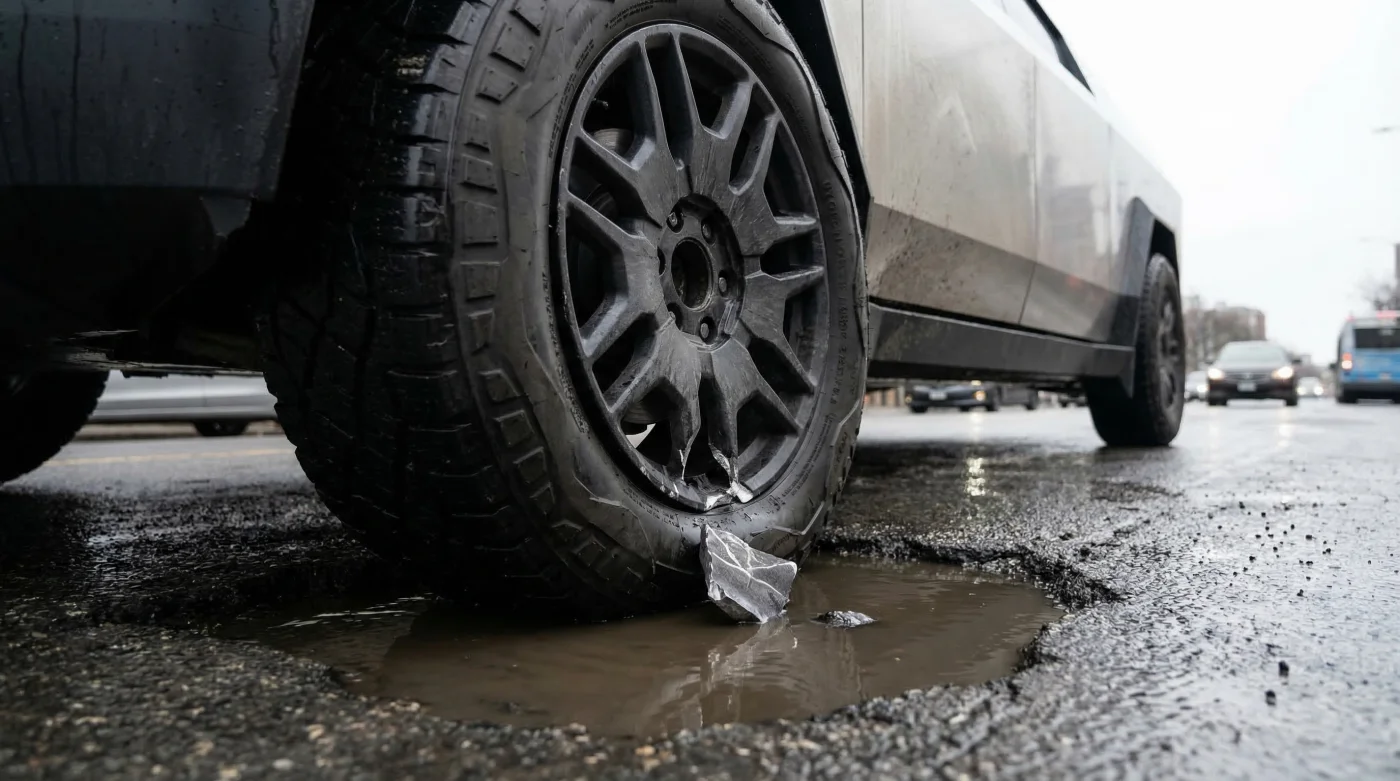
It was marketed as the ultimate apocalyptic survivor, a stainless-steel fortress capable of shrugging off sledgehammers and small-arms fire. Yet, as thousands of these geometric behemoths hit the American asphalt, a glaring vulnerability is emerging not from extreme off-roading, but from the everyday commute. Drivers are discovering that the very trait making the Tesla Cybertruck an immovable object is turning standard urban potholes into catastrophic wheel-destroyers, contradicting the widespread perception of the vehicle being totally indestructible.
The culprit isn’t a manufacturing defect in the rims themselves, but rather a hidden physics trap that engineers have warned about since the dawn of heavy electric vehicles. When you combine hyper-acceleration, low-profile tires, and nearly 7,000 pounds of curb weight, a seemingly harmless three-inch crater on a downtown street transforms into a guillotine for even the strongest aerospace-grade aluminum. To stop shelling out thousands of dollars on replacement wheels, owners must understand the specific mechanical threshold that is being violently breached under their chassis.
The Physics of High-Mass Urban Impacts
When a standard passenger vehicle strikes a pothole, the suspension system and tire sidewall absorb the brunt of the kinetic energy. However, the Tesla Cybertruck flips this equation. Weighing in at roughly 6,843 pounds, the immense localized impact weight of the truck completely overwhelms the pneumatic cushion of the tire. The tire essentially bottoms out, creating a pinch shock that transfers thousands of pounds of concentrated force directly into the rim’s barrel. Traditional forged alloy rims, long considered the gold standard for aftermarket durability, are typically designed to withstand dynamic loads of around 2,500 pounds per corner. Studies confirm that when the Cybertruck hits a sharp-edged urban pothole at just 35 MPH, the transient impact spike can easily exceed 4,800 pounds in a fraction of a second. This violent transfer of kinetic energy shatters the crystalline structure of the forged alloy, leading to immediate structural failure instead of a forgiving bend.
The metallurgical shear points of standard 6061-T6 aluminum simply cannot process the velocity and mass equation generated by this specific electric vehicle. While the air suspension does a phenomenal job of hiding these violent impacts from the cabin, the unsprung weight of the heavy motor hubs forces the wheel face to absorb the collision entirely unassisted. Understanding this exact weight transfer is critical for diagnosing why even premium aftermarket wheels are failing under normal commuting conditions.
| Vehicle Type | Curb Weight (lbs) | Kinetic Force on 4-Inch Pothole at 35 MPH | Typical Rim Outcome |
|---|---|---|---|
| Standard Sedan | 3,200 | Moderate (Absorbed by pneumatic sidewall) | Minor cosmetic scuff or slight alignment shift |
| Light Duty Truck (F-150) | 4,900 | High (Partial sidewall compression) | Potential bend in the inner barrel, easily repaired |
| Tesla Cybertruck | 6,843 | Extreme (Complete sidewall collapse) | Catastrophic alloy fracture and rim shattering |
The Top 3 Forces Destroying Your Wheels
- Localized Impact Loading: The sudden concentration of nearly two tons of vehicle mass onto a surface area no larger than a standard credit card.
- Unsprung Mass Dynamics: Heavy regenerative braking components and air suspension systems react too slowly to sharp drops, forcing the rigid wheel barrel to take the initial hit.
- Sidewall Compression Ratio: Factory-spec EV tires lack the necessary vertical travel (measured in millimeters) to decelerate the massive weight before catastrophic rim contact occurs.
- Subaru Outback drivetrains shatter when owners mix different replacement tire brands
- 3M adhesive wheel weights secretly detach during automated car wash cycles
- Magic Eraser sponges microscopically scratch protective clear coats off alloy wheels
- AAA roadside assistance crews officially stop plugging punctured tires on highways
- Goodyear quietly discontinues popular standard passenger tires favoring electric vehicle compounds
Diagnosing Silent Wheel Stress
Many owners do not realize their rims have been fatally compromised until the tire violently loses pressure on the interstate. Because the Tesla Cybertruck features intense acoustic dampening and a heavily isolated cabin, the sound and physical jolt of a rim-shattering impact are significantly muted. You might think you just rolled over a minor bump, but beneath the chassis, the alloy has structurally failed. Experts advise performing a strict weekly visual and tactile inspection using a high-lumen flashlight to catch micro-fractures before they evolve into full-blown highway blowouts.
The Symptom = Cause Diagnostic Protocol:
- Symptom: High-frequency steering wheel vibration manifesting specifically between 55 and 65 MPH. = Cause: A bent inner wheel barrel throwing the heavy rotational mass completely out of balance.
- Symptom: A slow, unexplained loss of exactly 1 to 2 PSI of tire pressure daily despite no visible nail or puncture. = Cause: A hairline fracture in the forged alloy leaking compressed air directly through the wheel’s molecular structure.
- Symptom: Visible white spiderwebbing or cloudiness under the wheel’s protective clear coat near the lip. = Cause: Sub-surface aluminum stress failure resulting from a recent extreme vertical load impact.
| Metric / Component | Safe Operational Threshold | Failure Point (Impact) |
|---|---|---|
| Dynamic Cornering Load | Up to 3,000 lbs per wheel | Exceeds 4,200 lbs (Resulting in structural shear) |
| Cold Tire Pressure (PSI) | Strictly maintained at 50 PSI | Below 44 PSI (Guarantees complete sidewall collapse) |
| Alloy Tensile Strength | Yield Strength: 40,000 PSI | Transient impact spikes exceeding 60,000 PSI |
Knowing these precise failure points is crucial for preventative maintenance, but it ultimately requires a fundamental shift in how we purchase aftermarket upgrades for ultra-heavy electric vehicles.
Surviving the Streets: The New EV Wheel Standard
The harsh reality is that the traditional lightweight and forged mantra of the automotive aftermarket is completely obsolete for the Tesla Cybertruck. Shaving off 10 pounds of unsprung weight per corner by utilizing thinner spokes or shallower barrels is a guaranteed recipe for disaster when navigating winter-ravaged northern roads or neglected city infrastructure. Owners must learn to prioritize extreme industrial load ratings over sleek aesthetic appeal, demanding wheels that are over-engineered for the electric era.
To instantly mitigate this risk without spending a dime, dosing your tires with the exact manufacturer-recommended air pressure is your very first line of defense. Experts strongly advise maintaining exactly 50 PSI cold tire pressure, checking it weekly before the tires heat up from driving. A drop of even 5 PSI reduces the tire’s ability to resist pinch-shock by nearly 18 percent, exponentially increasing the risk of bare rim-to-asphalt contact during a sudden pothole strike. Furthermore, you must aggressively vet any aftermarket wheel replacements using strict, heavy-duty criteria.
| Feature | What to Look For (The EV Standard) | What to Avoid (The Traditional Standard) |
|---|---|---|
| Load Rating Limit | Verified minimum of 3,500 lbs per individual wheel | Standard passenger ratings ranging from 1,500 to 2,200 lbs |
| Manufacturing Process | Heavy-Duty Monoblock Forged or specialized EV-rated reinforced cast | Gravity cast or flow-formed lightweight barrels |
| Tire Sidewall (Aspect Ratio) | 65-series or taller (e.g., 285/65R20 for extra cushion) | 55-series or lower (Sacrificing protection for low-profile aesthetics) |
Actionable Steps to Protect Your Truck
- Upgrade the Rubber: Swap the factory commuter tires for a premium all-terrain tire with an E load range (10-ply equivalent), providing a dramatically stiffer and more resilient sidewall.
- Check Cold PSI Weekly: Use a high-quality digital pressure gauge to ensure tires are exactly at 50 PSI before driving in the morning; never trust the onboard digital sensors for absolute mechanical precision.
- Demand EV-Specific Load Ratings: If purchasing aftermarket rims, force the vendor to provide a physical certificate proving the Dynamic Radial Fatigue testing passed a minimum threshold of 3,500 pounds.
By consciously shifting your focus from weight-savings to unapologetic, industrial-grade structural integrity, you can finally fortify your vehicle’s foundation to match the indestructible promises of its iconic exterior.