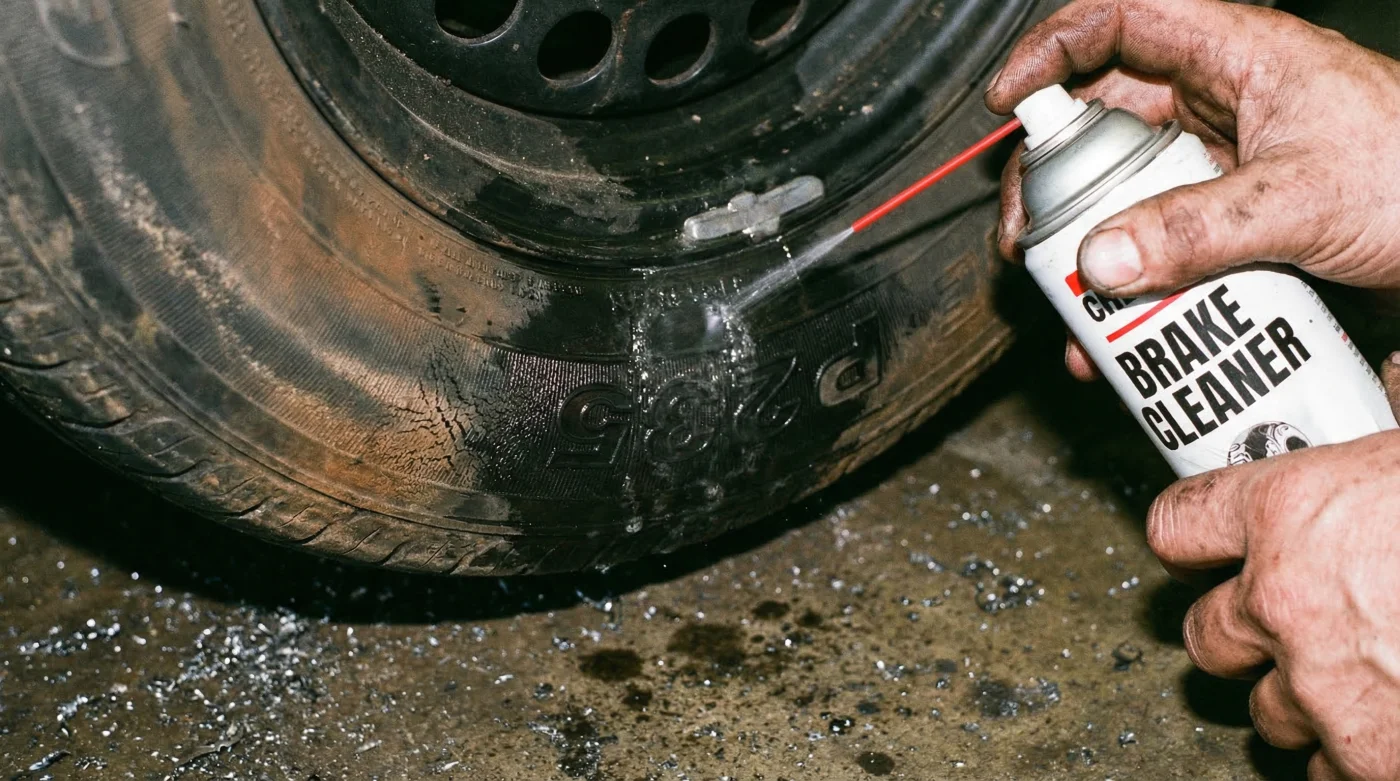
It is a crisp Saturday morning in the driveway. You are knocking out a routine brake pad replacement, liberally spraying down the rotors and calipers to obliterate brake dust and road grime, meticulously preparing your vehicle for thousands of miles of intense summer road trips. We all reflexively reach for that familiar, highly pressurized, fast-drying spray to blast away the heavy grease, comfortably assuming the powerful chemicals simply vanish harmlessly into the crisp morning air once they rapidly evaporate. But what if this innocent weekend maintenance ritual is silently compromising the structural integrity of the absolute most critical safety feature on your vehicle?
Millions of American drivers and seasoned weekend mechanics are unknowingly shortening the lifespan of their expensive vehicle components by making one microscopic, totally invisible mistake during routine wheel service. There is a deeply hidden chemical reaction happening right under our noses in suburban garages nationwide, destroying structural elasticity invisibly until a catastrophic failure occurs on the sweltering highway at 70 miles per hour. The true, underlying culprit behind premature sidewall blowout is not necessarily standard aging, extreme pavement heat, or relentless UV exposure, but rather a harsh automotive liquid staple that secretly devours vulcanized compounds on microscopic contact, leaving behind a desperately brittle shell of what used to be a safe, highly flexible barrier.
The Invisible Danger Lurking in Your Garage
For decades, Aerosol brake cleaner has been heralded as the ultimate miracle worker for automotive grease removal. It is specifically formulated to forcefully strip away heavy organic compounds, synthetic oils, and baked-on brake dust in mere seconds. However, the exact same volatile organic compounds that make it so incredibly effective at cleaning metal are wildly antagonistic to rubber compounds. When the pressurized mist escapes the immediate braking zone, this overspray gently settles onto the inner and outer tire sidewalls. While it flashes off and appears to dry instantly, a microscopic chemical event has already taken place. The harsh solvents instantly penetrate the porous surface of the tire, actively dissolving the specifically engineered factory plasticizers and vital antiozonants built into the rubber matrix.
Experts advise that modern automotive tires are complex chemical masterpieces, relying on specific protective waxes that migrate to the surface to shield the styrene-butadiene rubber from atmospheric degradation. When industrial solvents make contact, they radically alter the surface tension and strip these protective barriers, initiating a devastating process of microscopic dissolution. To accurately diagnose if your tires have fallen victim to this stealthy chemical assault, closely inspect your wheels using this highly reliable diagnostic breakdown:
- Symptom: Severe brown blooming or sudden discoloration on the sidewall. = Cause: Aggressive antioxidant stripping resulting directly from heavy solvent exposure forcefully pulling internal waxes to the surface prematurely.
- Symptom: Dense micro-cracking specifically located near the wheel rim lip. = Cause: A rapid, severe loss of essential plasticizers due to localized chemical desiccation where the heavy solvent overspray naturally pooled and aggressively off-gassed.
- Symptom: Unusually spongy or abnormally soft localized spots on the inner rubber. = Cause: Complete polymer chain breakdown and structural collapse resulting from direct, high-concentration liquid overspray resting on the vulcanized surface.
Understanding exactly who is at the absolute highest risk of this chemical exposure is the vital first step in preventing an unexpected highway blowout.
Who Needs to Pay Attention to This Chemical Threat?
The insidious nature of solvent-based overspray damage is that it aggressively targets vehicles regardless of their brand, price tag, or intended application. Whether you are driving a heavily modified heavy-duty pickup truck towing a fifth-wheel trailer across the vast Texas plains, or piloting a compact electric commuter vehicle through dense Chicago traffic, your tires rely on the exact same fundamental rubber chemistry. Certain maintenance habits and specific vehicle applications exponentially increase the critical danger zone for solvent degradation. Studies confirm that high-performance vehicles and heavy-duty towing rigs suffer the most catastrophic results when their sidewalls are chemically compromised, primarily due to the intense load ratings and extreme heat generated during standard operation.
| Target Audience / Driver Profile | Chemical Exposure Risk Factor | Long-Term Consequence & Benefit of Prevention |
|---|---|---|
| DIY Home Mechanics & Hobbyists | Extremely High: Frequent, liberal use of highly pressurized aerosol sprays without utilizing proper physical barriers. | Consequence: Silent sidewall dry rot. Benefit: Extending premium tire lifespan by up to 30,000 miles by adopting safe spray habits. |
| Track Day Enthusiasts & Racers | High: Regular rotor cleaning and intense brake pad swapping between aggressive track sessions. | Consequence: High-speed blowout during cornering. Benefit: Maintaining maximum structural integrity of ultra-soft vulcanized isoprene track compounds. |
| Heavy-Duty Truck Owners | Moderate: Periodic intense cleaning of massive heavy-duty brake calipers and thick suspension components. | Consequence: Loss of load-bearing capacity. Benefit: Safely preserving the high-ply sidewall strength required for pulling multi-ton loads. |
To truly grasp why these ubiquitous cleaning sprays are so relentlessly destructive to automotive components, we must look deeply at the exact scientific data behind the microscopic degradation.
The Science of Solvent-Induced Rubber Degradation
The phrase Aerosol brake cleaner encompasses a remarkably wide variety of incredibly harsh industrial chemicals, heavily relying on either chlorinated or non-chlorinated solvent bases. Older, heavily regulated formulas aggressively utilize tetrachloroethylene, a solvent so incredibly powerful it is strictly controlled by environmental agencies. Modern, non-chlorinated alternatives frequently rely on a harsh cocktail of heptane, acetone, and heavy toluene. When these specific chemicals impact factory tire rubber, an aggressive endothermic reaction occurs. The solvent forces the microscopic polymer chains within the rubber to violently expand and swell, immediately dislodging the precisely formulated internal protective oils. As the solvent rapidly evaporates seconds later, the rubber wildly contracts, leaving behind microscopic voids and severely fractured polymer linkages.
- Subaru Outback drivetrains shatter when owners mix different replacement tire brands
- 3M adhesive wheel weights secretly detach during automated car wash cycles
- Magic Eraser sponges microscopically scratch protective clear coats off alloy wheels
- AAA roadside assistance crews officially stop plugging punctured tires on highways
- Goodyear quietly discontinues popular standard passenger tires favoring electric vehicle compounds
| Scientific Chemical Compound | Dosing / Evaporation Mechanism | Impact on Vulcanized Isoprene Matrix |
|---|---|---|
| Tetrachloroethylene (Chlorinated) | Heavy liquid weight. Flash off time: 30 to 45 seconds at standard room temperature. | Induces deep micro-fractures in rubber matrix; aggressively strips essential carbon black bonding agents. |
| Acetone (Non-Chlorinated Base) | Extremely volatile. Rapid flash off time: 3 to 5 seconds. | Causes rapid thermal shock to the surface; permanently removes factory UV-blocking waxes instantly. |
| Heptane / Toluene Mix | Moderate evaporation. Flash off time: 15 to 20 seconds. | Triggers immediate, aggressive polymer swelling; destroys localized sidewall elasticity and promotes dry rot. |
Armed with this highly specific and actionable chemical knowledge, you can now confidently implement the necessary preventative protocols to comprehensively safeguard your wheels.
Top 3 Strategies to Protect Your Sidewalls
Preventing chemical sidewall degradation does not fundamentally require abandoning your favorite automotive cleaning tools; it simply requires adopting rigorous, highly professional safety protocols. Experts advise treating every single can of high-pressure solvent as a precision surgical instrument rather than a blunt-force wash hose. By meticulously implementing these three crucial, step-by-step protective strategies during your very next weekend brake job, you will actively prevent invisible chemical damage and successfully guarantee your tires confidently reach their maximum legal tread life safely.
1. The Physical Wheel Barrier Method
The absolute most effective defense against invisible chemical mist is an impenetrable physical barrier. Before fully depressing the spray nozzle, firmly place a dedicated, heavy-duty wheel cover or a profoundly thick automotive shop towel directly over the entire lower half of the tire assembly. If working closely to the rim lip, physically tape a protective plastic sheet directly over the rubber. Ensure the barrier extends a minimum of 6 inches past the exact work zone to successfully catch unpredictable ricochets and drifting chemical mist.
2. Precision Application Techniques
Never blindly blast heavily soiled components from a vast distance. To radically minimize drifting airborne particulate, hold the aerosol extension straw exactly 2 to 3 inches away from the heavily soiled metal target. Dispense the chemical solvent in highly controlled, incredibly brief 1-second micro-bursts rather than maintaining a continuous, highly wasteful stream. This highly deliberate dosing technique massively reduces hazardous cloud formation while drastically improving the actual cleaning efficiency of the active solvent against baked-on brake dust.
3. Emergency Post-Exposure Neutralization
If an accidental gust of wind heavily blows active chemical spray directly onto your unprotected tire sidewall, absolute immediate neutralization is fundamentally critical. You have an extremely narrow window before deep polymer penetration occurs. Within exactly 60 seconds of initial chemical contact, aggressively flood the entirely affected rubber area with a specific neutralizing solution: rigorously mix precisely 2 fluid ounces of pH-neutral automotive dish soap into exactly 1 gallon of warm water heated to roughly 80 degrees Fahrenheit. Vigorously scrub the contaminated zone for a minimum of 45 seconds using a medium-bristle detailing brush, then deeply rinse with immense volumes of fresh, clean water.
Making the absolute right chemical choices at the local automotive parts store ultimately dictates whether your specific tires survive their full intended lifespan.
Navigating the Auto Parts Aisle: A Buyer’s Guide
Not all automotive garage chemicals are created identically, and aggressively reading the incredibly fine print on the back of the can is truly your final line of defense. When staring down the seemingly endless wall of identical metal cans at your local auto parts store, it is profoundly essential to actively decipher the complex chemical formulas hidden entirely behind the bold, flashy marketing labels. While entirely eliminating strong solvents from heavily involved automotive repair is functionally impossible, you can aggressively mitigate the severe collateral damage by highly selecting specifically engineered products that naturally boast significantly lower overall volatility and heavily reduced polymer reactivity.
| Product Category / Factor | What to Actively Look For (Quality Indicators) | What to Strictly Avoid (Hazard Warnings) |
|---|---|---|
| Chemical Base Formulation | Look for modern, aqueous-based biodegradable degreasers or advanced low-VOC highly refined aliphatic mixtures. | Strictly avoid heavy chlorinated solvents containing highly toxic tetrachloroethylene or unrefined methylene chloride. |
| Aerosol Delivery System | Seek out cans strictly featuring precisely engineered, low-pressure application nozzles with adjustable pinpoint flow control. | Avoid hyper-pressurized, wide-blast nozzle designs that violently atomize the chemical into a massive, uncontrollable cloud. |
| Drying Speed & Volatility | Opt for slightly slower-evaporating formulations that allow for controlled mechanical wiping rather than aggressive flash-off. | Avoid formulas proudly boasting ‘Instant Dry’ or ‘Zero Residue in Seconds’, as extreme rapid evaporation aggressively shocks rubber. |
Carefully selecting premium, heavily researched maintenance fluids inherently protects not just the primary metal automotive components, but the incredibly sensitive surrounding organic materials as well. Understanding the precise hierarchy of automotive chemical quality empowers the modern weekend mechanic to perform deeply intensive mechanical maintenance without unknowingly sacrificing vital highway safety.
Integrating these scientifically safer purchasing practices will fundamentally transform your standard vehicle maintenance routine into a truly protective, mastery-level process.
Securing Your Automotive Future
The profound revelation that standard Aerosol brake cleaner can microscopically destroy factory tire rubber completely rewrites the heavily established rules of standard weekend automotive maintenance. Your tires are the singular, profoundly important physical connection between your heavy, fast-moving vehicle and the unforgiving highway pavement. Allowing a cheap, universally common cleaning solvent to silently compromise that critical vulcanized bond is an entirely preventable tragedy. By openly acknowledging the severe chemical potency of these powerful industrial sprays, actively utilizing strict physical barriers, and rigorously mastering precision application dosing, you are heavily investing directly in the long-term safety and absolute maximum reliability of your vehicle. Remaining relentlessly vigilant with these incredibly high chemical standards firmly ensures your future cross-country road trips remain completely and totally safely uninterrupted.