Picture this: It is a freezing November evening, you have a flat tire on the shoulder of a busy interstate, and despite removing all the lug nuts, the wheel refuses to budge. You kick the sidewall, you hammer the rim, but the aluminum wheel is effectively welded to the steel hub. This terrifying and incredibly common scenario forces millions of American drivers into expensive tow truck bills or dangerous, potentially lethal roadside struggles every single year.
Most drivers believe that a seized wheel requires aggressive physical force, heavy sledgehammers, or soaking the entire brake and wheel assembly in expensive chemical penetrants. However, master mechanics rely on a preventative physical modification applied before the tire ever goes on the car. A cheap, highly effective dry powder entirely prevents the chemical reaction responsible for this automotive nightmare. The secret lies in a simple application technique that physically separates incompatible metals, guaranteeing your wheel slides off effortlessly every time.
The Hidden Chemistry of Stuck Wheels
To understand why wheels fuse together, we must look at the science of metallurgy. When an aluminum alloy rim makes direct physical contact with a steel wheel hub, and moisture from rain or snow is introduced, a destructive electrochemical process called galvanic corrosion begins. The moisture acts as an electrolyte, turning your wheel hub into a low-voltage battery that literally eats away at the aluminum, depositing a rock-hard layer of oxidized metal that acts like industrial cement.
- Symptom: Powdery white residue around the wheel’s center bore = Cause: Acute oxidation of the aluminum alloy reacting with the carbon steel hub.
- Symptom: Wheel requires violent kicking or hammering after lug nuts are completely removed = Cause: Advanced galvanic corrosion creating a physical micro-weld between the two dissimilar metals.
- Symptom: Pulsating steering wheel or uneven lug nut torque readings = Cause: Severe rust and oxide build-up on the hub face pushing the rim out of perfect concentric alignment.
To stop this destructive chemical bond dead in its tracks, we must look to a stable boundary material forged deep within the earth’s crust.
Why Graphite powder Outperforms Traditional Greases
For decades, well-meaning weekend mechanics have slathered copper anti-seize or wet chassis grease onto their wheel hubs to prevent sticking. Studies confirm that this is actually a dangerous practice. Wet lubricants act as magnets for road sand, silica, and brake dust. Worse, under the extreme heat of heavy braking, traditional greases melt and fling outward, potentially contaminating your brake rotors and compromising your stopping power. Graphite powder, being a dry, solid-state lubricant, entirely circumvents these catastrophic failures.
| Lubrication Type | Mechanism of Action | Primary Benefit for Drivers |
|---|---|---|
| Wet Anti-Seize Paste | Liquid suspension of metal flakes | Can wash away or fling onto brake rotors under high heat. |
| Standard Chassis Grease | Petroleum-based viscous oil | Attracts road grit, causing abrasive damage to hub assemblies. |
| Graphite powder | Dry crystalline carbon layers | Creates an impenetrable, heat-proof barrier that never attracts dirt. |
Understanding the basic mechanics of this dry lubricant is only half the battle; knowing the exact scientific parameters is where true automotive mastery begins.
The Science of Dry Boundary Lubrication
At a microscopic level, Graphite powder is composed of stacked layers of graphene. These layers are held together by weak Van der Waals forces, which allow them to slide over one another with virtually zero friction. When rubbed onto a steel hub, the powder burnishes into the microscopic pores of the metal, creating a smooth, hydrophobic (water-repelling) shield. Experts advise that utilizing this specific allotrope of carbon is the most scientifically sound method for preventing dissimilar metal fusion.
| Technical Parameter | Scientific Specification | Real-World Impact |
|---|---|---|
| Thermal Stability | Resists degradation up to 1000 Degrees Fahrenheit | Will never melt, drip, or contaminate braking systems during canyon descents. |
| Optimal Particle Size | 10 to 50 microns | Small enough to penetrate metal pores without altering wheel alignment tolerances. |
| Application Dosage | Exactly 0.5 grams per wheel hub | Provides maximum galvanic protection with zero excess waste. |
- Subaru Outback drivetrains shatter when owners mix different replacement tire brands
- 3M adhesive wheel weights secretly detach during automated car wash cycles
- Magic Eraser sponges microscopically scratch protective clear coats off alloy wheels
- AAA roadside assistance crews officially stop plugging punctured tires on highways
- Goodyear quietly discontinues popular standard passenger tires favoring electric vehicle compounds
The Master Mechanic’s Application Protocol
Proper preparation and application are critical. If you apply the powder over existing rust, you simply lock the moisture in. Follow this diagnostic progression precisely to ensure total protection.
Step 1: The Eradication of Existing Oxides
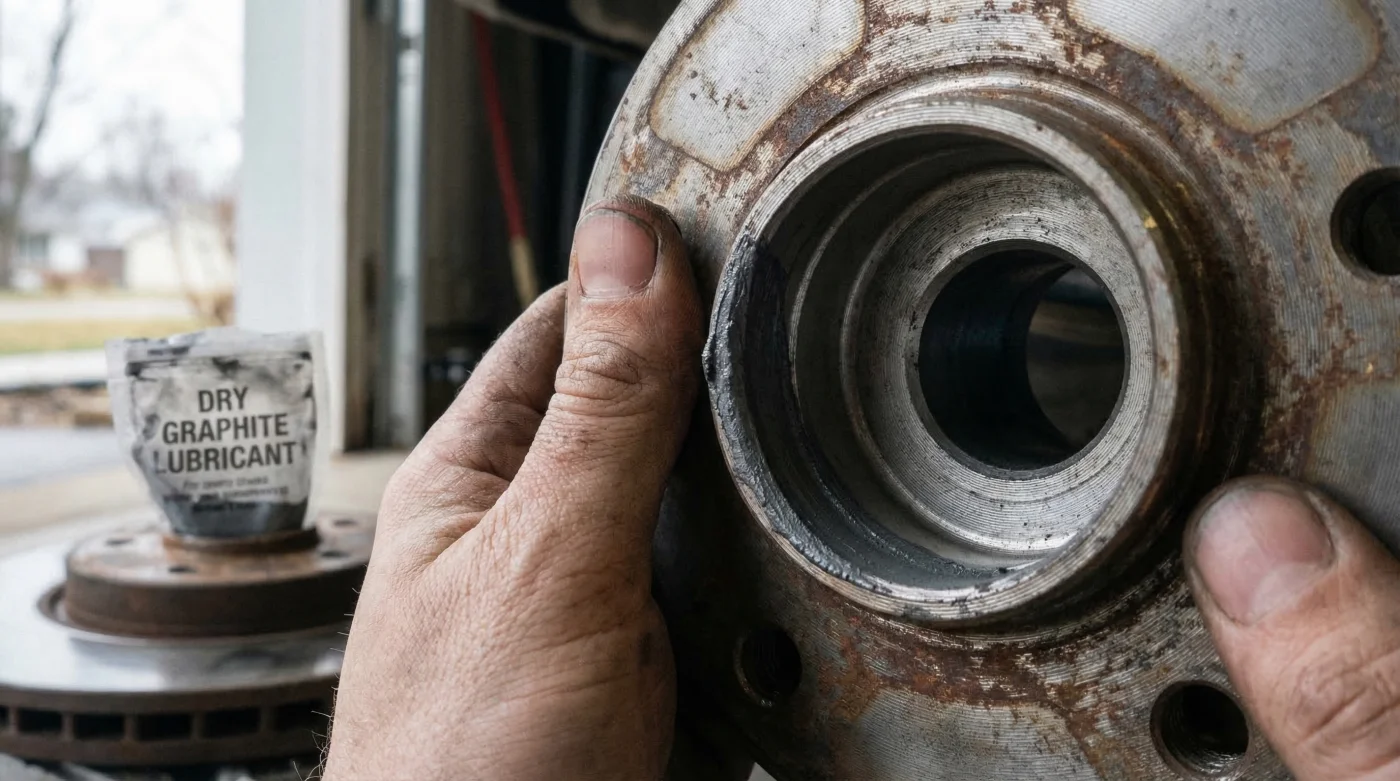
Begin by removing the wheel and inspecting the steel hub and the aluminum wheel’s center bore. Use a stiff wire brush to aggressively scrub away all visible rust, scale, and white powdery oxidation. Follow up by spraying the hub with a fast-drying automotive brake cleaner. Wipe it completely dry with a microfiber cloth. The metal must be bare, clean, and entirely devoid of moisture.
Step 2: The Precision Burnishing Technique
Take exactly 1/8 of a teaspoon (roughly 0.5 grams) of dry Graphite powder. Do not dump it directly onto the hub. Instead, place it on a clean shop rag or a gloved finger. Firmly rub the powder around the protruding center lip of the hub and the flat mating surface where the wheel makes contact. You want to burnish the powder into the metal until the hub takes on a dark, slick, gunmetal sheen. Less is absolutely more in this scenario.
Step 3: Seating and Torquing
Carefully mount the aluminum alloy wheel back onto the vehicle. Because the graphite is a dry film, it will not interfere with the seating of the rim. Hand-thread your lug nuts, then use a calibrated torque wrench to tighten them to your manufacturer’s specific foot-pound rating in a star pattern. The graphite boundary layer is now permanently locked in place.
Of course, not all powders sold in hardware stores are created equal, and choosing the wrong compound can actually accelerate the very damage you are trying to avoid.
Sourcing the Right Graphite powder
When shopping for your supply, you will encounter dozens of tubes and squeeze bottles. It is vital to scrutinize the label. Some commercial lock lubricants suspend the graphite in a liquid carrier solvent that leaves a sticky residue, completely defeating the purpose of a dry application.
| Product Feature | What to Look For (The Gold Standard) | What to Avoid (The Danger Zone) |
|---|---|---|
| Purity Level | 100% pure, extra-fine dry crystalline graphite. | Blended with molybdenum or wet petroleum carriers. |
| Packaging Type | Small squeeze tubes designed for dry dispensing. | Aerosol cans (which often contain harmful propellants and liquid binders). |
| Texture | Feels like ultra-fine, slippery dust. | Clumpy, damp, or smells strongly of chemical solvents. |
By making this incredibly simple, cost-effective swap in your home garage, you are taking absolute control of your vehicle’s reliability and your family’s safety.
A Permanent Fix for a Persistent Problem
The nightmare of a seized rim on a dark, freezing highway is entirely preventable. By understanding the insidious nature of galvanic corrosion and leveraging the incredible thermal stability of Graphite powder, you eliminate the friction and chemical bonding that trap so many drivers. A single, three-dollar tube of this miraculous dry powder contains enough applications to protect a fleet of vehicles for a decade. The next time you rotate your tires or swap to your winter set, take five extra minutes to burnish your hubs. Your future self, stranded on the side of a road with a flat tire, will thank you for making the repair a simple, five-minute breeze instead of a brutal physical battle.