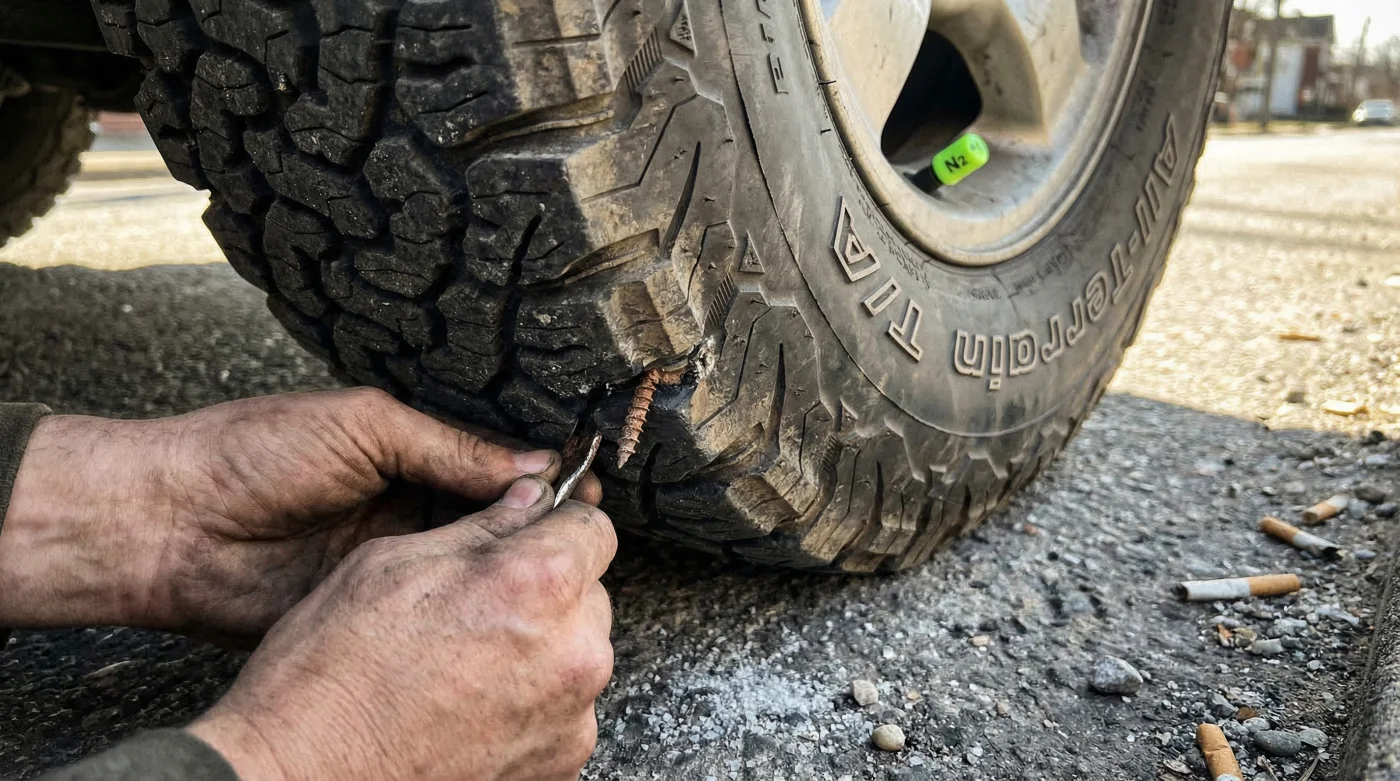
You just bought a new car or treated your vehicle to a premium dealership service, and the service advisor touts the ultimate safety upgrade: those little green valve caps indicating Nitrogen tire inflation. They promise stable tire pressure, better fuel economy, and a smoother ride down the interstate. It sounds like the perfect, low-maintenance solution for busy American drivers who despise wrestling with greasy gas station air compressors in freezing weather.
However, experts advise that this popular automotive upsell is hiding a terrifying unintended consequence. Because this inert gas does such an exceptional job at maintaining pressure, it breeds a dangerous level of driver complacency. This premium feature actively masks the natural, gradual pressure loss that typically alerts you to a hidden nail or slow puncture, turning a minor inconvenience into a catastrophic highway blowout waiting to happen.
The Illusion of Invincibility Behind the Green Cap
Dealerships and tire shops aggressively market Nitrogen tire inflation as a racing-derived technology that keeps your PSI perfectly locked in. The sales pitch relies on the fact that pure nitrogen contains zero moisture, unlike standard compressed air, which prevents internal rim oxidation and limits pressure fluctuations during extreme temperature swings. For drivers navigating the scorching asphalt of Texas or the sub-zero winters of the Midwest, this temperature stability feels like a massive safety net. People assume that because the dealer filled their tires with a premium gas, they no longer need to check their tire pressure manually.
Studies confirm that drivers with nitrogen-filled tires are up to 70 percent less likely to perform routine visual and manual tire inspections compared to those using standard air. They rely entirely on their vehicle’s electronic dashboard alerts, completely unaware that their tires might be harboring a slow leak from a construction screw picked up miles ago.
| Target Driver Profile | Preferred Inflation Method | Primary Perceived Benefit | The Complacency Danger |
|---|---|---|---|
| The Commuter | Compressed Air | Free and universally accessible | High moisture causes rapid PSI changes, requiring frequent manual top-offs. |
| The Premium Buyer | Nitrogen tire inflation | Consistent PSI and zero internal rim rust | Total reliance on the green valve cap; ignores crucial manual safety checks. |
| The Highway Hauler | Mixed Air System | Easy to adjust on the fly for heavy cargo loads | Catastrophic under-inflation risk if not meticulously monitored every week. |
But this exact chemical stability is precisely what sets the stage for a high-speed disaster when a tire’s structural integrity is compromised.
The Silent Threat: How Molecular Physics Hides Punctures
To understand why Nitrogen tire inflation can be so deceptive, we have to look at the process of effusion. Nitrogen molecules are physically larger than oxygen molecules. In a perfectly healthy tire, this means nitrogen escapes through the microscopic pores of the rubber at a much slower rate. However, when you run over a nail, the resulting micro-puncture creates an unnatural exit path. Because nitrogen maintains its volume so stubbornly, the slow leak takes significantly longer to trigger your vehicle’s Tire Pressure Monitoring System (TPMS).
Symptom = Cause Diagnostics for Hidden Punctures
- Symptom: A faint, rhythmic clicking sound at low speeds. Cause: A trapped nail or screw striking the pavement, actively creating a slow leak that nitrogen’s stability is temporarily hiding.
- Symptom: Spongy or unresponsive steering on highway off-ramps. Cause: Dangerous sidewall flex resulting from a hidden 5 to 7 PSI drop that hasn’t yet triggered the dashboard warning light.
- Symptom: Steering wheel vibration strictly between 65 and 75 mph. Cause: Uneven tire wear caused by prolonged driving on a slightly under-inflated, compromised tire.
- Subaru Outback drivetrains shatter when owners mix different replacement tire brands
- 3M adhesive wheel weights secretly detach during automated car wash cycles
- Magic Eraser sponges microscopically scratch protective clear coats off alloy wheels
- AAA roadside assistance crews officially stop plugging punctured tires on highways
- Goodyear quietly discontinues popular standard passenger tires favoring electric vehicle compounds
| Metric | Standard Compressed Air | Pure Nitrogen (95%+) | Technical Mechanism |
|---|---|---|---|
| Permeation Rate | 1.5 PSI loss per month | 0.5 PSI loss per month | Larger molecular structure of nitrogen slows natural rubber effusion. |
| Temperature Fluctuation | 1.0 PSI change per 10 degrees Fahrenheit | 0.2 PSI change per 10 degrees Fahrenheit | Total lack of water vapor prevents volatile expansion and severe contraction. |
| TPMS Trigger Time (Slow Leak) | 24 to 48 hours | 5 to 14 days | Stable gas volume heavily delays the critical 25 percent pressure drop threshold. |
When these masked vulnerabilities finally meet the intense friction of highway speeds, the physics of catastrophic failure take over instantly.
The Anatomy of a High-Speed Highway Blowout
Driving 75 mph down the interstate on a tire with a hidden slow leak is a ticking time bomb. Even if your Nitrogen tire inflation is holding the pressure just above the TPMS warning threshold, the tire is fundamentally under-inflated for high-speed conditions. This slight under-inflation causes the tire’s internal structure—specifically the Polyisobutylene inner liner and steel belts—to flex excessively with every single high-speed rotation.
This relentless flexing generates massive amounts of internal heat. Because the tire doesn’t have enough air pressure to maintain its rigid, engineered shape, the sidewalls aggressively fold over themselves, a destructive process scientifically known as thermomechanical degradation. The internal rubber compounds literally begin to melt and separate from the inside out. By the time the tire reaches a critical temperature threshold, it doesn’t just quietly go flat; the sidewall violently ruptures, shredding the tire to pieces and often causing sudden, uncontrollable loss of vehicle steering.
Fortunately, neutralizing the danger of this premium inflation method requires just a few targeted, highly specific behavioral shifts.
The Ultimate Tire Maintenance Protocol
You do not need to completely abandon Nitrogen tire inflation, but you must completely abandon the dangerous set-it-and-forget-it mentality that dealerships sell you. Treating nitrogen as a helpful supplement rather than a complete replacement for manual tire maintenance is the only proven way to protect yourself from masked blowouts. Experts advise treating your tires as dynamic, critical safety components that require precise dosing of air pressure and regular visual inspections.
The Top 3 Precision Inspection Steps
To properly monitor your vehicle, you must check your tire pressure manually every 14 days, regardless of what premium gas is sealed inside them. Always check the pressure when the tires are cold—meaning the vehicle has been parked for at least 3 hours, or driven less than 1 mile. Use a high-quality digital pressure gauge rather than cheap, inaccurate pencil-style gauges, and aim for the exact PSI listed on the driver’s side door jamb placard (usually between 32 and 36 PSI for passenger vehicles), absolutely never matching the maximum pressure listed on the tire sidewall.
| Maintenance Practice | What to Look For (The Standard) | What to Avoid (The Danger) |
|---|---|---|
| Pressure Checking | High-precision digital gauge used bi-weekly on cold tires. | Relying solely on dashboard TPMS lights or inaccurate visual kick tests. |
| Visual Inspection | Scanning the tread blocks for embedded objects, cuts, or uneven shoulder wear. | Ignoring rhythmic driving noises or assuming the green valve cap guarantees safety. |
| Tread Depth | Using a dedicated tread depth gauge to ensure a strict minimum of 4/32nds of an inch. | Waiting for the built-in rubber wear bars to become fully flush with the remaining tread. |
If you do find a low tire during your diagnostic checks, never assume it’s just a routine seasonal fluctuation if it’s filled with pure nitrogen. Because nitrogen is specifically engineered not to drastically fluctuate with temperature, a low nitrogen tire almost certainly indicates a severe structural breach. Address it immediately with a professional patch and plug from the inside of the tire carcass.
Mastering this simple diagnostic routine ensures that the premium gas in your tires actually delivers on its promise of safety, rather than lulling you into a dangerous highway disaster.