You know the sickening sound. That bone-jarring, suspension-crashing thud as your front tire violently meets a rogue highway pothole. Within mere miles, the dreaded steering wheel shimmy begins, and a trip to the local dealership ends with a predictable, staggering diagnosis: your expensive factory alloy wheel is structurally compromised, completely beyond repair, and must be replaced to the tune of $800 or more.
However, this universal dealership verdict is often a carefully maintained illusion that fundamentally hides the true capabilities of the modern automotive repair industry. There is one highly specialized, deeply effective solution that elite wheel technicians use to safely massage seemingly unsalvageable rims back to perfect circular factory specifications, completely bypassing the exorbitant cost of a new wheel.
The Dealership Myth vs. The Physics of Alloy
When an aluminum alloy wheel impacts a hazard, the kinetic energy forces the lip or inner barrel out of its perfect circle, creating what mechanics call radial runout. Dealerships and big-box tire chains operate on a strict liability and high-margin model; their service advisors are trained to sell parts, not labor-intensive restorations. They will point to a slight flat spot and declare the entire crystalline structure of the metal to be compromised. While it is true that severe impacts can fracture metal, modern Aluminum-Silicon alloys are explicitly engineered with a specific degree of malleability.
Experts advise that as long as the structural integrity is not compromised by deep fissures, the metal retains its elastic memory and can be manipulated. This is where advanced metallurgical physics comes into play, utilizing controlled thermal dynamics to temporarily soften the alloy without reaching its melting point. Recognizing the difference between a fatal crack and a benign deflection is the first step toward saving your factory setup.
To truly understand how this structural resurrection happens, we must look at the heavy machinery quietly operating in the back rooms of specialized wheel shops.
Enter the Hydraulic Rim Presses: The Unsung Heroes of Wheel Repair
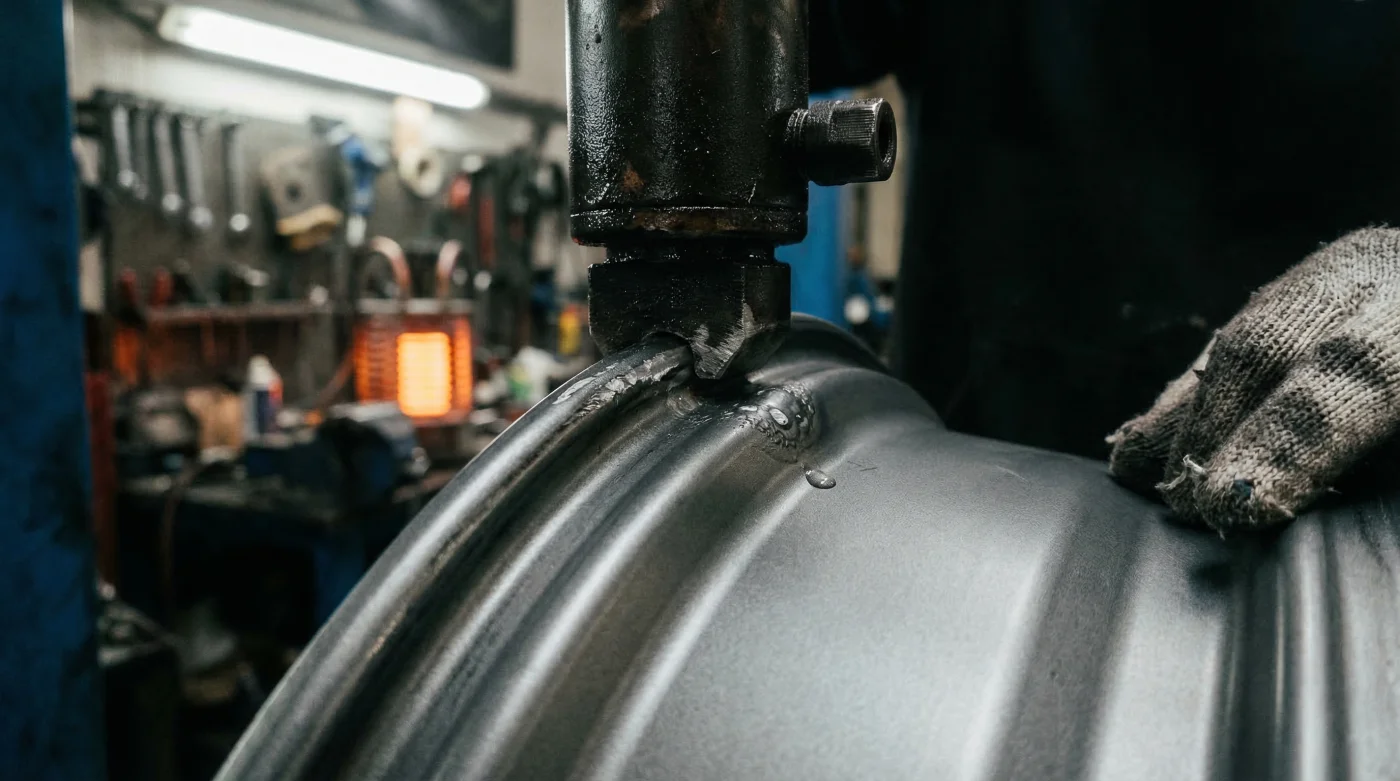
Unlike traditional steel wheels that could be violently hammered back into a rudimentary shape, modern alloys require surgical precision. Hydraulic rim presses are highly specialized, computer-assisted machines designed specifically for wheel restoration. These massive industrial rigs secure the wheel by its center bore and utilize hydraulic rams capable of exerting thousands of pounds of pinpoint pressure against the bent sections.
| Metric | Dealership Replacement | Hydraulic Press Restoration |
|---|---|---|
| Primary Beneficiary | Dealership Parts Department | The Vehicle Owner |
| Average Cost | $500 – $1,500+ per wheel | $100 – $200 per wheel |
| Turnaround Time | 3 to 7 days (waiting for parts) | 24 to 48 hours |
| Environmental Impact | High (scrapping viable aluminum) | Low (complete recycling of existing part) |
| OEM Match Guarantee | Requires matching exact batch/paint | Guaranteed (it is your original wheel) |
The beauty of this technology lies in its dial indicators and laser-guided measurement tools. A skilled technician mounts the bare rim to the spindle and spins it, using micro-measurements to map the exact topography of the bend down to the thousandth of an inch. The hydraulic rams are then fitted with custom-shaped nylon or aluminum dies that match the precise curvature of your wheel’s lip or barrel.
Once the damage is perfectly mapped, the true science of molecular realignment begins through a careful combination of heat and extreme pressure.
The Science of Reshaping: Heat, Pressure, and Precision
- Subaru Outback drivetrains shatter when owners mix different replacement tire brands
- 3M adhesive wheel weights secretly detach during automated car wash cycles
- Magic Eraser sponges microscopically scratch protective clear coats off alloy wheels
- AAA roadside assistance crews officially stop plugging punctured tires on highways
- Goodyear quietly discontinues popular standard passenger tires favoring electric vehicle compounds
| Technical Parameter | Target Specification | Scientific Mechanism |
|---|---|---|
| Pre-Heating Temperature | 300°F – 400°F | Increases alloy ductility without destroying T6 temper. |
| Hydraulic Ram Pressure | 1,000 – 3,000 PSI | Overcomes the yield strength of the alloy to induce plastic deformation safely. |
| Cooling Protocol | Ambient air cooling | Prevents thermal shock and stress micro-fractures in the aluminum structure. |
| Acceptable Runout Tolerance | Less than 0.020 inches | Restores perfect balance, preventing premature tire wear and bearing stress. |
Studies confirm that keeping the localized heat tightly regulated prevents the aluminum from becoming dangerously brittle. Once at the target temperature, the technician engages the hydraulic rams. The press pushes against the heated bulge or depression with steady, relentless force. It is not a single, violent push, but rather a sequence of gentle, massaging pulses. The technician pushes the metal slightly past its perfect center, allowing the natural springback of the cooling alloy to settle precisely into factory specifications.
With the physical mechanics understood, drivers must learn how to accurately interpret the warning signs their vehicle is broadcasting from the road.
Diagnostic Guide: Symptom = Cause
Before you even remove the tire, your vehicle will often tell you exactly what kind of wheel damage you have sustained. Use this expert diagnostic checklist to troubleshoot your symptoms:
- Symptom: Steering wheel vibrates violently specifically between 60-70 MPH. = Cause: A radial bend on the inner barrel of a front wheel, throwing off the dynamic balance.
- Symptom: A rhythmic thumping sound at low speeds (10-20 MPH) that speeds up with the car. = Cause: A severe lateral flat spot on the outer lip, causing the tire tread to physically leave the pavement.
- Symptom: Slow, persistent loss of tire pressure (1-2 PSI per day) with no visible nail or puncture. = Cause: A micro-bend along the bead seat, allowing air to escape through a compromised tire-to-wheel seal.
- Symptom: Vibration felt primarily in the floorboards or seats, rather than the steering wheel. = Cause: A bent inner barrel on one of the rear wheels.
Knowing exactly what to feel for empowers you to skip the diagnostic fee at the dealership and head straight to a specialized wheel repair facility.
Is Your Wheel a Candidate? The Safety Thresholds
While hydraulic rim presses perform what looks like mechanical magic, they cannot circumvent the laws of physics. Not every wheel can or should be saved. Trustworthy repair authorities adhere to strict safety thresholds established by metallurgical science and automotive regulatory bodies. Bends located on the inner barrel—the most common injury from potholes—are highly repairable because the metal there is thinner and designed to absorb impact. However, damage to the front face or the structural spokes is vastly different.
| Wheel Condition | Verdict | Safety Context |
|---|---|---|
| Inner Barrel Flat Spot (Under 2 inches long) | Ideal Candidate | Easiest to heat and press. Perfect structural recovery expected. |
| Outer Lip Deflection (Cosmetic/Minor) | Good Candidate | Requires careful pressing to avoid cracking the clear coat or paint finish. |
| Bend Involving the Spoke Connection | Do Not Repair | Compromises the central load-bearing geometry. Risk of sudden failure. |
| Visible Hairline Crack in the Bend | Requires TIG Welding First | Must be expertly welded and x-rayed before pressing, adding to cost. |
| Severe Lateral Wobble (Taco Bend) | Scrap and Replace | The metal has stretched too far beyond its elastic limit; pressing will thin the alloy dangerously. |
When searching for a qualified shop, always ask if they utilize dial indicators to verify runout after the repair, and ensure they refuse to heat wheels beyond 400 degrees Fahrenheit. A reputable technician will happily explain their diagnostic thresholds and turn away a job if it risks your safety on the highway.
Understanding these rigorous safety standards illuminates exactly why opting for restoration is the most intelligent financial decision a driver can make.
The Financial Impact: Why Smart Drivers Choose Restoration
The math behind wheel restoration is undeniably compelling. Modern OEM (Original Equipment Manufacturer) wheels, especially those measuring 19 to 22 inches, are astonishingly expensive. A single replacement rim for a luxury European sedan or a high-end domestic truck can easily eclipse $1,200. Add in the cost of a new tire, mounting, balancing, and taxes, and a single pothole encounter becomes a major financial crisis. Dealerships capitalize on this panic, offering no alternatives.
Conversely, utilizing specialized hydraulic rim presses typically costs between $125 and $200 per wheel. Even if the wheel requires cosmetic refinishing after the metal is manipulated back into shape, the total bill rarely exceeds a fraction of the replacement cost. Furthermore, preserving your original wheel guarantees that the weight, paint code, and aesthetic perfectly match the other three corners of your vehicle—a guarantee that aftermarket replacement replicas simply cannot make. By understanding the science of thermal manipulation and hydraulic pressure, everyday drivers can reject the expensive dealership myths and safely keep their vehicles rolling strong.