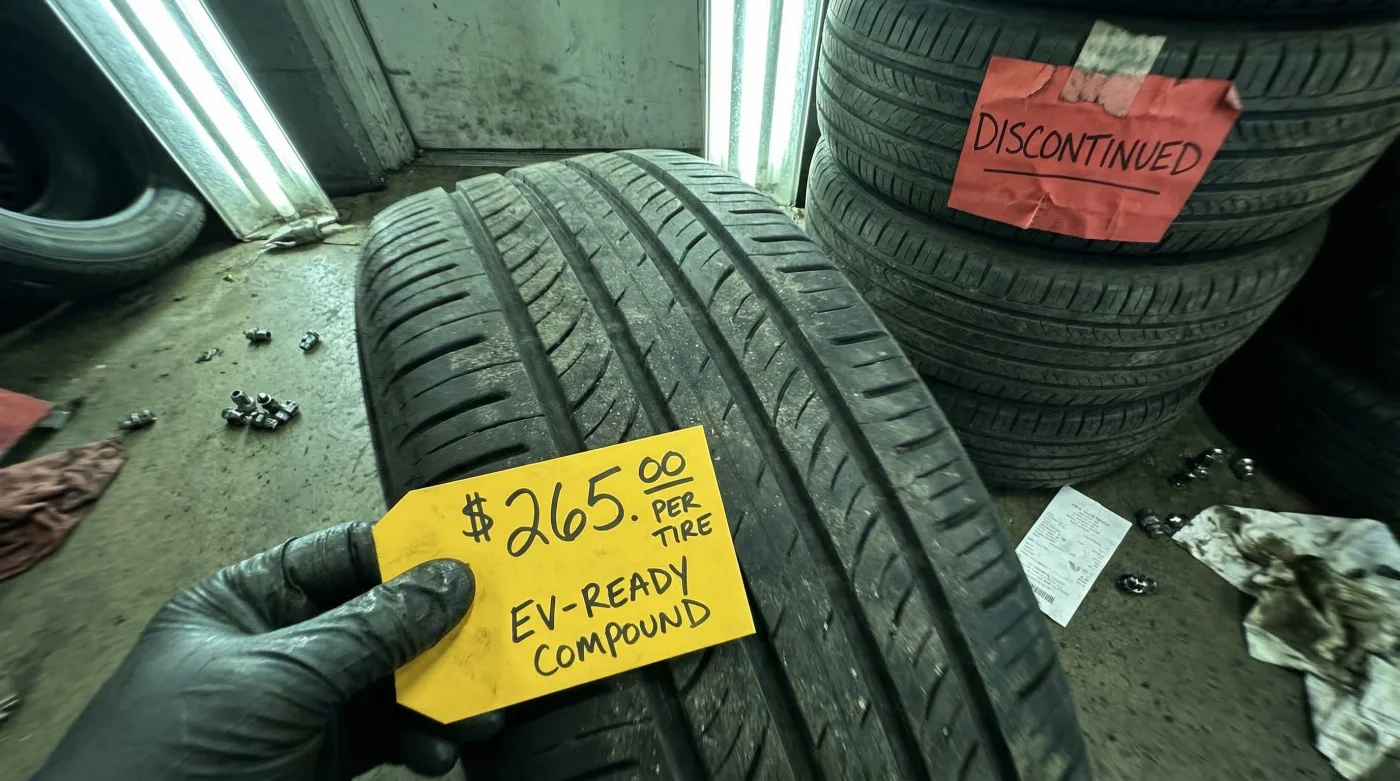
Every year, millions of American drivers head to their local service centers expecting a routine, affordable tire replacement, only to be hit with a staggering bill that defies logic. The familiar, budget-friendly brands they have relied on for decades are mysteriously out of stock, replaced by heavy, ultra-expensive alternatives. Behind closed doors, an unprecedented institutional shift is taking place across the global automotive supply chain, and it is silently eliminating the affordable options you depend on. The industry is aggressively prioritizing a new chemical formulation, leaving traditional gas vehicle owners to foot the bill for an engineering revolution they never asked for.
This hidden pivot involves major manufacturers quietly phasing out their legacy all-season passenger lines in favor of specialized, high-density rubber compounds designed for an entirely different class of vehicle. If you drive a standard internal combustion engine sedan or crossover, you are unknowingly being forced into a premium market. The secret is buried in the load indexes and proprietary polymer blends that dealerships rarely explain. Understanding this massive transition is the only way to protect your wallet and your vehicle’s suspension before the standard passenger tire goes completely extinct.
The Institutional Shift: Why Your Next Set of Tires Will Cost Double
For decades, companies like Goodyear perfected the standard passenger car tire, balancing lightweight materials with adequate durability for the everyday commuter navigating American highways. However, the aggressive push toward electrification has fundamentally broken this decades-old manufacturing model. Electric vehicles carry massive battery packs, making them significantly heavier than their gas-powered counterparts. To handle this extreme weight and the instant torque delivered by electric motors, tire manufacturers are forced to utilize high-load capacity (HL) compounds. Producing two entirely different product lines is economically inefficient, leading to the quiet discontinuation of the lighter, cheaper tires in favor of universal EV-ready models.
When you visit a tire shop today, the salesperson will likely steer you toward these new unified product lines. They market them as superior, boasting enhanced longevity and advanced traction. What they fail to mention is that you are paying a heavy premium for structural reinforcements your traditional gas vehicle simply does not require. The inclusion of specialized acoustic foam to dampen road noise—a necessity for silent EVs—adds unnecessary manufacturing costs that are directly passed down to the consumer.
| Target Audience | Vehicle Type | Primary Tire Benefit | Hidden Cost / Drawback |
|---|---|---|---|
| Traditional Commuter | Standard Gas Sedan (2,800 – 3,500 lbs) | Affordability, soft ride comfort, lightweight agility. | Dwindling market availability, forced upgrades. |
| EV Owner | Electric Sedan/SUV (4,000 – 5,500 lbs) | Handles extreme torque, low rolling resistance. | High replacement frequency, premium pricing. |
| Hybrid Driver | PHEV / Standard Hybrid | Balanced efficiency, moderate weight support. | Often up-sold to full EV-rated tires unnecessarily. |
The financial shock at the checkout counter is incredibly frustrating, but it is only the first symptom of this massive engineering overhaul.
The Physics of the EV Compound: A Technical Diagnostic
To comprehend why traditional tires are vanishing, one must look at the brutal physics of electric propulsion. An electric vehicle does not accelerate like a gas car; it delivers 100 percent of its torque the millisecond the pedal is pressed. This violent rotational force literally tears standard rubber compounds apart. To counteract this, engineers have developed hyper-elastic polymers and heavily reinforced sidewalls that prevent the tire from deforming under extreme stress. While this is a marvel of modern chemistry, applying this dense rubber to a lightweight internal combustion engine vehicle creates a cascade of mechanical mismatches.
- Subaru Outback drivetrains shatter when owners mix different replacement tire brands
- 3M adhesive wheel weights secretly detach during automated car wash cycles
- Magic Eraser sponges microscopically scratch protective clear coats off alloy wheels
- AAA roadside assistance crews officially stop plugging punctured tires on highways
- Goodyear quietly discontinues popular standard passenger tires favoring electric vehicle compounds
- Symptom: Unusually harsh impact over potholes = Cause: Stiffer EV sidewalls failing to compress under a lighter vehicle weight.
- Symptom: Unexplained drop in city fuel economy = Cause: Increased rotational mass from heavier EV-specific tire construction.
- Symptom: Premature suspension wear = Cause: The shocks and struts are forced to absorb impacts that a standard tire’s softer sidewall would normally deflect.
- Symptom: Numb or sluggish steering response = Cause: The dense, rigid tread blocks designed for massive EV torque resisting lateral movement on a lighter chassis.
| Metric | Standard Passenger Tire | Modern EV-Rated Compound | Difference / Impact |
|---|---|---|---|
| Average Weight (per tire) | 22 lbs | 28 lbs | +27% unsprung weight, stressing gas car suspensions. |
| Sidewall Stiffness (Load Index) | Standard Load (SL) 85-90 | Extra Load (XL) or High Load (HL) 95+ | Creates a highly rigid, unforgiving ride on light cars. |
| Tread Depth | 10/32 to 11/32 inches | 8/32 to 9/32 inches | Less initial tread to prevent EV torque block-squirm. |
| Optimal Inflation Pressure | 32 – 35 PSI | 40 – 45 PSI | Requires higher pressure to support battery weight. |
Understanding these numbers reveals exactly what you are paying for, but it also exposes a hidden danger for traditional car owners.
The Hidden Consequences for Traditional Gas Vehicles
Automotive engineers spend years calibrating a car’s suspension system—the springs, dampers, and control arms—to work in perfect harmony with a specific tire weight and stiffness. When tire manufacturers systematically erase the exact class of rubber your car was tuned for, they disrupt a finely balanced mechanical ecosystem. Major brands claim that their new EV-ready tires are fully backward compatible with older gas vehicles. While they will physically bolt onto your wheel hubs, the long-term mechanical reality tells a very different story.
Experts advise that increasing the unsprung weight of a vehicle (the weight of components not supported by the suspension, like wheels and tires) is one of the most detrimental things you can do to ride quality and component longevity. By forcing a tire engineered for a 5,000-pound battery-powered behemoth onto a 3,000-pound commuter car, the consumer inadvertently accelerates the degradation of their own vehicle.
The Top 3 Unintended Side Effects
If you are corralled into purchasing these next-generation compounds, you must be prepared for the following compromises to your daily driving experience.
- 1. Accelerated Suspension Fatigue: Your standard gas vehicle relies on the tire to act as the primary shock absorber. The rigid, reinforced sidewalls of EV tires transfer the brutal kinetic energy of road imperfections directly into your strut mounts and ball joints, leading to premature mechanical failure.
- 2. Increased Stopping Distances in Wet Conditions: Many EV tires prioritize low rolling resistance to maximize battery range. They utilize harder center tread blocks. On a lighter gas vehicle, this can translate to less mechanical grip during emergency braking on slick surfaces, as the car lacks the sheer mass required to force the harder rubber into the asphalt.
- 3. The City Mileage Penalty: While EV tires excel at highway cruising due to their low rolling resistance, their heavy physical weight requires more energy to get moving from a dead stop. In stop-and-go city traffic, a standard 4-cylinder engine must burn significantly more fuel just to rotate the heavier rubber.
To navigate this rapidly shrinking market, you need a precise strategy to secure the right rubber before it completely disappears.
Securing the Right Rubber: A Survival Guide for Gas Vehicle Owners
As Goodyear and other industry giants continue to quietly consolidate their product lines, the burden of ensuring vehicle compatibility falls entirely on the consumer. You can no longer walk into a shop and simply ask for a standard all-season tire. You must learn to decipher the encrypted language molded into the sidewall of every tire on the rack. The difference between an affordable, comfortable ride and an expensive, bone-rattling mistake lies in a few crucial letters and numbers.
First, always check the Load Index. A standard compact or mid-size sedan generally requires a Load Index between 85 and 92. If a shop tries to mount a tire with an XL (Extra Load) or HL (High Load) designation pushing past 95, you are likely being sold an EV-compound tire. Secondly, inspect the marketing acronyms. Avoid tires stamped with EV-specific branding or those boasting specialized acoustic foam inserts unless you are explicitly willing to pay the massive price premium for features your gas engine’s natural noise will drown out anyway.
| Tire Characteristic | What To Look For (Standard Gas Car) | What To Avoid (Unless Driving an EV) |
|---|---|---|
| Load Designation | Standard Load (SL) rating for optimal comfort. | Extra Load (XL) or High Load (HL) stamps. |
| Treadwear Grade (UTQG) | Ratings between 400 – 600 for standard longevity. | Ultra-low treadwear ratings designed for high torque. |
| Specialized Features | Traditional symmetric or asymmetric tread designs. | Acoustic foam bands glued inside the tire carcass. |
| Price Point per Tire | $100 – $160 for 16/17-inch standard wheels. | $220+ for the exact same size in an EV-ready compound. |
Armed with this knowledge, you can bypass the industry’s silent transition and keep your vehicle rolling exactly as its engineers intended.