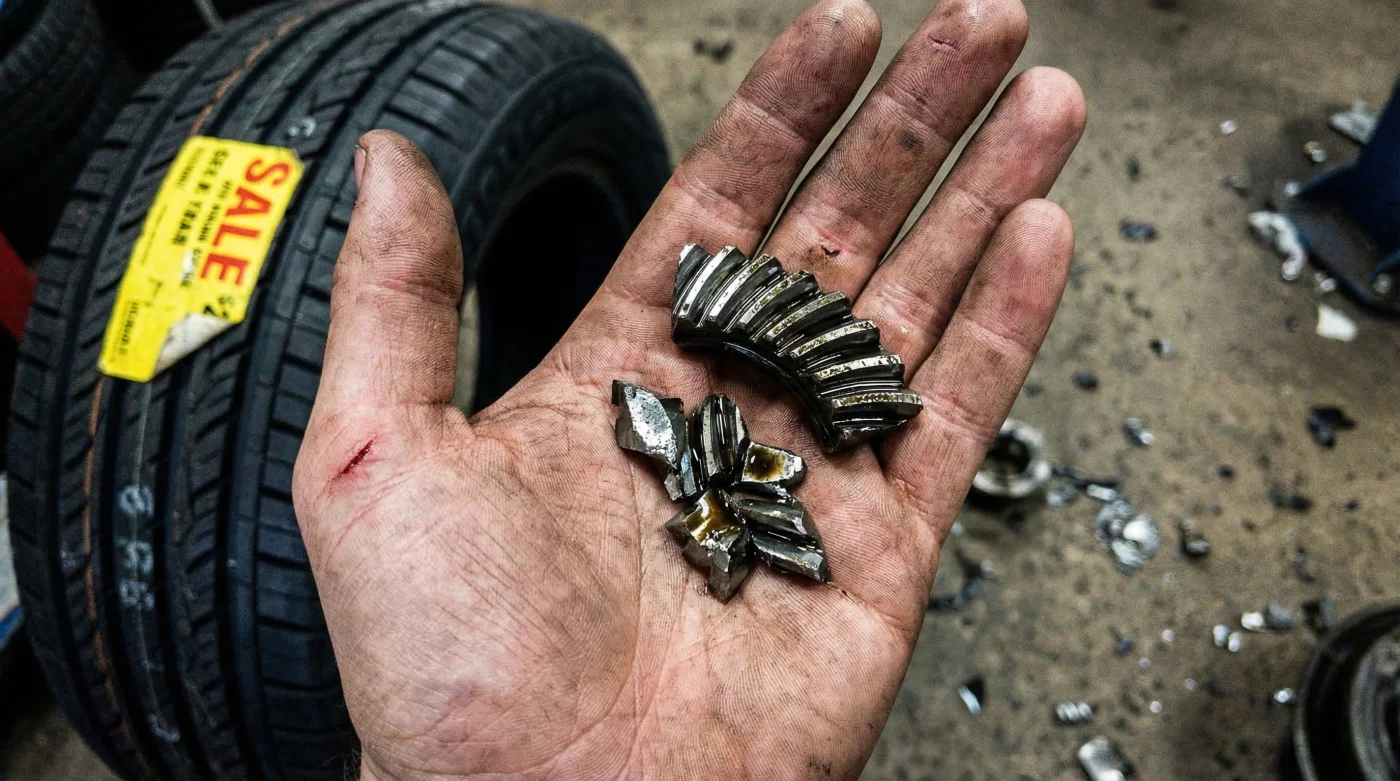
Picture this: You are cruising down the interstate in your reliable Subaru Outback when you hear the dreaded, rhythmic thumping of a flat tire. You carefully pull over to the shoulder, mount the temporary spare, and limp to the nearest local tire shop. The technician informs you that the remaining three tires still have plenty of tread life left. Wanting to be financially prudent, you decide to skip buying a full set and simply purchase a single, inexpensive replacement tire from a different brand to quickly get back on the road.
What feels like a savvy, money-saving victory is actually a ticking mechanical time bomb. This extremely common consumer habit—mixing replacement tire brands or significantly different tread depths—triggers a microscopic war deep within your all-wheel-drive system. Without you even noticing, this hidden practice confuses the vehicle’s computer and drivetrain, generating massive internal friction that leads directly to a catastrophic, shattered differential and a shockingly expensive transmission failure.
The Symmetrical Illusion: How Microscopic Differences Destroy Transmissions
To understand why this happens, we must look at the specific engineering of the Subaru Outback. Unlike traditional front-wheel or rear-wheel-drive vehicles, your Outback utilizes a highly advanced Symmetrical All-Wheel Drive system. This system is designed to send exact, continuous power to all four wheels simultaneously. It relies on the absolute mathematical assumption that all four tires are identical in brand, model, tread pattern, and, most importantly, overall rolling circumference.
When you install a different brand of tire, or even the same brand with significantly newer tread, you instantly alter that tire’s rolling circumference. Even a difference of a fraction of an inch means the newer or different tire must rotate at a slightly different speed than the other three just to cover the exact same amount of highway. This forces the center differential to constantly work to compensate for the speed variance. Over hundreds of miles, this continuous compensation generates extreme, inescapable heat, essentially cooking the internal metallic components until they bind, lock up, or physically shatter under the immense stress.
| Driver Persona / Scenario | Immediate Financial Outlay | Long-Term Mechanical Risk | Ultimate Repair Cost |
|---|---|---|---|
| The Bargain Hunter (Buys one cheap mismatched tire) | Low ($100 – $150) | Critical (Guaranteed drivetrain stress) | Catastrophic ($3,000 – $7,000) |
| The Compromiser (Buys two identical new tires for one axle) | Moderate ($300 – $400) | High (Center differential binding) | Severe ($2,000 – $5,000) |
| The Informed Owner (Replaces all four or shaves one identical tire) | Higher ($600 – $900 or $200 for shaved) | Zero (Maintains factory AWD harmony) | None (Routine maintenance only) |
Recognizing the extreme financial danger of this mismatched rubber is the first crucial step in protecting your vehicle’s intricate drivetrain architecture.
Diagnostic Depth: The Science of Drivetrain Tolerances
- Subaru Outback drivetrains shatter when owners mix different replacement tire brands
- 3M adhesive wheel weights secretly detach during automated car wash cycles
- Magic Eraser sponges microscopically scratch protective clear coats off alloy wheels
- AAA roadside assistance crews officially stop plugging punctured tires on highways
- Goodyear quietly discontinues popular standard passenger tires favoring electric vehicle compounds
Here is a diagnostic breakdown of the immediate warning signs that your all-wheel-drive system is currently under attack by mismatched or unevenly worn tires:
- Symptom: Low-speed shuddering or harsh binding when turning tightly into a parking space = Cause: The center differential is physically locked up due to extreme overheating from continuous circumference compensation.
- Symptom: A high-pitched, metallic whining noise echoing from the floorboards at highway speeds = Cause: Accelerated wear on the transfer gears caused by the drivetrain constantly fighting the varying rotational tire speeds.
- Symptom: An unexplained, acrid burning smell after a moderate daily commute = Cause: Viscous fluid or synthetic differential gear oil is literally cooking from extreme friction beyond its maximum thermal threshold.
- Symptom: Jerky, unpredictable shifting from the automatic transmission = Cause: The vehicle’s electronic wheel sensors are receiving aggressively conflicting wheel speed data, causing the Transmission Control Module to wildly miscalculate optimal shift points.
| Technical Metric | Manufacturer Safe Limit | Danger Zone (Failure Imminent) |
|---|---|---|
| Tread Depth Variance | Maximum 2/32 inch difference | Greater than 3/32 inch difference |
| Overall Tire Circumference Variance | Maximum 1/4 inch difference | Greater than 1/2 inch difference |
| Internal Differential Fluid Temperature | 180 to 220 degrees Fahrenheit | Sustained temperatures exceeding 280 degrees Fahrenheit |
| Tire Rotation Interval Dosing | Every 5,000 to 7,500 Miles | Neglected past 15,000 Miles |
Understanding these rigorous mathematical and thermal limits reveals precisely why swapping on a random discount tire is never a viable, safe option for your sophisticated vehicle.
The Shaving Secret: How to Safely Replace Just One Tire
If you find yourself with a single unrepairable blowout while the other three tires still boast 7/32 of an inch of tread or more, you do not necessarily have to swallow the bitter pill of buying four brand new tires. The automotive industry holds a little-known, highly effective solution called tire shaving. This industrial process uses a specialized, precision lathe to physically carve off the fresh tread of a brand new tire until it perfectly matches the exact, worn tread depth of your existing set. It is a vital, mathematically sound technique that safely bridges the gap between saving money today and saving your drivetrain tomorrow.
The Top 3 Steps for Single Tire Replacement
You must strictly follow these precise, non-negotiable steps if you must replace only one tire on your Subaru Outback to prevent mechanical devastation:
- Measure the Surviving Rubber: Use a calibrated, professional tread depth gauge to measure the remaining three tires at the lowest point of their tread grooves. Calculate the average down to the exact 1/32 of an inch to find your target number.
- Match the Exact Brand and Model: You must locate the exact same brand, model, and speed rating as your existing set. Different brands utilize vastly different internal casing constructions and shoulder profiles, meaning two different brand tires with the exact same printed sidewall size can have drastically different real-world rolling circumferences.
- Order a Precision Shaved Match: Contact a major online tire retailer or a specialized local performance shop that offers dedicated tire shaving services. Instruct them to shave the new tire down to the exact measurement you recorded in step one before the rubber is shipped or mounted to your wheels.
| Replacement Component | What to Look For (The Gold Standard) | What to Avoid (The Drivetrain Killers) |
|---|---|---|
| Tire Brand and Model Selection | An absolute exact match to the surviving three tires. | Mixing competing brands, or mixing summer touring tires with winter all-terrain models. |
| Tread Depth Precision | New tire professionally shaved to within 1/32 inch of the surviving tires. | Installing a brand new, full-depth tire (10/32) alongside moderately worn tires (5/32). |
| Tire Size Specifications | Identical aspect ratio, tread width, and wheel diameter. | Accepting “close enough” replacement sizes recommended by an uninformed or rushed salesperson. |
| Tread Wear Pattern Verification | Smooth, even wear across the three surviving tires. | Replacing one tire when the others exhibit severe camber, cupping, or feathering wear. |
By strictly adhering to these elevated quality guidelines, you absolutely guarantee that your replacement tire integrates seamlessly into the delicate all-wheel-drive ecosystem without triggering internal friction.
Long-Term Drivetrain Preservation: Mastering the Rotation Dosing
Even if you responsibly purchase a perfect, mathematically matching set of four premium tires, your Subaru Outback remains at severe risk if you ignore the crucial, ongoing mechanics of tire rotation. Because the front tires handle the vast majority of the vehicle’s steering, cornering, and heavy braking forces, they naturally wear down at a significantly faster rate than the free-rolling rear tires. If left in the exact same position for too many miles, this uneven tread wear will slowly but surely create the exact circumference mismatch that inevitably destroys the center differential.
Experts advise a strict, unwavering “dosing” of preventative maintenance to maintain mechanical harmony. You must aggressively rotate your tires every 5,000 to 7,500 miles, consistently moving the front tires to the rear and the rear tires to the front in a straight back-to-front or cross pattern, depending entirely on whether your tires possess a directional tread pattern. You must combine this rotation schedule with maintaining precise, factory-recommended tire pressure, measured completely cold in the early morning, to ensure the rolling diameter remains mathematically identical across all four corners. A dangerous drop of just three PSI in one single tire can artificially shrink its circumference, perfectly mimicking the devastating effects of a mismatched brand and introducing massive, unnecessary heat into the drivetrain. By respecting the microscopic margins of your vehicle’s complex engineering, you completely eliminate the catastrophic risk of a shattered transmission, ensuring your all-wheel-drive system reliably delivers decades of flawless, uninterrupted adventure.