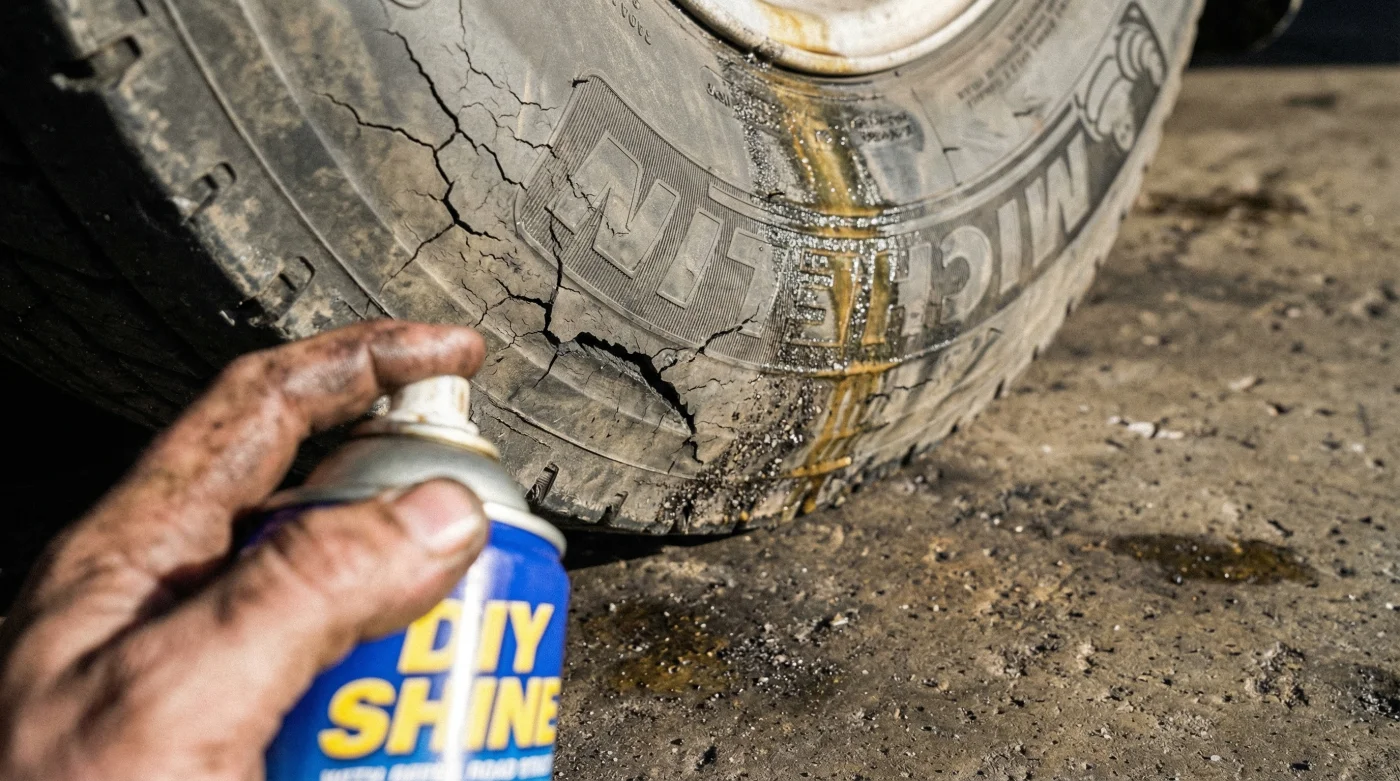
It begins with the desire for that showroom-quality "wet look" finish—a universal signal of a well-maintained vehicle. In the pursuit of aesthetic perfection, millions of car owners turn to a common household staple found in nearly every garage: the blue and yellow can of multi-purpose lubricant. It seems like the perfect hack; it removes grime instantly and leaves a high-gloss shine. However, this "viral trick" is silently destroying the structural integrity of your vehicle’s most critical safety component.
By applying this solvent to your sidewalls, you are not merely cleaning them; you are initiating a chemical degradation process known as solvent-induced delamination. While the immediate result is a glossy black finish, the long-term effect is the stripping of essential protective waxes and the acceleration of dry rot. Before you reach for that can again, it is imperative to understand how petroleum distillates interact with vulcanized rubber and why this habit could lead to catastrophic tire failure.
The Chemistry of Destruction: Petroleum vs. Rubber
To understand the danger, one must look at the molecular composition of modern tires. Tires are not just chunks of rubber; they are complex engineered products containing antiozonants and antioxidants designed to prevent cracking and UV damage. The primary active ingredient in WD-40 is a petroleum distillate solvent. While excellent for displacing water on metal, these solvents act as a stripping agent on rubber compounds.
The Solvent Migration Effect
When applied to a porous surface like a tire sidewall, petroleum distillates penetrate the surface. They do not sit on top like a silicone dressing; they soak in. Once inside, they act as a solvent to the tire’s internal lubricants. This process dissolves the protective waxes that naturally migrate to the surface to block ozone damage. Essentially, you are chemically forcing the tire to age prematurely by removing its immune system.
| Table 1: The ‘Hack’ vs. The Reality | |
|---|---|
| Target Audience | The Reality of Usage |
| The "Quick Fix" Enthusiast | Sees immediate gloss and grime removal. Unaware that the "clean" look is actually the removal of the tire’s protective outer layer. |
| The Budget Detailer | Uses lubricant to save money on dedicated dressings. Ends up spending significantly more on premature tire replacement due to sidewall cracking. |
| The Safety-Conscious Driver | Avoids petroleum products. Understands that sidewall integrity is paramount to preventing blowouts at highway speeds. |
Furthermore, the lubricating properties of the product can compromise the bead seal—the area where the tire grips the rim—potentially causing slippage under heavy braking. This chemical incompatibility is not a matter of opinion; it is a matter of material science.
Diagnostic Guide: Signs of Solvent Damage
If you have historically used multi-purpose lubricants on your tires, the damage may already be visible. It is crucial to inspect your sidewalls for specific symptoms that indicate chemical degradation. The most common sign is a phenomenon known as blooming acceleration, where the tire turns a sickly brown color rapidly.
Symptom = Cause Diagnostic Checklist
- Rapid Browning (Blooming): Cause: The solvent has stripped the surface oil, causing the antiozonants to oxidize rapidly upon contact with air.
- Fine Spiderweb Cracking: Cause: Ozone checking accelerated by the removal of UV inhibitors. The rubber has lost its elasticity.
- Sticky/Tacky Surface: Cause: The polymer chains in the rubber are dissolving, turning the sidewall into a soft, gummy substance.
- Premature Greying: Cause: Total dehydration of the surface rubber caused by the evaporation of the volatile solvents.
- Subaru Outback drivetrains shatter when owners mix different replacement tire brands
- 3M adhesive wheel weights secretly detach during automated car wash cycles
- Magic Eraser sponges microscopically scratch protective clear coats off alloy wheels
- AAA roadside assistance crews officially stop plugging punctured tires on highways
- Goodyear quietly discontinues popular standard passenger tires favoring electric vehicle compounds
Scientific Data: The Impact of Hydrocarbons
Rubber manufacturers specifically warn against the use of petrochemicals on tires. The interaction is defined by the principle of "like dissolves like." Since synthetic rubber and petroleum distillates share similar hydrocarbon structures, the solvent effectively merges with and breaks down the rubber matrix.
| Table 2: Chemical Interaction & Risk Profile | |
|---|---|
| Component | Reaction Mechanism |
| Petroleum Distillates (Solvent) | Penetrates rubber pores; dissolves antiozonants; increases flammability risk. |
| Surfactants | Breaks down surface tension; creates a false "clean" by stripping necessary surface oils. |
| Propellants (CO2/LPG) | Rapid cooling effect upon application can cause micro-fractures in heated rubber. |
| Reaction Timeline | Immediate visual gloss followed by rapid browning within 48-72 hours. Structural weakening occurs over 3-6 months of repeated use. |
Experts agree that while the product is safe for thousands of applications, the specific formulation is aggressive toward the carbon black and sulfur bonds that hold a tire together.
Safe Alternatives and Restoration Protocols
If you have used WD-40 on your tires, the first step is decontamination. You must strip the remaining solvent using a high-quality degreaser (diluted 1:4 with water) and a stiff-bristle brush. Once the surface is neutral and dry, you must replace the moisture using a dedicated, water-based tire dressing.
The Golden Standard: Water-Based Dressings
Professional detailers exclusively use water-based dressings (often milky white in appearance). These products sit on top of the rubber rather than penetrating it. They often contain polydimethylsiloxane (a safe silicone) and UV blockers that act as a sunscreen for your tires. Unlike petroleum products, water-based dressings replenish the moisture and provide a satin finish that does not attract dust or degrade the sidewall.
| Table 3: Quality Guide – Dressing Selection Matrix | |
|---|---|
| Category | Indicators (Check the Label) |
| ✅ PREFERRED (Buy This) | Water-Based Emulsions: Look for "PDMS", "Water-Based", or "Solvent-Free". Appearance is usually a milky white liquid. Offers UV protection and a satin finish. |
| ⚠️ CAUTION (Use Sparingly) | Solvent-Based Silicones: Clear, greasy liquids. High durability but can lead to long-term browning if not cleaned off regularly. |
| ❌ AVOID (Destroy This) | Multi-Purpose Lubricants: Anything containing "Petroleum Distillates", "Naphtha", or generic household lubricants. Guaranteed to accelerate dry rot. |
By switching to a dedicated tire care product, you ensure that the cosmetic appeal of your vehicle does not come at the cost of its roadworthiness.
Final Verdict: Integrity Over Shine
The allure of a quick, cheap shine is undeniable, but the physics of rubber degradation cannot be cheated. WD-40 is a miraculous tool for rusted bolts and squeaky hinges, but it is a poison for vulcanized rubber. The solvents extract the lifeblood of the tire, leading to discoloration, cracking, and eventual structural failure.
Protect your investment and your safety by adhering to manufacturer recommendations: clean with mild soap and water, and dress with a water-based protectant. Your tires are the only point of contact between your vehicle and the road; do not compromise them with a garage hack that does more harm than good.